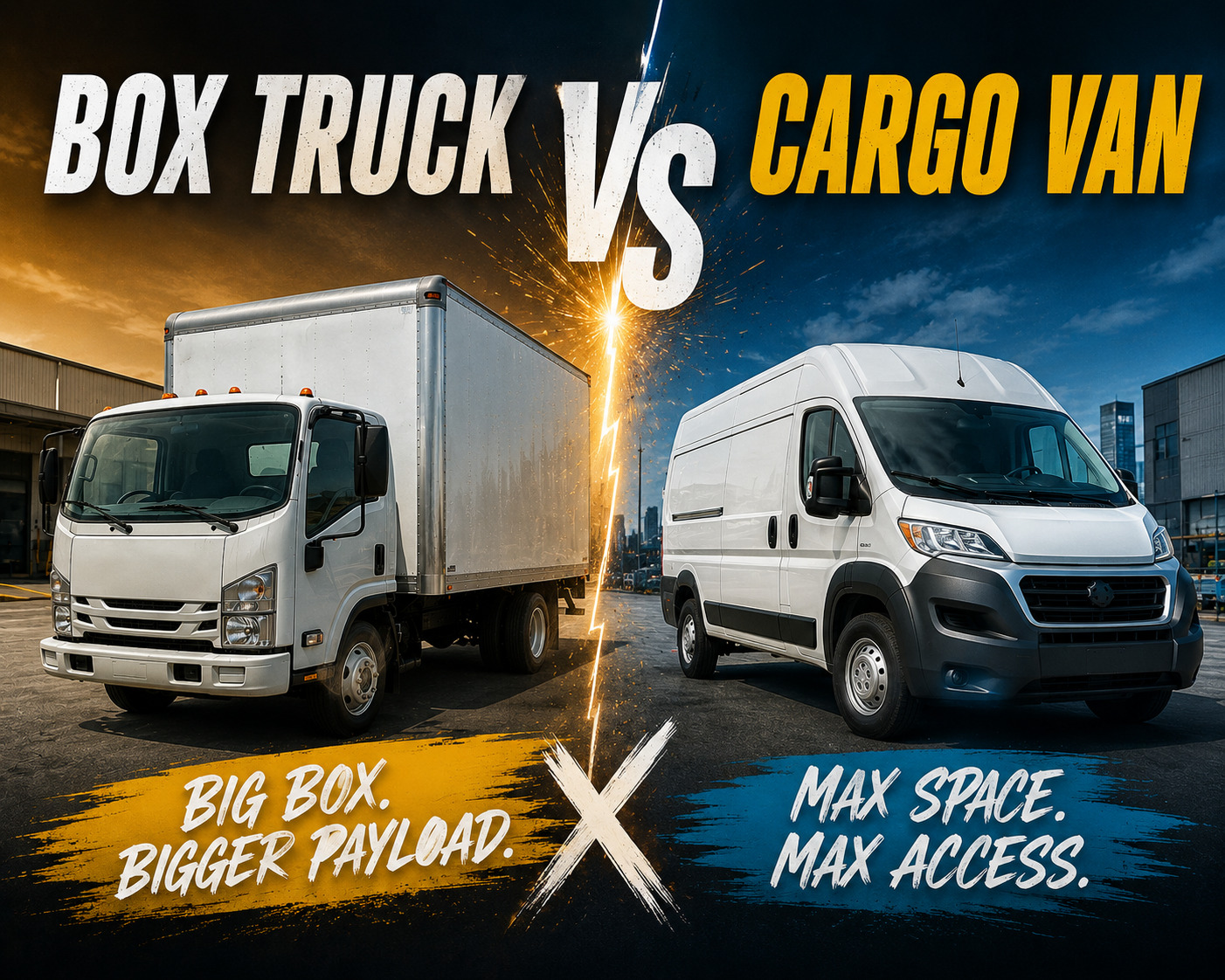
When expanding or upgrading a commercial fleet along the Florida Gulf Coast, one question consistently dominates the strategic planning process: Should you buy a high-roof cargo van or step up to a dedicated box truck? While both vehicle classes serve as the backbone of modern delivery, service, and logistics operations, their capabilities differ dramatically across two fundamental engineering metrics: cargo volume (cubic feet) and payload capacity (weight rating).
Full-size commercial cargo vans—such as the Ford Transit, Ram ProMaster, and Chevrolet Express—typically deliver between 230 and 500 cubic feet of interior cargo space alongside payload ratings ranging from 3,000 to 5,000 pounds. In contrast, commercial box trucks—ranging from 12-foot cutaway models to massive 26-foot straight trucks—scale from 800 to well over 1,800 cubic feet of vertical storage while handling 6,000 to more than 12,000 pounds of heavy payload. Choosing the wrong platform can lead to dangerous overloading, accelerated drivetrain wear, higher fuel expenditure, or severe driver operational constraints.
At SRQ Auto LLC in Bradenton, FL, we specialize exclusively in commercial workhorses. Whether you are navigating dense residential neighborhoods in Lakewood Ranch, hauling heavy equipment into downtown Sarasota, or running regional logistics along the I-75 corridor to Fort Myers, this definitive breakdown analyzes spatial efficiency, weight ratings, licensing laws, insurance costs, and real-world total cost of ownership (TCO) to help you choose the ideal vehicle. Explore our Used Commercial Inventory to inspect work-ready fleet options available right now. How Body Design Distinguishes a Box Truck From a Cargo Van
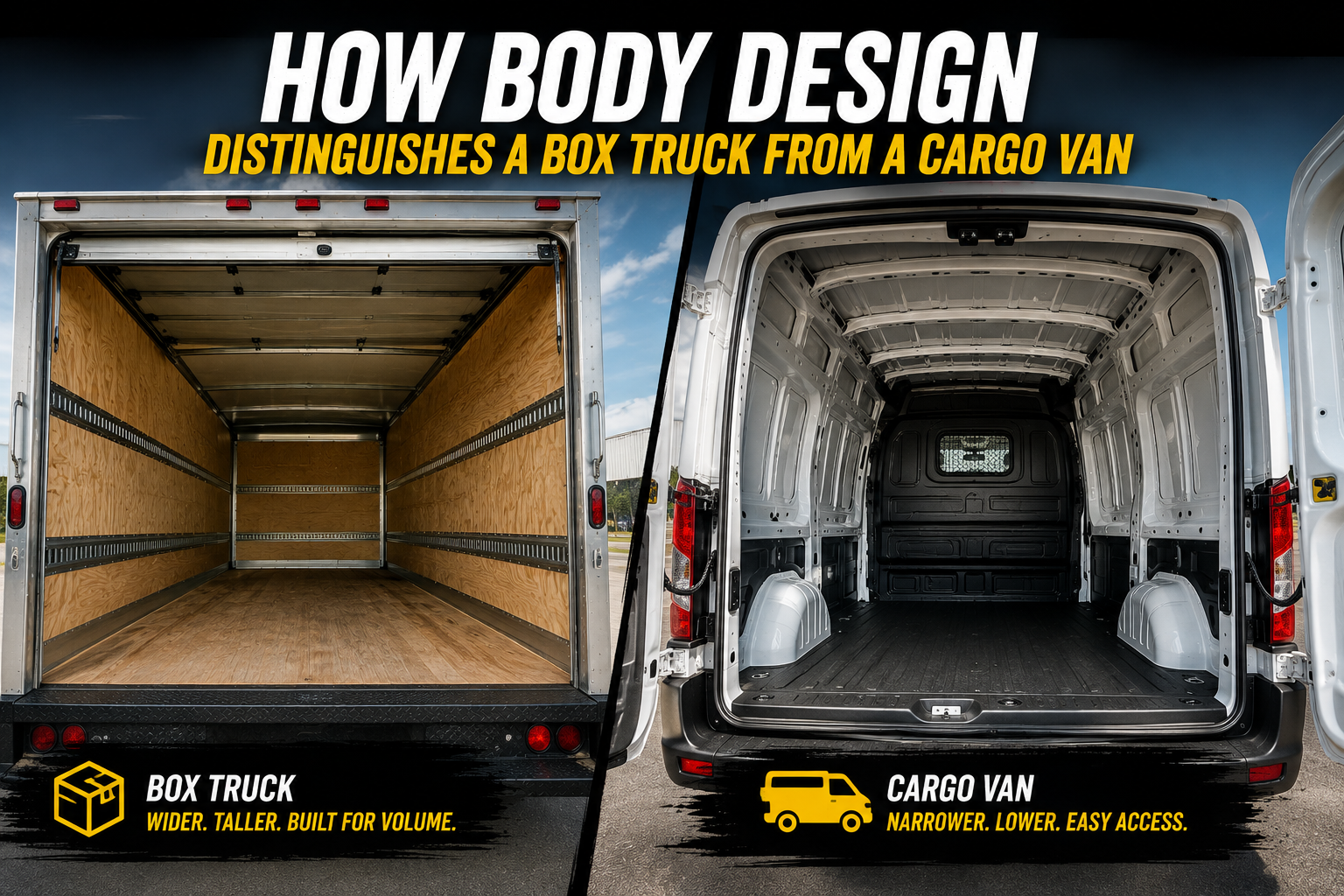
The structural distinction between a cargo van and a box truck comes down to architectural design: unified unibody/stamped steel construction versus cab-chassis box construction. A cargo van is built with an integrated body shell where the cab and cargo area share a continuous, contoured metal floor and side panels. While modern extended high-roof cargo vans offer remarkable vertical clearance, their interior width is constrained by tapered side walls, roof curvature, and rear wheel-well humps protruding directly into the cargo floor.
A box truck (often built on a heavy-duty cutaway or straight-truck chassis) features a separate, square cargo container mounted atop a rigid frame rail assembly. This box structure provides standard vertical walls, 90-degree right angles, and completely flat loading floors without wheel-well intrusions (especially in models equipped with raised flatbeds or wheel pockets). This box geometry allows for maximum interior cubic space utilization, straightforward shelving installation, and easy forklift loading of standard 40x48-inch pallets.
However, this structural gain in box trucks involves tradeoffs in overall vehicle maneuverability and height profile. High-roof cargo vans sit lower to the ground, offering tighter turning radii, superior wind stability, and access to standard drive-thrus, underground parking garages, or low-hanging tree canopy streets across Bradenton and Sarasota. Box trucks require dedicated overhead clearance management and careful corner navigation, but reward operators with unmatched volumetric loading efficiency.
Looking to inspect specialized upfits? Check our available Used Service Truck/Van Inventory or see how work vehicles are structured to fit specific trade demands. Comparing Cargo Capacity in Cubic Feet and Payload Weight Limits
To accurately compare these two vehicle classes, business owners must distinguish between volumetric cargo capacity (measured in cubic feet) and payload weight capacity (measured in pounds). Exceeding either threshold creates serious operational bottlenecks or safety liabilities. A truck loaded with bulky insulation may run out of space before hitting its weight limit, while a truck carrying dense stone tiles will reach its payload maximum long before the cargo box is visually full.
Cargo Van Dynamics
Cargo vans excel when handling mobile service tool sets, parcel distribution, or trade equipment. High-roof models like the Ford Transit High Roof allow technicians up to 6'5" of standing headroom inside the cargo bay. However, because wheel wells cut into floor width (reducing usable floor width between wheel arches to roughly 48-54 inches), loading side-by-side materials or multiple pallets requires careful placement.
Box Truck Scalability
Box trucks provide unobstructed rectangular cubic volumes. A 16-foot box truck offers nearly triple the usable volume of a extended cargo van. Straight vertical walls allow full-height stacking of furniture, appliances, or palletized freight right to the ceiling. Roll-up rear doors combined with hydraulic liftgates make dock loading and heavy unloading straightforward.
Understanding GVWR
Gross Vehicle Weight Rating (GVWR) is the maximum allowable weight of the vehicle including curb weight, fuel, driver, passengers, and cargo. Subtracting the empty truck weight (curb weight) from the GVWR gives your true payload capacity. Overloading suspension springs, axles, or tires leads to DOT fines and safety hazards.
Understanding the 26,001 LB GVWR Threshold That Requires a CDL
For commercial fleet operations across Florida, the regulatory divide between driver availability and operational capability hinges on one key number: 26,001 pounds Gross Vehicle Weight Rating (GVWR). Under federal Department of Transportation (DOT) and Florida highway compliance regulations, driving any single vehicle with a GVWR of 26,001 pounds or more requires a Commercial Driver's License (CDL Class A or B).
Non-CDL Box Trucks (Under 26,000 lbs GVWR): Most 12-foot to 26-foot medium-duty box trucks sold for local distribution are intentionally engineered with GVWR ratings capped at 25,999 pounds (such as Class 6 Ford F-650s or Freightliner M2s). This allows business owners to recruit drivers with standard non-commercial driver's licenses, vastly expanding the candidate pool and lowering recruitment costs.
Cargo Vans (Class 1-3 Commercial Vehicles): All standard full-size cargo vans operate well under the 10,000 to 14,000 lb GVWR threshold. They require no specialized driver certification, though drivers must still comply with company safety protocols and local traffic laws. Operating non-CDL box trucks or cargo vans simplifies staffing for Gulf Coast businesses while maintaining high operational throughput.
Note that even non-CDL vehicles used in commercial interstate or intrastate trade over 10,001 lbs GVWR may still require DOT medical cards, company markings, and vehicle safety inspections. Our expert sales team at SRQ Auto LLC helps guide clients through exact GVWR classifications during every vehicle purchase.
What Is the Typical Fuel Economy Difference Between Cargo Vans and Box Trucks?
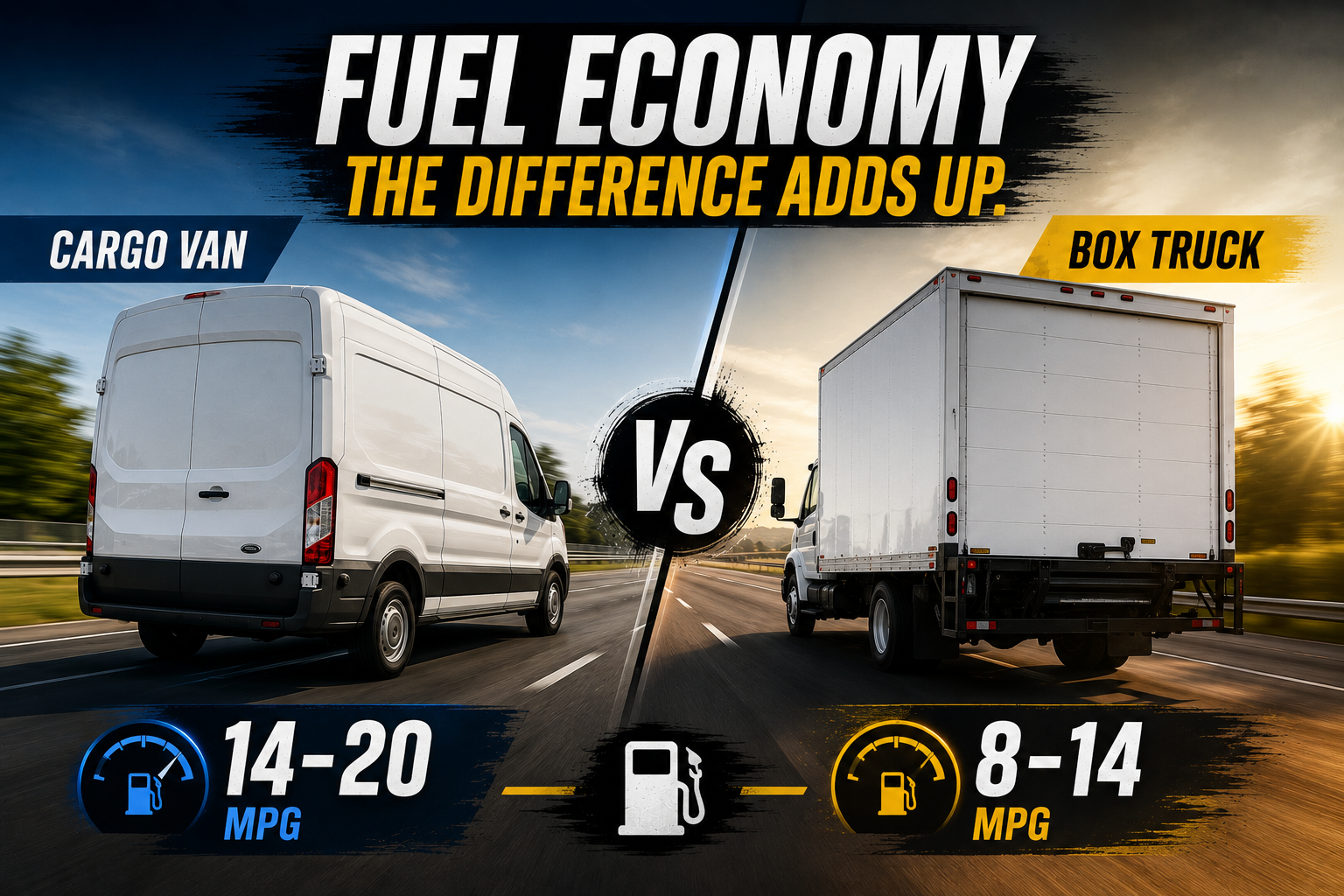
Fuel economy is one of the largest ongoing operational expenses for any fleet. Due to fundamental aerodynamic principles and vehicle curb weight, cargo vans offer significantly higher fuel efficiency than commercial box trucks under nearly all driving conditions.
Cargo Van Fuel Efficiency (14 – 20 MPG): Aerodynamic front fascia, streamlined roof contours, and lighter unibody frames allow modern V6 gas and turbocharged cargo vans to achieve between 15 and 20 MPG on highway runs along I-75, and 13 to 16 MPG during stop-and-go delivery routes across Bradenton and Sarasota. EcoBoost V6 and modern 10-speed transmission powertrains optimize fuel delivery under variable loads.
Box Truck Fuel Efficiency (8 – 14 MPG): The blunt, vertical front wall of a commercial box container acts as a massive aerodynamic air drag component. Smaller 12-to-14-foot gas cutaway box trucks typically achieve 10 to 14 MPG. Larger 16-to-26-foot heavy-duty diesel box trucks typically range from 8 to 11 MPG depending on payload weight, route terrain, and idle times. For businesses driving 25,000 miles annually per vehicle, this fuel efficiency gap represents thousands of dollars in operational differences.
Want to offset acquisition costs through commercial tax incentives? Learn how businesses take advantage of Section 179 and Used Vehicle Tax Deductions on qualified commercial fleet purchases. Is Commercial Auto Insurance More Expensive for Box Trucks Than Cargo Vans?
In almost all cases, commercial auto insurance premiums are higher for box trucks than for standard cargo vans. Underwriters evaluate insurance risk based on vehicle kinetic energy (mass x velocity), potential third-party liability damage, cargo value, driver experience requirements, and structural repair complexity.
1. Vehicle Weight & Liability Risk
Because a fully loaded box truck weighs between 12,000 and 26,000+ lbs compared to a cargo van's 8,000 to 10,000 lbs GVWR, collisions involve substantially higher energy transfers. Liability premiums increase proportionately with vehicle weight class to cover potential third-party property or bodily injury claims.
2. Repair Costs & Overhead Structure
Box trucks feature composite fiberglass/aluminum corner posts, roll-up door assemblies, hydraulic liftgates, and specialized chassis components that require commercial body shop facilities for repairs. Cargo van parts benefit from high-volume OEM automotive production lines, lowering collision repair costs.
3. Cargo Value & Theft Risk
Box trucks carry larger volumes of commercial goods, household furniture, or retail inventory, increasing cargo loss limits under marine policies. Cargo vans frequently carry specialized service tools, which can be secured using internal lock boxes and modern alarm upfits.
To safeguard your fleet investment, review SRQ Auto LLC's comprehensive Commercial Warranty Options designed specifically to protect commercial work vehicles against unexpected mechanical downtime. What Factors Should a Business Evaluate When Choosing Between a Van and a Box Truck?
Selecting the right vehicle platform requires systematically evaluating your daily operational workflow. Business owners in Southwest Florida should analyze the following six core criteria before making a purchase decision:
• Daily Payload & Floor Dimensions: Do you carry heavy, compact items (plumbing fittings, tile, batteries) or lightweight, bulky items (mattresses, trade show displays, HVAC ductwork)? Measure maximum cargo height, length, and weight per trip. • Loading Method & Dock Access: Will you be loading via forklift at industrial warehouse docks (where flat floors and roll-up doors shine) or hand-loading equipment from curb level (where lower cargo van floor heights reduce operator fatigue)? • Parking & Route Restrictions: Do your routes involve tight residential streets, narrow alleyways, or strict HOA parking regulations in suburban communities like Lakewood Ranch or Palmer Ranch? Cargo vans navigate residential driveways seamlessly.
• Driver Pool Availability: Can your existing staff safely drive a large 16-foot or 24-foot box truck with significant rear overhang and wide turning radiuses, or do you need vehicles that drive similarly to standard passenger SUVs? • Future Fleet Expansion: Will your business double its load volume per route over the next 18 to 24 months? Buying slightly excess volume capacity now often prevents costly vehicle trade-in cycles later.
Long-Term Ownership Costs, Wear and Tear, and Fleet Maintenance Needs
Total Cost of Ownership (TCO) extends beyond initial sticker price and monthly loan payments. Operating commercial vehicles under heavy loads in Southwest Florida's hot, humid climate introduces specific mechanical wear patterns that demand proactive fleet maintenance.
Cooling Systems & FL Heat
Extreme Florida heat places immense strain on engine cooling systems, air conditioning compressors, and transmission fluid temperatures. Box trucks operating under maximum payload require heavy-duty auxiliary transmission coolers and frequent fluid flush cycles to prevent thermal breakdown.
Brake & Tire Cycles
Due to higher curb weights, box trucks wear through heavy-duty brake pads, rotors, and commercial 19.5-inch or 22.5-inch tires faster than light-duty cargo vans. However, commercial truck tires feature thicker tread depth engineered for higher total mileage retreading.
Resale Value Retention
Well-maintained pre-owned box trucks and cargo vans retain strong residual value across the Gulf Coast market. High demand from independent tradesmen, delivery subcontractors, and regional contractors ensures excellent liquidity when updating your fleet.
Curious about market value retention? Browse our list of Recently Sold Vehicles to see how quickly quality pre-owned work trucks move off our lot. Matching Commercial Vehicles to Gulf Coast Routes in Sarasota, Fort Myers, and Lakewood Ranch
Geography and urban density play a vital role in determining whether a cargo van or box truck delivers better daily productivity for your Southwest Florida operations.
Downtown Urban Cores (Sarasota, Downtown Bradenton, Naples): Tight street grids, parallel curb parking, multi-story commercial parking structures, and narrow alleyways favour the compact footprint and short turning radius of a high-roof cargo van. A van can park in standard spaces while delivering tools or parcels straight to front doors.
Master-Planned Communities (Lakewood Ranch, Venice, Palmer Ranch): Gatehouse security clearances, strict HOA vehicle height limits, and tight residential cul-de-sacs require careful consideration. While cargo vans pass HOA overnight parking guidelines easily, box trucks require designated service access routes.
Regional Interstate Freight (I-75 & US-41 Corridor to Fort Myers): For bulk transfers between distribution hubs, furniture delivery, or major contractor operations running between Palmetto, Bradenton, Venice, and Fort Myers, non-CDL 16-to-24-foot box trucks deliver unmatched volume efficiency per driver shift.
Where Businesses Shop for Used and New Box Trucks and Cargo Vans
Finding reliable commercial work vehicles requires partnering with a dealership that understands commercial operations. Unlike consumer retail car dealerships, specialized commercial dealers focus on structural integrity, drivetrain durability, upfit readiness, and commercial financing solutions.
At SRQ Auto LLC, located at 2212 1st St, Bradenton, FL 34208, every pre-owned commercial vehicle undergoes a rigorous mechanical inspection and reconditioning process backed by our Job Ready Promise. We verify frame alignment, hydraulic liftgate function, door seal integrity, braking power, cooling system pressure, and tire load ratings before any vehicle hits our showroom floor.
We work directly with business owners, fleet directors, and independent contractors across Bradenton, Sarasota, and nation-wide. With tailormade Commercial Financing, flexible credit options, and dedicated nationwide transport services, SRQ Auto LLC simplifies your vehicle acquisition process from start to finish. Read real customer experiences on our Reviews page, or check out our Recent Deliveries to see commercial trucks and vans delivered across Florida and nationwide. Box Trucks vs Cargo Vans: Side-by-Side Industry Recommendation Matrix
To streamline your vehicle selection, our fleet specialists compiled this quick-reference recommendation matrix pairing popular commercial industries with their ideal vehicle configuration based on volume, weight, and job-site access needs:
Ready to Expand Your Fleet? Explore Commercial Vehicles at SRQ Auto LLC
At SRQ Auto LLC, we know your business depends on vehicles that are ready to perform from day one. That is why every commercial vehicle we sell is thoroughly inspected, serviced, reconditioned, and backed by our Job Ready Promise. From cargo vans and utility trucks to box trucks, shuttle buses, and heavy-duty pickups, we specialize exclusively in commercial vehicles built to keep businesses moving.