
Maximizing Your Write-Offs: The Ultimate Guide to Florida Business Vehicle Expensing

Maximizing Your Write-Offs: The Ultimate Guide to Florida Business Vehicle Expensing

Maximizing Your Write-Offs: The Ultimate Guide to Florida Business Vehicle Expensing

As a business owner in Florida, navigating the complex waters of tax season can feel like a full-time job. Whether you operate a growing landscaping company in Bradenton, a bustling contracting firm in Sarasota, or a real estate agency in Fort Myers, every dollar saved on your tax return is a dollar that can be reinvested into your company's growth. One of the most powerful and underutilized tax strategies available to modern businesses is the Section 179 vehicle deduction. This federal tax provision allows you to write off up to the entire purchase price of qualifying vehicles in the very first year you put them into service, rather than slowly depreciating them over five or six years. However, understanding how to apply these rules to your unique financial situation requires a solid grasp of the legal thresholds, state conformity guidelines, and physical vehicle specifications. At SRQ Auto LLC, we want to go beyond merely selling you a car, truck, or van; we strive to act as a trusted resource that helps your business grow. That is why we have put together this comprehensive, follow-up guide to help you understand the nuances of Used Vehicle Tax Deductions, vehicle classifications, and how you can leverage these rules to dramatically lower your state and federal tax liability this year.

What Is the Section 179 Deduction Limit for Business Vehicles This Tax Year?

The federal Section 179 limits are adjusted annually to account for inflation, and they represent a massive financial opportunity for business owners. For the current tax year, the maximum deduction limit for qualifying equipment—which includes business vehicles—is exceptionally high, allowing businesses to immediately expense up to the federal cap on their tax returns. This applies to individual pieces of equipment as well as entire fleets, provided the total amount of equipment put into service during the tax year does not exceed the maximum investment threshold. Once your total equipment purchases surpass the investment phase-out threshold, the deduction begins to reduce dollar-for-dollar. This prevents massive corporations from disproportionately benefiting from a tax break designed to support small and medium-sized local businesses. For passenger vehicles, heavy SUVs, and light-duty commercial vehicles, specific sub-limits apply, which we will break down in detail below. Planning your capital expenditures around these thresholds is essential to getting the absolute most out of your vehicle investments.

Vehicle Type Classification

Federal Section 179 Treatment

Heavy Commercial Trucks (>6k lbs GVWR)

Up to 100% full deduction in year one

Heavy SUVs (6k to 14k lbs GVWR)

Subject to capped limit (approx. $30,000+)

Passenger Cars / Light SUVs (<6k lbs)

Subject to individual annual luxury auto caps

Total Purchase Cap (All Equipment)

Up to $1.16M+ subject to inflation indexing

Does Florida Allow Full Section 179 Write-Offs on State Corporate Tax Returns?

While federal tax rules offer incredible savings, you must also consider how your state of operation handles these deductions. In Florida, the intersection of federal and state corporate tax law requires careful attention. Historically, Florida does not fully conform to federal bonus depreciation guidelines. However, Florida corporate tax law does allow for a healthy Section 179 deduction on state corporate income tax returns, though there are specific state-level caps and adjustments that a corporate entity must make when filing. For businesses structured as LLCs, partnerships, or sole proprietorships where business income flows directly onto the owner's personal tax return, the federal Section 179 rules are the primary driver of your tax savings because Florida does not levy a personal state income tax. This makes purchasing business vehicles incredibly advantageous for local LLCs in Sarasota, Bradenton, and Lakewood Ranch. To learn more about how our team supports local business operators in our community, read About Us and find out why so many commercial fleet buyers partner with SRQ Auto LLC.

Understanding the Weight Requirement for Full Section 179 Vehicle Expensing

The absolute most critical factor in determining whether a vehicle qualifies for a full, uncapped Section 179 deduction in its first year is its Gross Vehicle Weight Rating (GVWR). The magic number established by the IRS is 6,000 pounds. Vehicles with a GVWR of 6,000 pounds or less are classified as passenger vehicles and are subject to strict annual luxury auto limits. These limits heavily restrict the amount of depreciation you can claim in year one, forcing you to spread the deduction over many years. Conversely, vehicles with a GVWR of 6,001 pounds or more are treated as heavy vehicles or commercial equipment. This higher weight class opens the door to much larger first-year write-offs, and in many cases, allows you to deduct 100% of the purchase price on your tax return immediately. If you want to maximize your current year deductions, targeting vehicles above the 6,000-lb GVWR mark is the most effective approach.

At SRQ Auto LLC, we specialize in providing businesses with the exact inventory they need to meet these strict tax guidelines. Whether you are searching for a heavy-duty pickup truck, a robust cargo van, or a utility vehicle, our inventory is curated to include options that fall safely into the qualifying heavy vehicle weight class. We make it easy to find vehicles that not only get the job done but also deliver maximum relief on your business taxes. We invite you to explore our wide selection of vehicles that meet these critical weight guidelines. Click below to view our comprehensive selection of work-ready trucks and vans designed to keep your business running smoothly and your tax liabilities low.

Can I Claim Section 179 on a Used Business Vehicle in Florida?
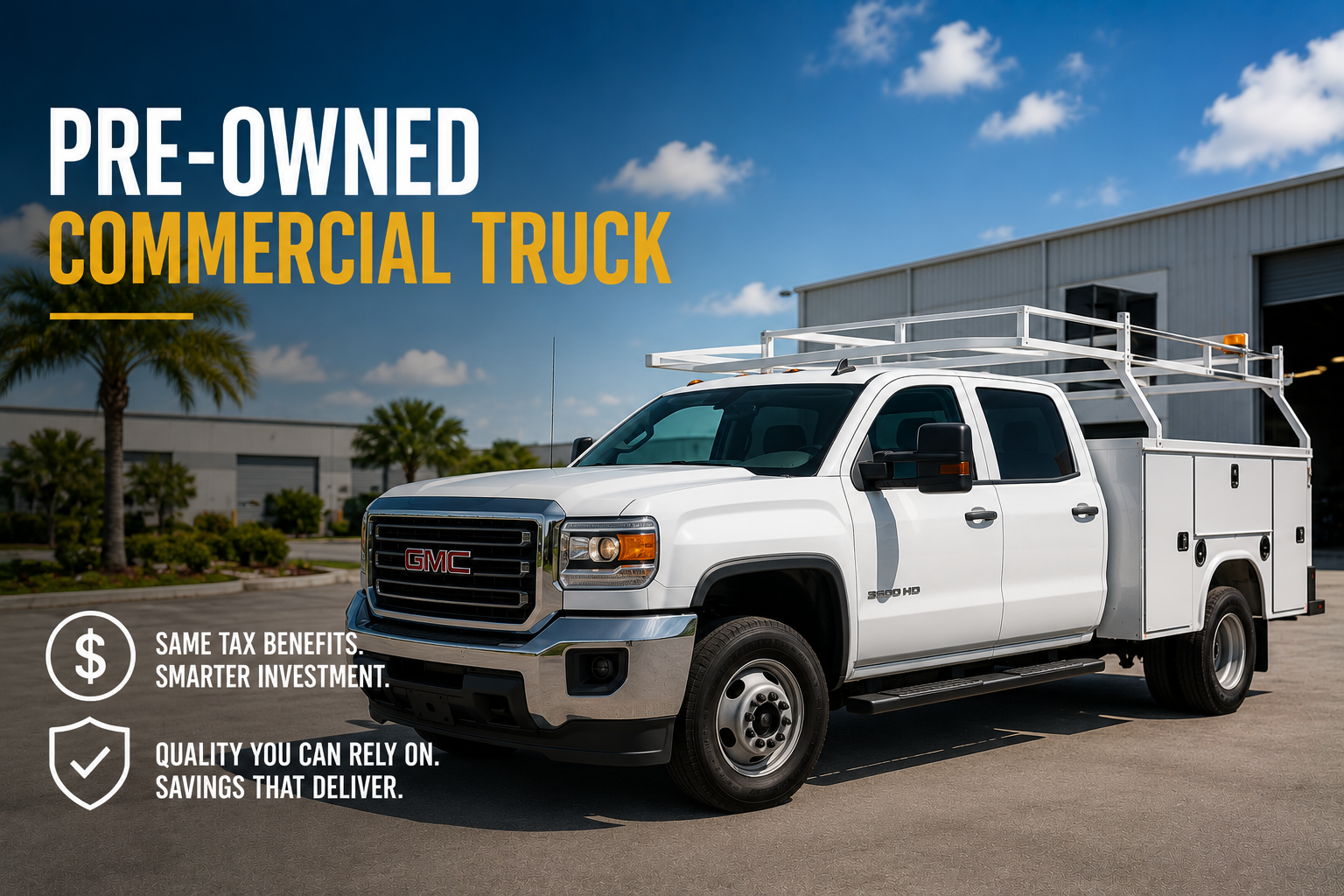
A common misconception among business owners is that Section 179 deductions are reserved exclusively for brand-new, off-the-lot vehicles. Fortunately, this is not the case. Under current tax rules, pre-owned vehicles are fully eligible for Section 179 tax deductions. The key requirement is that the vehicle must be "new to you." This means the vehicle cannot have been previously owned by your business, its partners, or yourself as an individual prior to being put into commercial service. By choosing to purchase a high-quality used vehicle, your business wins twice. First, you avoid the steep initial depreciation hit that occurs when driving a brand-new vehicle off a franchise dealer's lot. Second, you still enjoy the exact same Section 179 tax benefits as if you had purchased a brand-new vehicle.

To successfully claim this deduction on a used commercial asset, you must also meet the business-use percentage threshold. The IRS dictates that the vehicle must be used for business purposes more than 50% of the time. If the vehicle's business use falls below 50% in any future year, the deduction can be clawed back, which can result in unexpected tax penalties. Sourcing your pre-owned vehicles from a reputable dealership like SRQ Auto LLC ensures that your vehicles are in top operational shape and come with transparent vehicle history reports. Don't just take our word for it—see what our other commercial customers have to say by checking out our online Reviews to see how we help businesses buy with confidence.

What Qualifies as a Heavy SUV for Tax Purposes in Sarasota and Lakewood Ranch?

For many business owners, particularly real estate agents, consultants, and mobile service providers, a full-sized commercial truck or cargo van might not fit their brand image or daily needs. Instead, a premium passenger SUV is often preferred. This is where the famous "heavy SUV loophole" comes into play. To qualify as a heavy SUV for tax purposes, a passenger-carrying vehicle must have a GVWR between 6,001 and 14,000 pounds. While these heavy SUVs qualify for Section 179, they are subject to a specific annual dollar cap that is lower than the uncapped deduction allowed for specialized commercial vehicles or heavy-duty pickup trucks. Despite this cap, the deduction is still significantly higher than what is allowed for passenger cars under 6,000 pounds, making heavy SUVs highly sought-after assets for business owners in Bradenton, Sarasota, and Lakewood Ranch looking to write off substantial acquisition costs in year one.

If you find that an SUV doesn't provide the cargo volume or payload capacity your business requires, you might want to look into other heavy vehicle formats. For instance, box trucks offer unparalleled cargo security and space, making them ideal for delivery services, moving companies, and mobile service businesses. At SRQ Auto LLC, we carry a wide range of commercial assets. If your business needs go beyond passenger SUVs, we invite you to explore our highly versatile Used Box Truck Inventory to find the perfect work-ready vehicle that meets your business transport and tax requirements.

How and When a Florida Business Can Fully Deduct the Purchase Price of a Truck in Year One

To claim a 100% deduction on a commercial truck in the first year, several strict guidelines must be met. First, the truck must have a GVWR of over 6,000 pounds. Second, it must be used more than 50% for business. However, the IRS also examines the physical design of the truck. If a truck features a cargo bed that is at least six feet in interior length, it is generally exempt from the passenger vehicle caps, allowing for a full 100% write-off in the first year. This specific rule makes heavy-duty pickup trucks, dump trucks, and utility trucks incredibly popular among construction, landscaping, and agricultural companies in Bradenton and Fort Myers. For example, if you operate a landscaping business, investing in specialized equipment can revolutionize your daily productivity while providing a massive tax shelter. We highly recommend reviewing our high-capacity Landscape Dump Trucks to see how our heavy-duty inventory can help you tackle larger projects and secure substantial tax savings at the end of the year.

How Should Full Vehicle Expensing Be Recorded in a Company’s Accounting System?

Proper bookkeeping is your best defense against an IRS or Florida Department of Revenue audit. When you purchase a vehicle for your business, it must first be recorded on your balance sheet as a fixed asset at its full purchase price, including taxes, dealer fees, and registration costs. To claim Section 179, your accountant will file IRS Form 4562 alongside your corporate tax return, electing to expense the qualifying portion of the vehicle's cost rather than capitalizing and depreciating it over time. Additionally, you must maintain meticulous records of your business vs. personal mileage. Keeping a continuous, detailed mileage log that notes dates, destinations, business purposes, and odometer readings is mandatory. If you finance the vehicle, the loan itself is recorded as a liability, but the interest paid on that commercial vehicle loan is typically fully deductible as a business expense, providing yet another layer of financial relief.

Securing the correct purchase documentation, purchase contracts, and finance agreements is critical for your bookkeeping team to log the asset accurately. Our finance department at SRQ Auto LLC is highly experienced in working with commercial clients, providing clear, structured invoice details and loan paperwork that align with professional accounting standards. If you are ready to explore your financing options and get the necessary paperwork in place before the end of the tax year, visit our dedicated Commercial Financing department to learn about our competitive rates and customized commercial credit solutions.

Can a Bradenton Dealership’s Section 179 Information Be Relied on as Tax Advice?

At SRQ Auto LLC, we pride ourselves on being an honest, transparent partner for local business owners. While our sales and finance professionals are highly knowledgeable about vehicle specifications, weight classifications, and general IRS guidelines, it is critical to understand that our informational content is not a substitute for professional tax, legal, or financial advice. Tax laws are subject to constant change, and individual business structures can dramatically alter how these deductions apply to your specific situation. We always advise our clients to consult with a certified public accountant (CPA) or a qualified tax professional before making final purchasing decisions based on expected tax benefits. What we *can* guarantee is that we will provide you with precise, documented vehicle details—such as the official GVWR listed on the safety certification label—and clear purchase contracts so that your tax professional has the accurate data they need to file your returns. We build our reputation on transparency, which you can see reflected in our commercial clients' Recent Deliveries and our commitment to professional service. To speak directly with our team about a vehicle's specifications or to request details for your CPA, feel free to Call us at (941) 214-2231 today. We are always happy to supply the specific vehicle documentation you need to make an informed business decision.

How to Find the GVWR of a Vehicle in Florida Before Purchasing
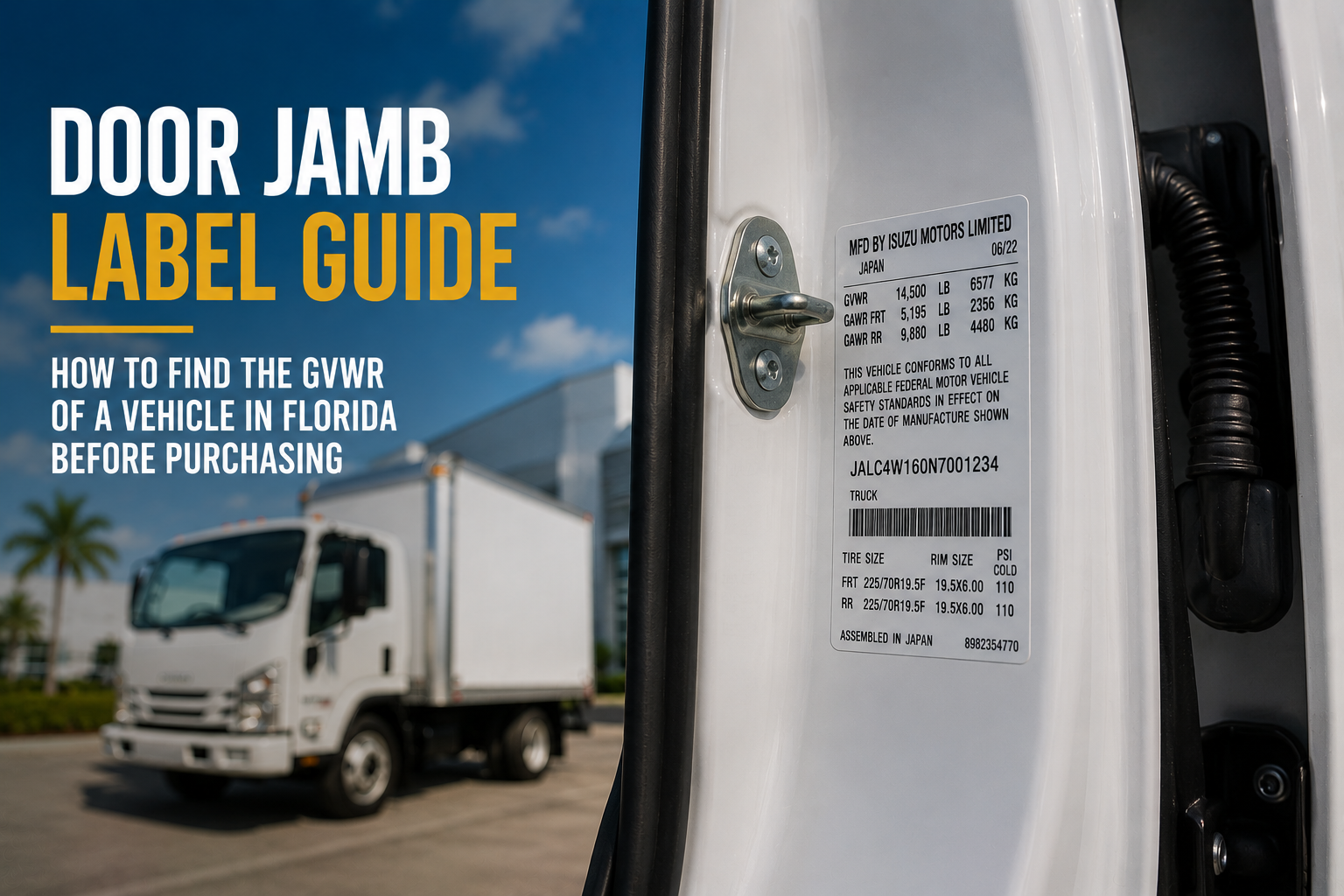
Finding the exact Gross Vehicle Weight Rating of a vehicle before you sign any paperwork is critical to ensuring your tax write-off plans go off without a hitch. Many buyers mistakenly look at "curb weight" or "payload capacity" in manufacturer marketing materials, but the IRS specifically looks at the GVWR. The most reliable way to find this number is by locating the safety certification label, which is typically found on the driver's side door jamb or the inner door edge. This label is a federal requirement and prints the exact GVWR in pounds and kilograms, along with other critical axle-specific weight limits. Checking this physical sticker is the only foolproof way to confirm the vehicle's true rating.

If you are shopping online and cannot physically inspect the door jamb, you can ask the seller to send you a clear photograph of the safety label. Reputable commercial dealers will gladly provide this. Additionally, some online VIN decoders can pull the exact vehicle specifications directly from the manufacturer database. At SRQ Auto LLC, we offer a wide range of commercial body styles beyond standard pickups. If your business requires high-volume transportation, you might explore our specialized Used Cargo Van Inventory or our passenger-focused Used Shuttle Bus Inventory, both of which contain multiple options safely meeting the heavy vehicle weight threshold.

A Tax-Season Checklist for Business Owners in Fort Myers, Sarasota, and Bradenton

To make sure your vehicle acquisition is fully eligible for Section 179 and other tax benefits, we recommend following a strict tax-season checklist. The timing of your purchase is just as important as the physical vehicle specs. To deduct a vehicle on this year's tax return, the vehicle must be purchased, delivered, and actively placed into service before midnight on December 31st of the tax year. Simply signing the purchase agreement or financing papers is not enough; the vehicle must actually be driven for business purposes before the calendar year ends. This means that waiting until the final days of December can be risky if shipping or registration delays occur. Planning your purchases in the summer or early fall gives you plenty of time to secure the right vehicle, finalize your financing, and integrate the asset into your operations.

Before finalizing any commercial purchase, make sure you check off these critical operational steps: • Confirm the vehicle's GVWR is over 6,000 lbs on the door jamb sticker. • Ensure the vehicle will be used for business purposes more than 50% of the time. • Verify delivery and placement into service will occur before December 31st. • Collect and organize all purchase contracts, bill of sale documents, and registration papers. • Submit your pre-approval application to secure commercial financing. Getting pre-approved early streamlines the entire process. You can start by filling out our secure, online Credit Application to get approved for commercial vehicle financing before visiting our showroom.

Upgrade Your Fleet and Save: Visit SRQ Auto LLC in Bradenton Today

Investing in your business's vehicle fleet is one of the most effective ways to drive growth while simultaneously lowering your tax burden. At SRQ Auto LLC, we specialize exclusively in providing high-quality, pre-owned commercial vehicles that are fully inspected, serviced, and ready to go to work from day one. Whether you are adding a single heavy SUV for client meetings or expanding a fleet of work trucks for your contracting business, we are here to provide dependable, work-ready solutions. Every commercial vehicle we sell is backed by our Job Ready Promise, ensuring you get a vehicle that performs reliably. We also offer affordable commercial protection plans that safeguard your investments, providing nationwide coverage and flexible deductibles. Learn more about your options by reviewing our comprehensive Commercial Warranty Options. We invite you to visit our dealership in Bradenton to explore our extensive inventory in person, speak with our commercial finance experts, and test drive your next tax-saving asset. Get Directions to SRQ Auto LLC and let us help you find the perfect vehicle to drive your business forward today.
Four smiling people posing in front of white box trucks at SRQ Auto dealership.