When business owners think about scaling operations, the default instinct is usually to post a job opening, recruit new technicians, and manage rising payroll overhead. However, progressive contractors and fleet managers across Florida are discovering a powerful strategic alternative: investing in a purpose-built commercial service truck. In many field service industries—ranging from HVAC and electrical to heavy equipment repair—the primary bottleneck isn't a lack of skilled hands, but rather the operational friction of unorganized equipment, missing tools, and limited field capabilities. A properly outfitted work truck functions as a tireless, highly specialized employee that never calls in sick, pays into social security, or requires health insurance.
By bringing complete workshop capability directly to the jobsite, a custom utility truck transforms a single skilled technician into a high-output revenue generator. Upfitted side compartments, onboard air compressors, integrated generators, and specialized crane booms eliminate wasted trips to supply houses and reduce non-billable windshield time. At SRQ Auto LLC in Bradenton, FL, we help trade professionals identify how upgrading their fleet with quality Used Service Truck/Van Inventory can deliver immediate productivity gains that rival adding another full-time position—at a fraction of the long-term cost. Why Do Growing Florida Businesses Treat Service Trucks as Force Multipliers?
In high-growth markets across Bradenton, Fort Myers, and Tampa, field time translates directly to top-line enterprise revenue. When a technician is forced to search through a cluttered pickup bed or make multiple trips back to the main office for specific tools, billable hours vanish. A specialized service truck operates as a force multiplier by systematically organizing every tool, fitting, and piece of hardware into weather-sealed exterior compartments.
This direct link between structural vehicle organization and daily output means technicians can complete 1 to 2 additional service calls per day. Over a standard 52-week operating year, those extra calls generate tens of thousands of dollars in incremental revenue without needing to recruit, hire, or train additional personnel.
Furthermore, a mobile workshop expands your geographic operational radius across Gulf Coast highways. With heavy-duty payload capacity, onboard auxiliary power, and specialized equipment mounted directly to the chassis, your crew can handle complex repairs on-site rather than towing equipment back to a central facility.
Whether responding to emergency agricultural machinery breakdowns in Manatee County or maintaining municipal utility lines along the Suncoast, a mobile productivity engine ensures your team arrives fully equipped to solve problems on the first visit, building unmatched customer trust and operational authority.
What Types of Businesses Typically Use Commercial Service Trucks?

HVAC & Commercial Plumbing
Commercial HVAC contractors and master plumbers depend on service bodies featuring deep vertical side cabinets, shelf divider systems, and pipe racks. Carrying refrigerant tanks, recovery units, specialized fittings, and power snakes in dedicated lockable compartments ensures fast diagnostic response and job completion.
Heavy Equipment & Welding
Mobile mechanics and structural welders require open center bed space alongside heavy-duty cranes, engine-driven welder/generators, and high-CFM air compressors. Service trucks allow technicians to repair earthmoving equipment, agricultural tractors, and structural steel directly on remote job sites.
Utilities & Municipal Services
Electrical contractors, water authority crews, and highway maintenance teams rely on utility trucks equipped with bucket lifts, emergency lighting packages, and heavy power distribution units. These vehicles keep crucial Florida infrastructure operating smoothly around the clock.
When Should a Business Choose a Service Truck Over a Commercial Service Van?
While enclosed cargo vans are an exceptional choice for lightweight deliveries, residential electrical work, or mobile detailers who need weather-protected interior workspace (browse our Used Cargo Van Inventory), they present clear physical limits when work demands heavy machinery, extreme payloads, or open-air load capacity. A commercial service truck built on a chassis cab platform offers significantly higher Gross Vehicle Weight Ratings (GVWR), heavy-duty frame strength, and enhanced rear axle capacities. This solid foundation allows for the installation of hydraulic corner-mount cranes, heavy welder platforms, and large fuel/lube transfer tanks that would exceed a van's structural payload rating.
Service trucks also separate tools from the passenger cab. Exterior lockable side compartments mean toxic solvents, heavy metal components, and noisy machinery stay outside the driver cabin, improving safety and cabin ergonomics. Plus, the open center bed provides bulk hauling capacity for palleted material, replacement engines, or raw piping.
If your operations require lifting capacity over 1,500 lbs, heavy towing, or rugged off-road traction on construction sites, a service truck chassis is the indisputable platform of choice for Florida contractors.
How Do GVWR and Payload Ratings Affect What a Service Truck Can Handle in Daily Operations?
Understanding Gross Vehicle Weight Rating (GVWR) is critical when engineering a service truck for safe, legally compliant operations across Florida highways like I-75 and US-41. GVWR is the maximum allowable total weight of the vehicle when fully loaded, including the chassis, utility body, fuel, driver, tools, and cargo. Subtracting the curb weight of the empty vehicle from the GVWR gives you the actual payload capacity.
Overloading a service vehicle leads to premature brake failure, blown transmission components, suspension sagging, and severe state DOT safety fines. Factoring in the weight of custom drawer systems, mounted compressors, and daily consumable hardware ensures your fleet remains operating within legal axle limits while maintaining maximum road stability.
How Does a Service Truck Help Reduce Tool Loss and Theft Costs?
Tool shrinkage and jobsite theft represent thousands of dollars in hidden annual drain for trade contractors. Standard pickup truck beds covered by flimsy tonneau covers or plastic toolboxes offer little resistance against opportunist theft on busy job sites or overnight hotel parking lots.
Purpose-built utility bodies feature heavy-gauge steel or aluminum construction with continuous stainless steel piano hinges and recessed rotary door latches. Advanced central locking systems allow technicians to lock every exterior compartment with a single keyfob button, ensuring tools are secured the moment a worker steps away.
Beyond theft prevention, dedicated interior drawer layouts end lost-tool expenses caused by disorganization. When every diagnostic meter, impact driver, socket set, and specialty fitting has a designated, contoured slot, workers instantly notice if an item is missing before leaving a job site.
Weather-sealed compartment gaskets also protect costly electronic testing equipment and power tools from humidity, torrential rain, and corrosive Gulf Coast salt air, substantially extending tool service life and reducing replacement expenses.
Calculating True ROI: Commercial Truck Financing vs. Adding Payroll Overhead
The Real Cost of W-2 Payroll
Adding a full-time technician earning $65,000/year actually costs a business $80,000 to $95,000 annually when factoring in payroll taxes, workers' compensation insurance, health benefits, paid time off, and training. That overhead recurs every year regardless of seasonal fluctuations.
Capital Equipment Financing
Financing a premium work truck through Commercial Financing provides immediate operational output for a predictable monthly payment. Unlike payroll, capital equipment payments build long-term business equity in a physical asset that retains strong resale value. Tax Benefits & Section 179
Under Section 179 tax guidelines, qualifying commercial service vehicles may allow business owners to write off up to 100% of the purchase price in the first year of operation. Read our guide on Used Vehicle Tax Deductions to learn how equipment financing lowers net acquisition costs. What Does It Take to Keep a Service Truck Running Like a Reliable Employee?
Just as an employee requires structure, onboarding, and routine reviews to maintain high performance, a commercial service truck requires systematic fleet management discipline. Establishing a daily pre-trip inspection checklist ensures key systems—tire pressure, fluid levels, brake wear, and crane hydraulics—are verified before heading out to jobs.
Integrating modern route telemetry and GPS tracking gives dispatch managers real-time visibility into driver behavior, idle times, speed metrics, and preventative service alerts. This operational oversight minimizes unnecessary engine wear and optimizes route dispatching.
Assigning primary vehicle responsibility to specific field drivers fosters operator accountability. When technicians take pride in their mobile workspace, tools stay organized, cabs stay clean, and minor mechanical issues are flagged immediately before evolving into expensive breakdowns.
Adhering to strict hour-meter service intervals for mounted auxiliary equipment (such as engine-driven compressors or lube pumps) guarantees 99%+ operational fleet uptime throughout demanding work cycles.
What Preventive Maintenance Does a Hard-Working Service Truck Typically Need in Gulf Coast Climates?
Operating work trucks in coastal Florida environments like Bradenton, Sarasota, and Tampa Bay introduces unique environmental stressors that demand tailored preventive maintenance schedules. The combination of high ambient summer temperatures, intense humidity, and airborne salt air accelerates wear on mechanical, electrical, and structural chassis components.
Key Gulf Coast maintenance focus areas include: 1. Severe-Duty Cooling System Care: Flushing engine coolant regularly, inspecting fan clutches, and keeping radiators clean of coastal debris to prevent thermal breakdowns during stop-and-go summer traffic. 2. Corrosion Protection: Applying undercoating treatments to frame rails and door hinges, alongside frequent undercarriage rinses to neutralize salt deposits. 3. Transmission & Axle Service: Fluid change intervals should be reduced by 25-30% due to the heavy weight of utility bodies and constant stop-start driving cycles. 4. Tire Rotation & Alignment: High static payloads in utility bodies increase tread wear, requiring 5,000-mile rotations and regular alignment checks to avoid uneven tire wear.
Essential Utility Body Configurations: Crane Beds, Welder Platforms, and Lube Rigs
Hydraulic Crane Bodies
Featuring reinforced rear corner pedestals, hydraulic outriggers, and telescopic crane booms with capacities up to 10,000+ lbs. Essential for heavy equipment dealers, pump repair technicians, and vault installers who lift heavy components safely without hiring third-party crane services.
Mobile Welder Platforms
Configured with heavy-duty rear platform decks, oxygen-acetylene tank brackets, cable reels, and integrated engine-driven welder/generators. Ideal for field structural steel repairs, heavy equipment bucket hardfacing, and municipal pipe welding.
Field Lube & Maintenance Rigs
Outfitted with fresh oil tanks, waste fluid recovery systems, grease pumps, and high-pressure hose reels. Allows mobile technicians to perform complete fluid servicing on construction machinery, agricultural equipment, or stationary generators in remote locations.
What Commercial Vehicle Dealers Serve the Bradenton and Tampa Bay Area?
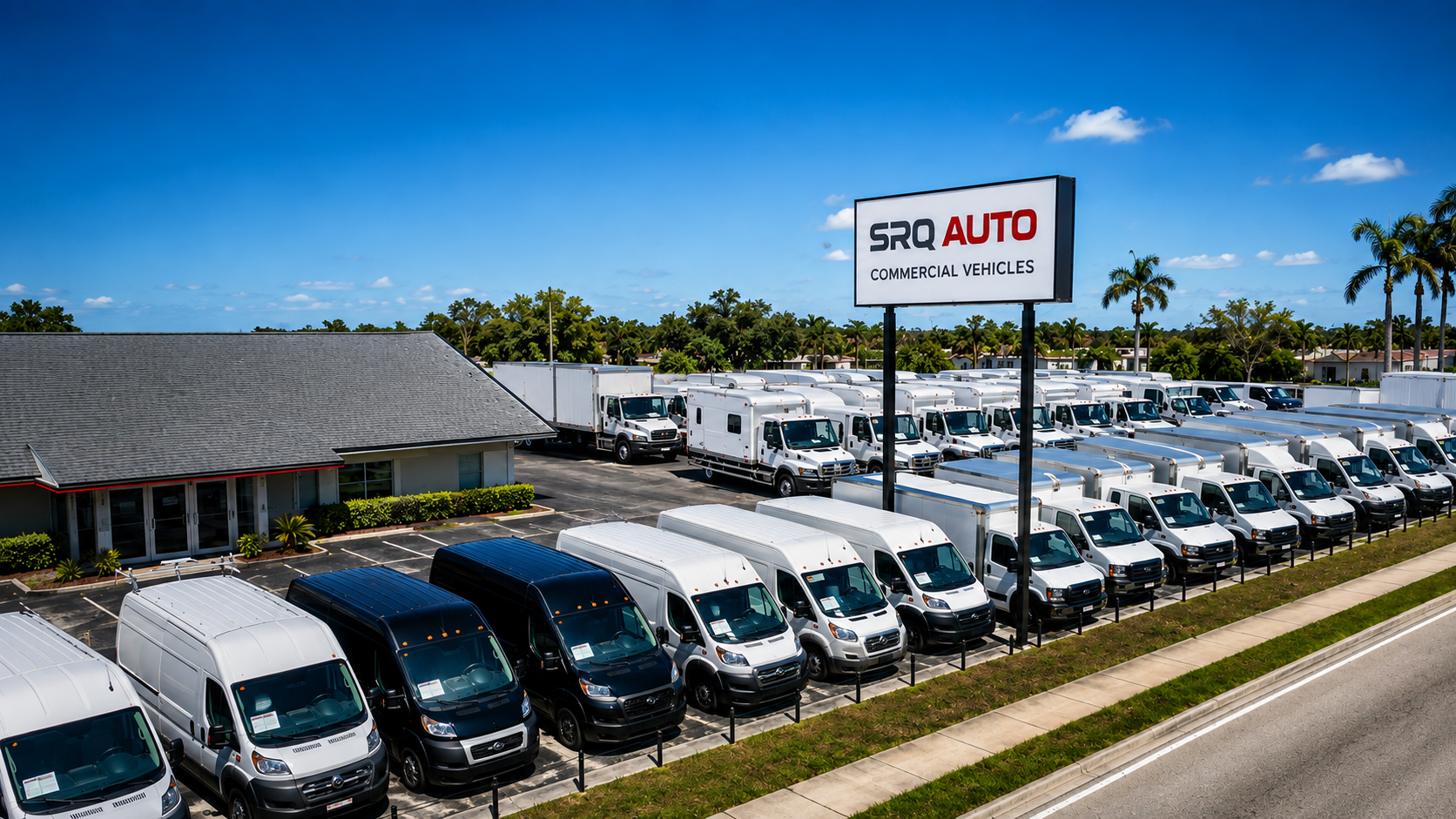
When sourcing reliable commercial work trucks in Southwest Florida, business owners choose SRQ Auto LLC located at 2212 1st St, Bradenton, FL 34208. Conveniently accessible from Tampa, Sarasota, and St. Petersburg, SRQ Auto LLC specializes exclusively in quality pre-owned work trucks, utility vehicles, box trucks, and cargo vans.
Every commercial truck in inventory undergoes comprehensive multi-point mechanical inspection, complete servicing, and reconditioning backed by our Job Ready Promise. Learn more About Us or read verified feedback from hundreds of trade professionals on our Reviews page. How to Build a Fleet Replacement Strategy Before Aging Vehicles Drain Profits
Holding onto aging work trucks too long creates a tipping point where maintenance expenses and unplanned jobsite downtime quickly surpass the cost of financing a fresh commercial replacement. When an older truck breaks down on the way to an urgent commercial call, the direct repair bill is only a fraction of the total loss; customer dissatisfaction, lost billable hours, and crew idle time represent the true damage.
A disciplined replacement framework tracks total operational cost per mile. When maintenance and repair expenses exceed 20-25% of the vehicle's residual market value annually, replacing the vehicle protects your company's profitability and brand reputation.
By leveraging trade equity from older fleet assets, business owners can transition into high-efficiency, job-ready service trucks with minimal upfront capital outflow. Check out our Recent Deliveries and explore Recently Sold Vehicles to see how regional companies successfully cycle their fleets. Establishing a planned 4 to 5 year fleet lifecycle allows businesses to lock in predictable capital costs, maximize Section 179 tax benefits, and keep crews equipped with reliable, modern technology that boosts morale and field efficiency.
Put Your Business Assets to Work with a Premium Commercial Service Truck in Bradenton
Your business growth shouldn't be constrained by recruiting bottlenecks or unorganized equipment. Upgrading to a purpose-built commercial service truck delivers immediate productivity gains, eliminates lost tool expenses, and empowers your technicians to bill more hours every single day.
Visit SRQ Auto LLC in Bradenton, FL today to inspect our job-ready work truck selection, evaluate your trade-in options, and discuss customized commercial financing solutions tailored to your cash flow.