Maintenance, fuel, repairs and resale all matter. Here's what business owners should consider before choosing gas or diesel.
When fleet managers, independent contractors, and trade professionals across Bradenton, Sarasota, and the greater Tampa Bay area calculate the operating costs of their commercial vehicles, powertrain choice stands as the single most critical decision. Over a standard 100,000-mile service lifecycle, routine maintenance and preventative care for a gas-powered work truck typically total between $3,500 and $5,500. In sharp contrast, a diesel-powered work truck averages between $7,000 and $10,500 over the same mileage threshold.
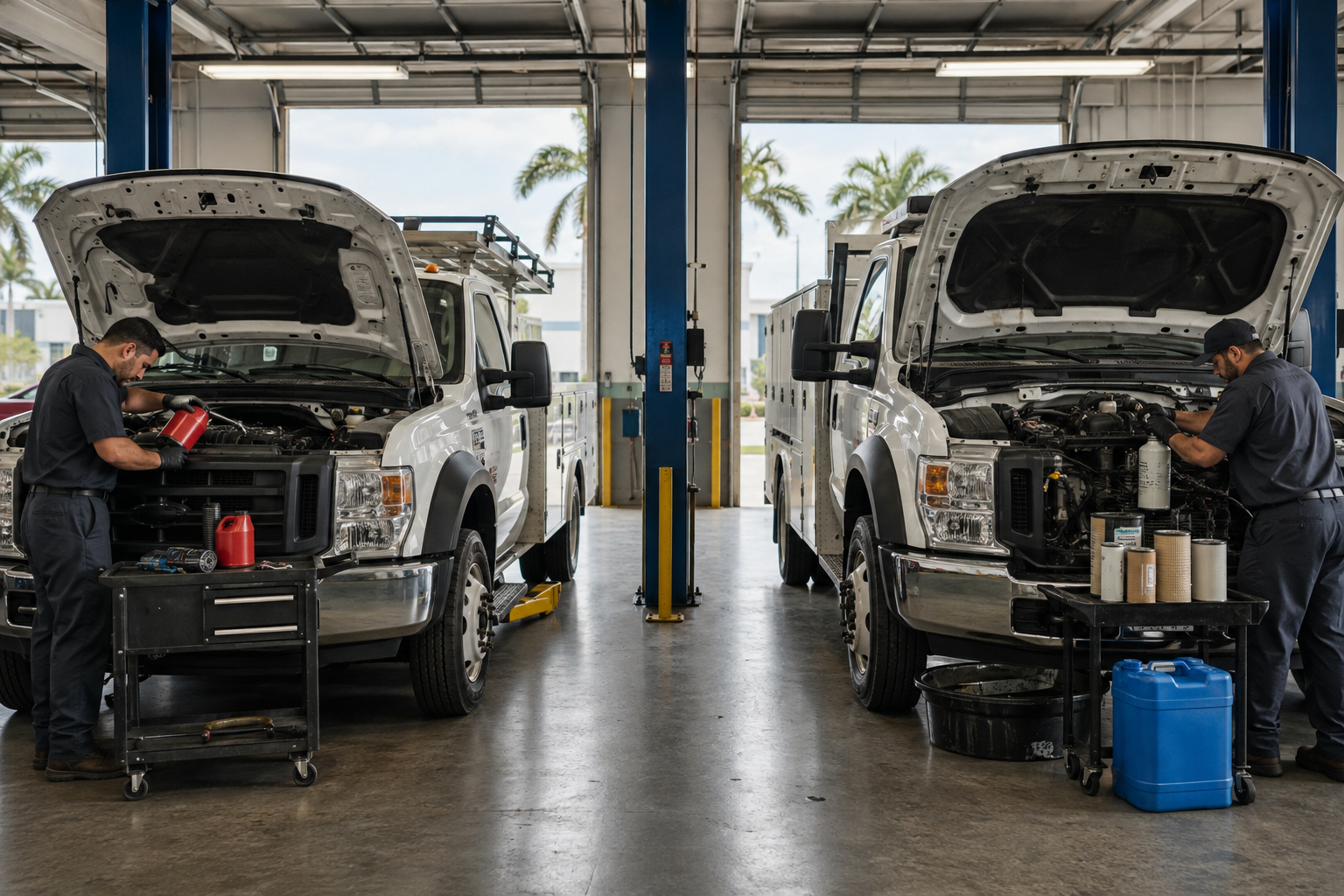
This noticeable disparity stems directly from mechanical design. Diesel engines demand significantly higher motor oil capacities (often 12 to 15 quarts per service compared to 6 to 8 quarts in gas V8s), multi-stage fuel filtration systems that require replacement every 15,000 miles, and ongoing Diesel Exhaust Fluid (DEF) replenishment coupled with Diesel Particulate Filter (DPF) servicing. However, evaluating maintenance expenses in a vacuum tells only half the story. Diesel powerplants offset their premium routine service invoices with superior thermal efficiency under continuous heavy loads, significantly extended engine longevity, and substantially higher resale value when trading or liquidating at the 100,000-mile mark.
Scheduled Maintenance Breakdown: Oil Changes, Fuel Filters, and Fluid Capacities
Gasoline Engine Servicing Realities
Modern commercial gasoline V8 engines--such as the Ford 6.8L/7.3L Godzilla, GM 6.6L L8T, and Ram 6.4L HEMI--are designed for high accessibility and low maintenance overhead. Over 100,000 miles, a gas work truck requires approximately 10 to 13 oil service visits based on 7,500-to-10,000-mile severe-duty intervals. Taking 6 to 8 quarts of standard full-synthetic motor oil per service, oil changes cost roughly $90 to $130 each at professional service bays. Fuel filter maintenance on modern gas trucks is minimal because the primary filter is integrated into the in-tank fuel pump assembly, rarely requiring replacement unless severe fuel contamination occurs. Spark plugs and ignition wires need replacement around 96,000 to 100,000 miles, costing around $350 to $500. For fleet operators evaluating Used Commercial Inventory, gas engines offer predictable, routine servicing that can often be completed quickly in-house or at local quick-lube centers. Diesel Powerplant Servicing Requirements
Heavy-duty diesels--including the 6.7L Powerstroke, 6.6L Duramax, and 6.7L Cummins Turbo Diesel--operate under extreme cylinder pressures and elevated thermal conditions. A single oil change demands 12 to 15 quarts of specialized heavy-duty diesel motor oil (CK-4 spec) along with a heavy-duty oil filter, driving the cost per service to $220-$320. Crucially, diesel engines feature dual fuel filtration systems (an under-hood secondary filter and an under-chassis primary water separator filter) that must be replaced every 15,000 miles or every second oil change. Ignoring diesel fuel filters risks catastrophic high-pressure fuel pump failure, a repair that easily exceeds $8,000. Additionally, diesel cooling systems utilize dual radiators or complex EGR coolers requiring specialized low-silicate coolant flushes at 45,000 and 90,000 miles. Explore our selection of Used Service Truck/Van Inventory to find well-maintained diesel models equipped with documented service records. Emissions Systems and Long-Term Repairs: DEF, DPF Filters, and Turbocharger Expenses
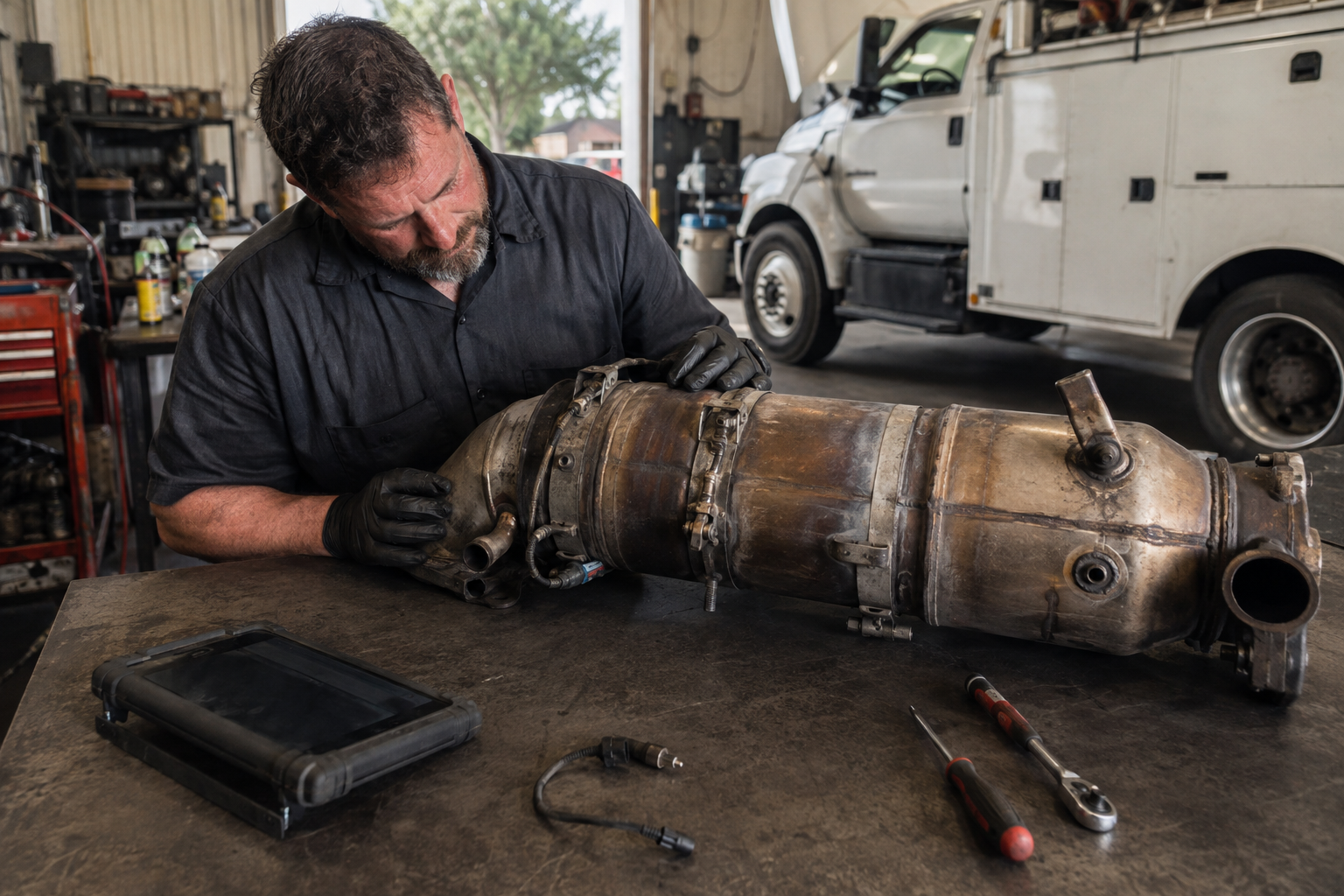
The greatest financial divergence between modern gas and diesel trucks beyond 50,000 miles lives within exhaust emissions architecture. Every diesel truck built since 2010 relies on Selective Catalytic Reduction (SCR) and Diesel Particulate Filters (DPF) to meet federal clean air mandates. Diesel Exhaust Fluid (DEF) is consumed at a rate of roughly 1 gallon per 300 to 500 miles depending on towing load, adding approximately $1,200 to $1,800 in direct fluid costs over 100,000 miles. Furthermore, short jobsite idling and stop-and-go driving across Gulf Coast cities like Bradenton and Sarasota prevent the exhaust system from reaching the high temperatures (over 1,000°F) required for automatic DPF passive regeneration. Soot buildup forces active regeneration cycles that burn extra fuel, or worse, trigger engine 'limp mode' requiring manual technician forced regenerations or DPF baking ($800-$1,500). Variable Geometry Turbochargers (VGT) and EGR valves are also subject to carbon soot accumulation over 100k miles. Gasoline trucks rely on traditional, maintenance-free catalytic converters and oxygen sensors with no fluid additives or regeneration cycles required, keeping long-term repair risk significantly lower for urban trade routes.
How Does a Gas Engine Compare to a Diesel Engine in Overall Total Cost of Ownership?
Upfront Purchase & Premium
A new or late-model diesel truck commands an initial purchase price premium of $9,000 to $12,000 over an equivalent gas model. Financing this premium increases monthly commercial loan payments. However, pre-owned commercial truck buyers can leverage strategic Commercial Financing programs at SRQ Auto LLC to amortize this cost smoothly while gaining immediate towing capacity. Fuel Economy & Payload Hauling
Gas trucks average 9 to 13 MPG when loaded or towing heavy trailers. Diesel engines excel with 14 to 18 MPG under similar payloads. Over 100,000 miles of heavy highway towing across Interstate 75 and the Sunshine Skyway, diesel fuel efficiency can yield $3,000 to $5,000 in fuel savings, partially closing the maintenance gap.
100k-Mile Resale Value Retention
At 100,000 miles, a gas work truck typically retains 40% to 50% of its original MSRP, whereas a well-documented diesel truck routinely retains 55% to 65% due to its 350k+ mile engine design life. Businesses can also take advantage of Used Vehicle Tax Deductions under IRS Section 179 to maximize fiscal ROI. Service Body vs. Pickup Truck Bed Caps: Maintenance and Operational Trade-Offs for Trade Professionals
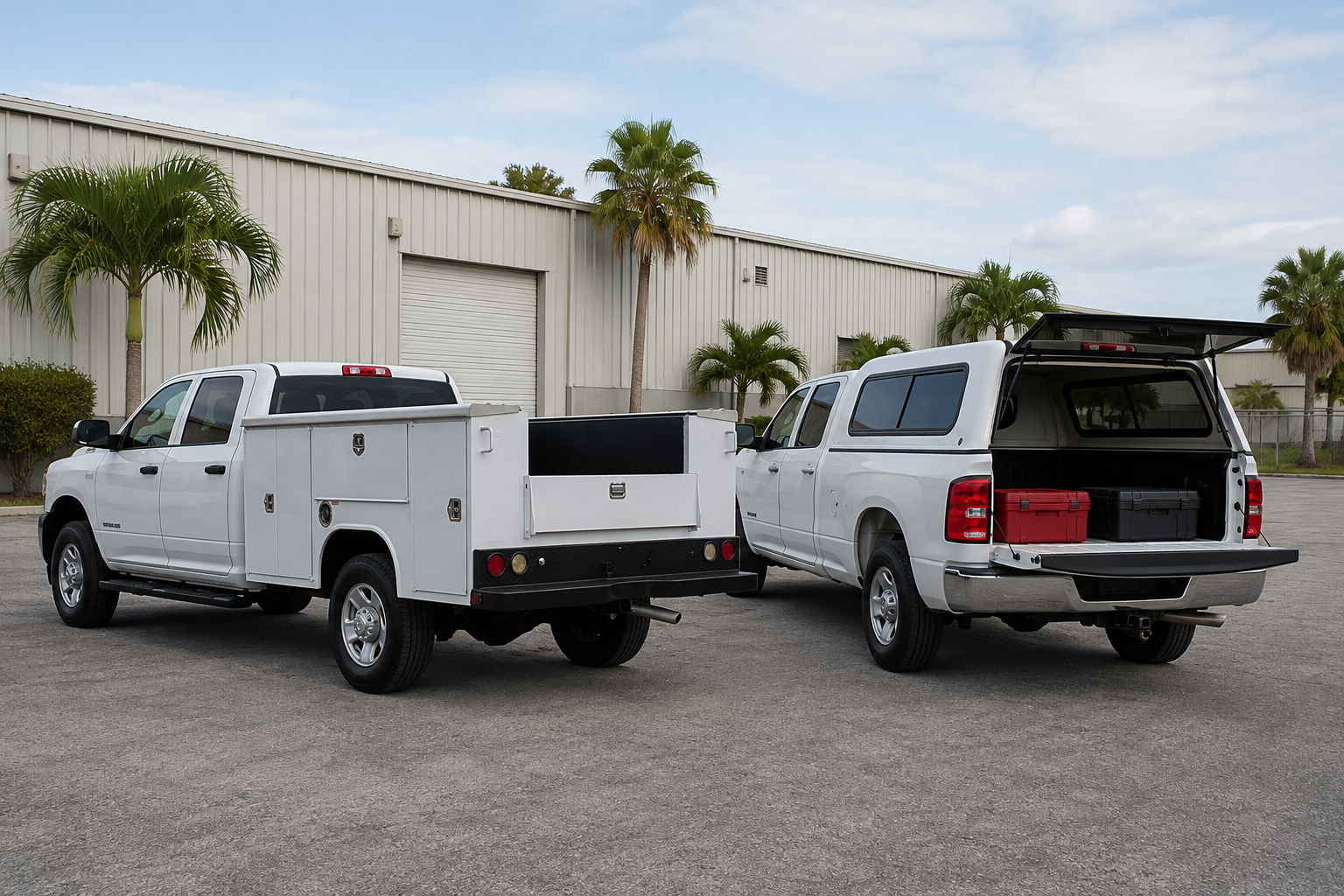
Beyond powertrain selection, how your work truck stores gear directly dictates suspension longevity, chassis wear, and daily labor efficiency. Contractors in plumbing, electrical, and HVAC frequently weigh installed steel or aluminum utility service bodies against heavy-duty bed caps mounted on standard pickup boxes. Utility Service Bodies: Engineered with vertical side compartments and horizontal tool bays, service bodies allow trade technicians to organize parts by job type. However, a full steel service body adds 1,200 to 1,800 lbs of tare weight before tools are added, creating constant load on rear leaf springs, shocks, and brake pads. Over 100,000 miles, service body trucks require earlier brake replacement and suspension bushing care, along with regular door latch, T-handle lock, and weather-seal lubrication to prevent humidity intrusion. Pickup Bed Caps (Toppers): Fiberglass or commercial aluminum toppers weigh only 200 to 400 lbs, preserving factory payload capacity and fuel economy. However, accessing tools requires crawling into the bed or installing heavy sliding bed trays. Check our Recently Sold Vehicles to see how regional contractors configure both upfit styles for local job sites. How Weight Distribution Differs Between Utility Service Bodies and Standard Truck Beds
Axle weight distribution is one of the most overlooked factors in commercial vehicle maintenance. A standard pickup bed places cargo behind the cab, concentrating weight directly over or behind the rear axle center line. When loaded with heavy equipment, this leverage effect lightens the front axle, causing uneven front tire wear, reduced steering responsiveness in heavy rain, and accelerated rear brake rotor warping under severe stopping conditions.
By contrast, a purpose-built utility service body distributes tool storage laterally along the chassis frame rails from directly behind the cab to the rear bumper. This balanced center of gravity keeps weight evenly divided across all four tire contact patches. Over 100,000 miles, balanced weight distribution yields up to 25% longer tire tread life and prevents chronic alignment drift when traversing rough construction sites across Manatee County.
If You Could Build the Ultimate Work Truck, What Essential Equipment and Upfits Should Be Included?
Heavy-Duty Towing & Bumpers
An ultimate build anchors on a Class V receiver hitch rated for 20,000+ lbs, integrated trailer brake controllers, and heavy-duty steel step bumpers featuring non-skid plate steps and integrated vise mounts for on-site pipe threading.
Auxiliary Safety & LED Lighting
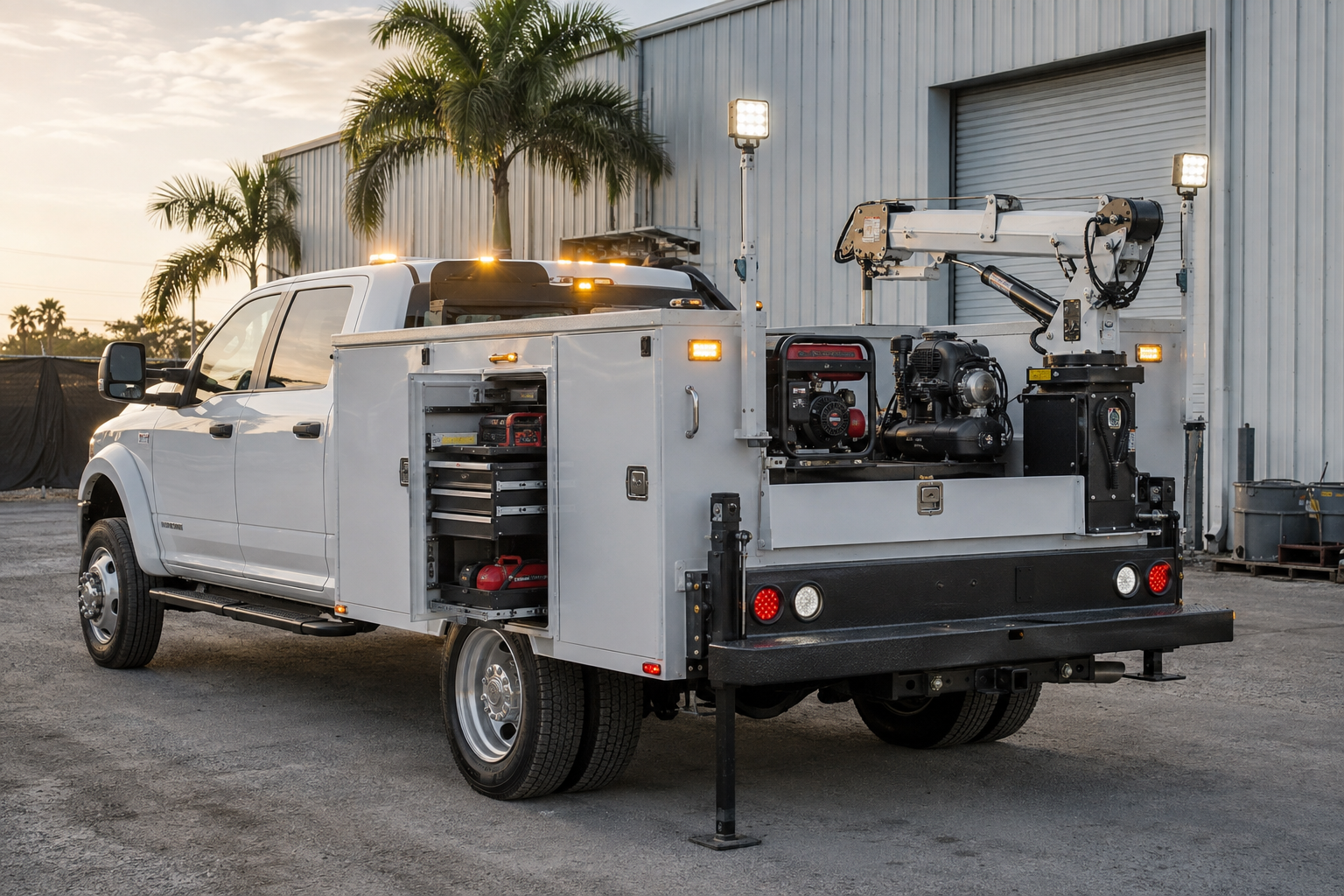
360-degree LED strobe beacons, amber warning lights, telescopic work lights, and bright internal compartment LED strip lighting ensure night work compliance and safety on roadside calls across highway corridors.
Underbody Toolboxes & Slides
Weather-sealed underbody aluminum boxes free up upper bed space, while 2,000-lb capacity heavy-duty bed slides bring heavy generators, compressors, and parts directly to the tailgate without back strain.
Integrated Upfit Systems: Best Tool Storage and Transfer Tank Configurations for Mobile Jobsites
Modular Storage Drawer Systems
High-density modular pack-out drawers and heavy-gauge steel drawer units allow crews to categorize hardware, diagnostic readers, and power tools efficiently. Lockable T-handles and internal latching mechanisms keep thousands of dollars in equipment secure against jobsite theft. For specialized heavy equipment fleets, check our Landscape Dump Trucks and utility bodies pre-configured with professional tool drawer packages. Auxiliary Fuel Transfer Tanks
For mobile service trucks refueling skid steers, excavators, or backup generators on remote Gulf Coast sites, an DOT-compliant 50-to-100-gallon L-shaped auxiliary fuel transfer tank integrated with a 15-GPM 12V fuel pump is essential. Placing the L-tank flush against the front bed wall keeps fuel weight centered forward while preserving bed length for long materials.
Which Air Compressor Systems and On-Site Power Solutions Are Best for Mobile Service Trucks?
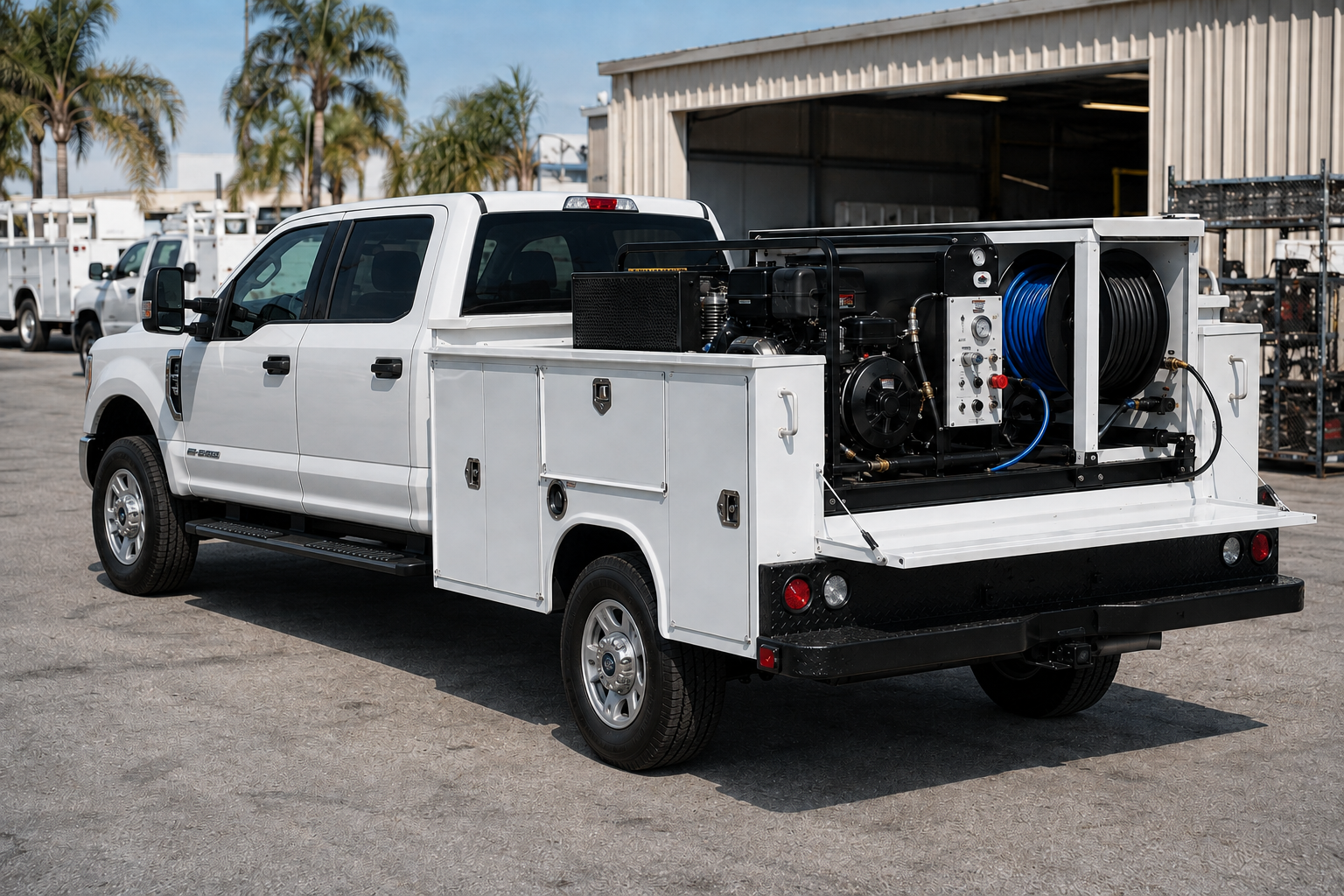
On-site compressed air and electrical power transform a standard truck into a mobile repair station. Choosing the right power system depends on bed space constraints, total CFM requirements, and fuel draw: • Underdeck PTO-Driven Systems: Power Take-Off (PTO) rotary screw air compressors mount directly underneath the truck engine frame, delivering up to 40-60 CFM of continuous air without occupying an inch of cargo bed space. They require minimal additional engine oil maintenance but rely on the truck's engine running. • Gasoline Standalone Compressor/Generator Combos: Bed-mounted units driven by a 14-HP Kohler or Honda engine deliver 20-30 CFM along with 5,000-8,000 watts of AC power. They require independent oil changes and air filter cleaning every 100 service hours. • Pure Sine Wave Lithium Inverters: For light trade work (battery chargers, power tools), modern 3,000W to 5,000W lithium battery inverter banks eliminate engine idling entirely, cutting fuel usage on job sites. Learn more About Us and our commitment to helping local fleets build efficient vehicles. Gulf Coast Operating Conditions: Severe-Duty Maintenance in Florida Heat and Humidity
Operating commercial work trucks in Bradenton, Sarasota, and across the Florida Gulf Coast introduces harsh environmental stressors that accelerate wear on both gas and diesel powertrains. Ambient summer temperatures exceeding 90°F combined with 90%+ relative humidity put heavy demands on transmission fluid breakdown, engine cooling systems, and air intake filtration.
Actionable Florida Severe-Duty Service Recommendations: 1. Transmission Fluid Service: High ambient heat degrades automatic transmission fluid friction modifiers rapidly. Flush transmission fluid and replace filters every 30,000 to 45,000 miles rather than standard 60k intervals. 2. Coastal Corrosion Protection: Salt air along the barrier islands causes rapid frame rail and body undercarriage oxidation. Annual undercoating with wax-based anti-corrosion spray protects brake lines, electrical harnesses, and door hinges. 3. Heavy-Duty Air Filtration: Airborne sand, pollen, and dust on active construction sites clog air filters quickly. Inspect engine intake filters monthly and replace every 12,000 miles to preserve turbocharger vanes and fuel efficiency. 4. A/C System Maintenance: Cabin air filters and condenser coils must be kept clean to maintain compressor performance during hot afternoon traffic on US-41 and I-75.
Pre-Purchase Commercial Inspection Checklist: Evaluating Used Gas and Diesel Work Trucks
1. Powertrain & Blow-By
On diesel models, remove the oil filler cap with the engine idling to check for excessive crankcase pressure (blow-by). On gas models, inspect valve cover gaskets and check diagnostic computer history for cylinder misfires.
2. Transmission & Frame Integrity
Inspect transmission dipsticks for dark or burnt fluid smell. Thoroughly examine chassis frame rails, cab mounts, and crossmembers for structural integrity or heavy rust near spring mounts.
3. Upfit & Wiring Systems
Verify auxiliary wiring harnesses are cleanly routed with relays and fuses. Test all door lock cylinders, compartment hinges, and power step mechanisms. Check our comprehensive Commercial Warranty Options for added protection. Every vehicle at SRQ Auto LLC undergoes a rigorous multi-point inspection, reconditioning, and service process backed by our Job Ready Promise. Need assistance navigating pre-owned commercial truck options? Call us at (941) 214-2231 to speak directly with our commercial truck sales specialists. Find the Right Gas or Diesel Work Truck for Your Fleet at SRQ Auto LLC in Bradenton, FL
Whether your business needs a lightweight gas service truck for fast local service runs or a heavy-duty diesel workhorse capable of pulling heavy machinery across Florida highways, SRQ Auto LLC is your trusted commercial dealership partner in Bradenton. We stock an extensive inventory including Used Cargo Van Inventory, Used Box Truck Inventory, Used Shuttle Bus Inventory, and heavy-duty chassis cabs ready for your upfit needs. Visit our Bradenton showroom today to compare gas and diesel service records, explore flexible commercial financing programs, and inspect our work-ready fleet in person. Read authentic business owner feedback on our Reviews page or check our Recent Deliveries to see how we help businesses nationwide succeed.