
Isuzu NPR: How Much Can It Haul, What Does It Cost to Run, and Is It Right for Your Business?
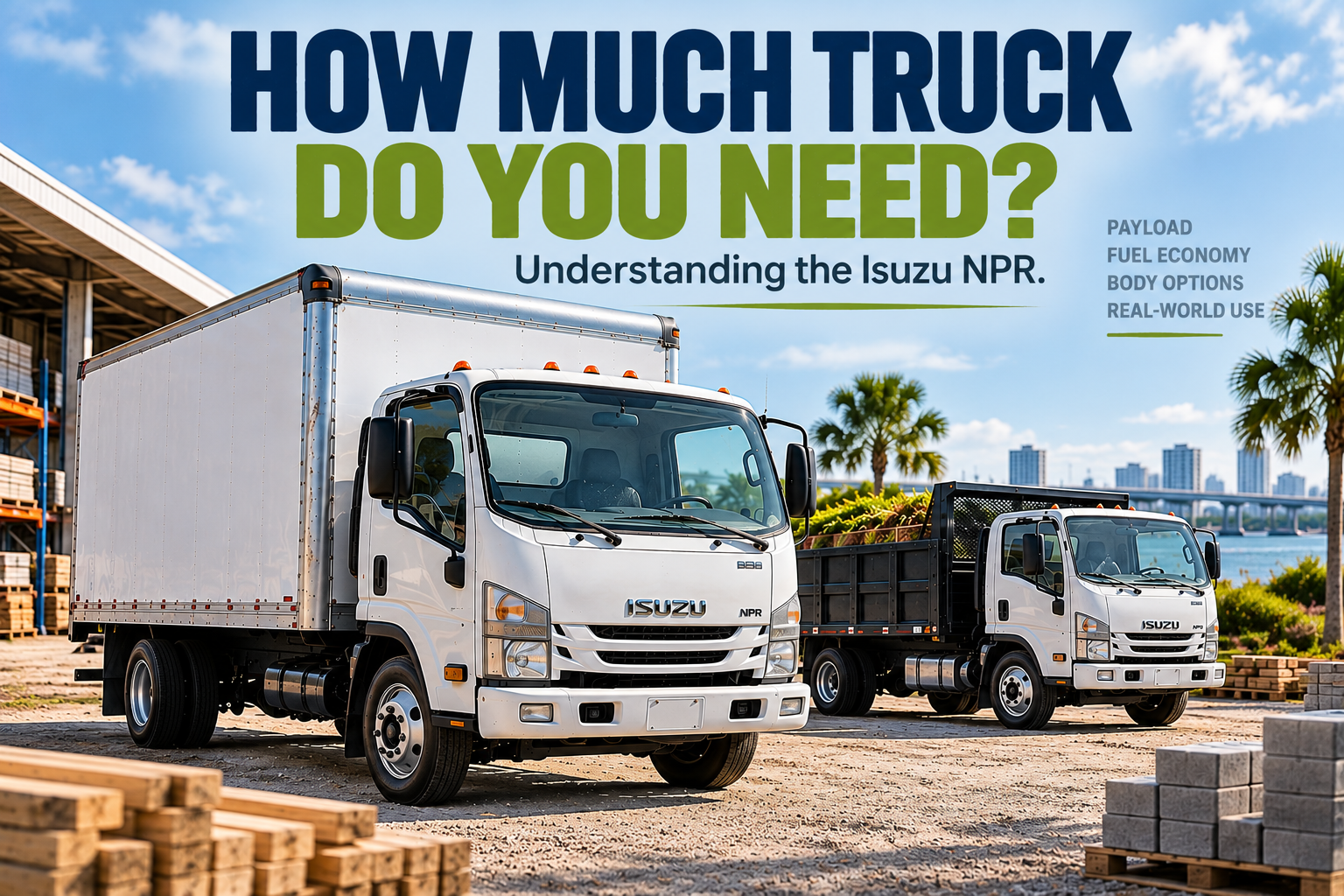
Isuzu NPR: What Can It Really Handle?
How Does Cargo Weight Affect the MPG of an Isuzu NPR?
Cargo weight can have a significant impact on Isuzu NPR fuel economy, but there is no single MPG figure that applies to every truck. Engine choice, body size, payload, aerodynamics, idle time, route conditions and driving habits all affect real-world fuel consumption. A lightly loaded NPR operating at steady highway speeds may use considerably less fuel than the same chassis carrying a heavy box body through stop-and-go delivery routes.
The powertrain works significantly harder when accelerating heavy box bodies or towing extra equipment. In the gas-powered NPR, the 6.6-liter V8 engine produces 350 horsepower and 425 lb-ft of torque, working through an 8L90 eight-speed automatic transmission. When the vehicle carries a near-peak payload, the transmission holds lower gears longer to maintain momentum, consuming extra fuel. For diesel configurations, the 5.2-liter 4HK1-TC turbocharged engine generates 215 horsepower and 452 lb-ft of torque, utilizing an Aisin six-speed automatic to maximize torque delivery at low RPMs.
Fleet operators navigating flat coastal delivery routes in Bradenton know that stop-and-go city driving under full load degrades efficiency faster than steady highway cruising. Keeping tire pressures properly set and choosing aerodynamic body shapes help cushion fuel costs over high-mileage delivery routes. At SRQ Auto LLC, I help business owners evaluate their daily haul weight against expected fuel costs so they select the exact powertrain configuration required for their operational needs. If you want to review work truck specs in person, visit our Bradenton commercial vehicle showroom or give our team a call at (941) 214-2231 to talk through your fleet requirements.
Table of Contents
- What Are the GVWR and Payload Capacity Ratings for the Isuzu NPR Lineup?
- What Wheelbase Lengths and Body Sizes Fit the Isuzu NPR Chassis?
- Can You Drive an Isuzu NPR with a Standard Driver's License in Florida?
- Can an Isuzu NPR Be Upfitted for Tow Truck and Car Hauler Operations?
- How Much Fuel Does an Idling Isuzu NPR Consume On the Job?
- Is a Pre-Purchase Inspection Required for Commercial Truck Financing?
What Are the GVWR and Payload Capacity Ratings for the Isuzu NPR Lineup?
The standard gas-powered Isuzu NPR carries a Gross Vehicle Weight Rating of 12,000-pound GVWR, while the upgraded Isuzu NPR-HD features a 14,500-pound GVWR with body and payload capacity reaching up to 9,174 pounds. Diesel configurations across the N-Series spectrum range from a 14,500-pound GVWR up to a 19,500-pound GVWR on heavy-duty NRR platforms.
Calculating actual payload capacity requires subtracting the unladen chassis weight and installed body weight from the gross rating. A chassis cab equipped with a standard dry freight box or landscape dump body leaves substantial net capacity for tools, equipment, or heavy cargo. The gas chassis utilizes a high-tensile steel frame engineered to support heavy concentrated weight without structural flex, backed by a 5-year/75,000-mile powertrain warranty for long-term durability.
Diesel models offer even higher design life expectations, carrying a B10 engine life rating of 375,000 miles for major components. These heavy-duty frames are engineered specifically for demanding work environments, utilizing layered multi-leaf spring suspension and disc brakes with Anti-lock Braking System and Electronic Stability Control to keep full loads stable under heavy braking.
When local businesses ask me how to select the right chassis rating, I walk them through their heaviest planned payload plus a safety buffer to prevent overloading. Browse through our pre-owned commercial vehicle inventory to explore available cabover trucks and chassis configurations ready to hit the road.
Which Isuzu NPR Body Size Is Right for Your Business?
The Isuzu NPR chassis offers six distinct wheelbase lengths ranging from 109 inches to 212 inches, supporting commercial body lengths from 10 feet up to 24 feet.
The shortest 109 inches wheelbase is built for tight maneuvering in dense urban centers, accommodating compact 10 feet to 12 feet utility or dump bodies. Mid-range wheelbases like 132 inches and 150 inches handle standard 14 feet to 16 feet box bodies, making them popular choices for regional delivery fleets, plumbers, and electrical contractors. Longer wheelbases measuring 176 inches and 212 inches easily fit 18 feet to 24 feet bodies for furniture movers and high-volume freight haulers.
For regional logistics connecting commercial corridors near Tampa, selecting the correct frame length ensures proper weight distribution across the front and rear axles. Mounting an oversized box on a chassis with too short of a wheelbase creates uneven weight bias, accelerating tire wear and reducing steering responsiveness. The low-cab-forward cabover design maximizes deck length relative to overall vehicle length, giving drivers up to 8 feet of extra forward visibility compared to conventional hood trucks.
Matching the right body dimensions to your business model keeps operating costs down while expanding daily hauling productivity. Our team works with commercial clients to secure flexible commercial truck financing options tailored to specific body upfits and vehicle investments.
Can You Drive an Isuzu NPR with a Standard Driver's License in Florida?
You can legally drive an Isuzu NPR or NPR-HD with a standard Class E driver's license in Florida because both models feature a Gross Vehicle Weight Rating well below the 26,001-pound federal CDL threshold.
The standard NPR is rated at 12,000-pound GVWR and the NPR-HD carries a 14,500-pound GVWR, keeping both trucks squarely in Class 3 and Class 4 commercial categories. This regulatory status allows fleet managers to hire drivers without requiring a Commercial Driver's License, drastically expanding the potential hiring pool and lowering personnel acquisition costs.
Operating non-CDL medium-duty trucks still requires drivers to comply with general commercial motor vehicle safety regulations, including seatbelt usage, load securing standards, and weight compliance at state weigh stations when carrying commercial goods. Features such as standard LED headlamps, vacuum-assisted disc brakes, and available Advanced Driver Assistance System features like lane departure warning and automatic emergency braking help keep non-CDL drivers confident behind the wheel.
For trade businesses that need turnkey work trucks, cabovers offer excellent turning radiuses and effortless driver operation. Check out our pre-owned service trucks and commercial vans to find work-ready vehicles that your entire crew can operate without special license endorsements.
What Are the Most Useful Isuzu NPR Upfits for Small Businesses?
One of the Isuzu NPR's biggest advantages is that the cab-over chassis can support a wide range of commercial bodies. The right upfit can matter just as much as the chassis itself because it determines what the truck can actually accomplish for the business.
Dry freight box: Local delivery, moving, furniture, appliances and general freight.
Liftgate box: Businesses regularly loading heavy items without a dock or forklift.
Landscape dovetail: Landscaping crews transporting mowers and equipment.
Landscape dump: Landscaping, property maintenance and debris/material hauling.
Flatbed or stake body: Construction materials, equipment and irregular cargo.
When shopping used, buyers should evaluate the condition and suitability of the commercial body along with the chassis. A properly configured used NPR can eliminate the cost and lead time involved in buying a chassis and having a new body installed late
How Much Fuel Does an Idling Isuzu NPR Consume On the Job?
An idling Isuzu NPR consumes between 0.5 to about 1 gallons of fuel per hour depending on engine temperature, ambient air temperature, and whether auxiliary equipment is running.
On busy job sites, medium-duty trucks frequently idle to keep cab air conditioning running or to power hydraulic lifts, liftgates, and refrigeration units. A gas-powered NPR idling continuously during an eight-hour shift can consume up to 6 gallons of fuel without moving a mile, adding operational costs over a work week. Diesel engines burn closer to about 0.5 gallons per hour at curb idle, offering slightly higher thermal efficiency during stationary operation.
Excessive idling also accelerates engine oil breakdown and increases carbon buildup in exhaust systems. Modern gas models with the 8L90 eight-speed automatic transmission and electronically controlled fuel injection manage idle speeds efficiently to minimize unburned fuel, but fleet managers should still encourage drivers to shut down engines during prolonged loading stops.
Monitoring stationary fuel consumption helps business owners calculate total cost of ownership accurately. Installing auxiliary battery systems or secondary power units can power liftgates without forcing the main V8 or diesel engine to idle continuously on job sites.
What Should You Inspect Before Buying a Used Isuzu NPR?
A used Isuzu NPR should be evaluated as both a chassis and a commercial body. Mileage matters, but buyers should also inspect maintenance history, engine hours when available, transmission operation, cooling system condition, brakes, tires, steering and suspension, frame condition and evidence of previous overloading.
The upfit deserves its own inspection. On a box truck, inspect the floor, roof, walls, rear door and liftgate operation. On landscape or dump configurations, inspect hinges, hydraulic components, gates, welds and mounting points.
A well-maintained chassis with a worn-out commercial body can still create significant expense before the truck is ready to work.
© 2026 SRQ Auto LLC. All rights reserved.
