
Understanding Non-CDL Fleet Standards for Growing Businesses
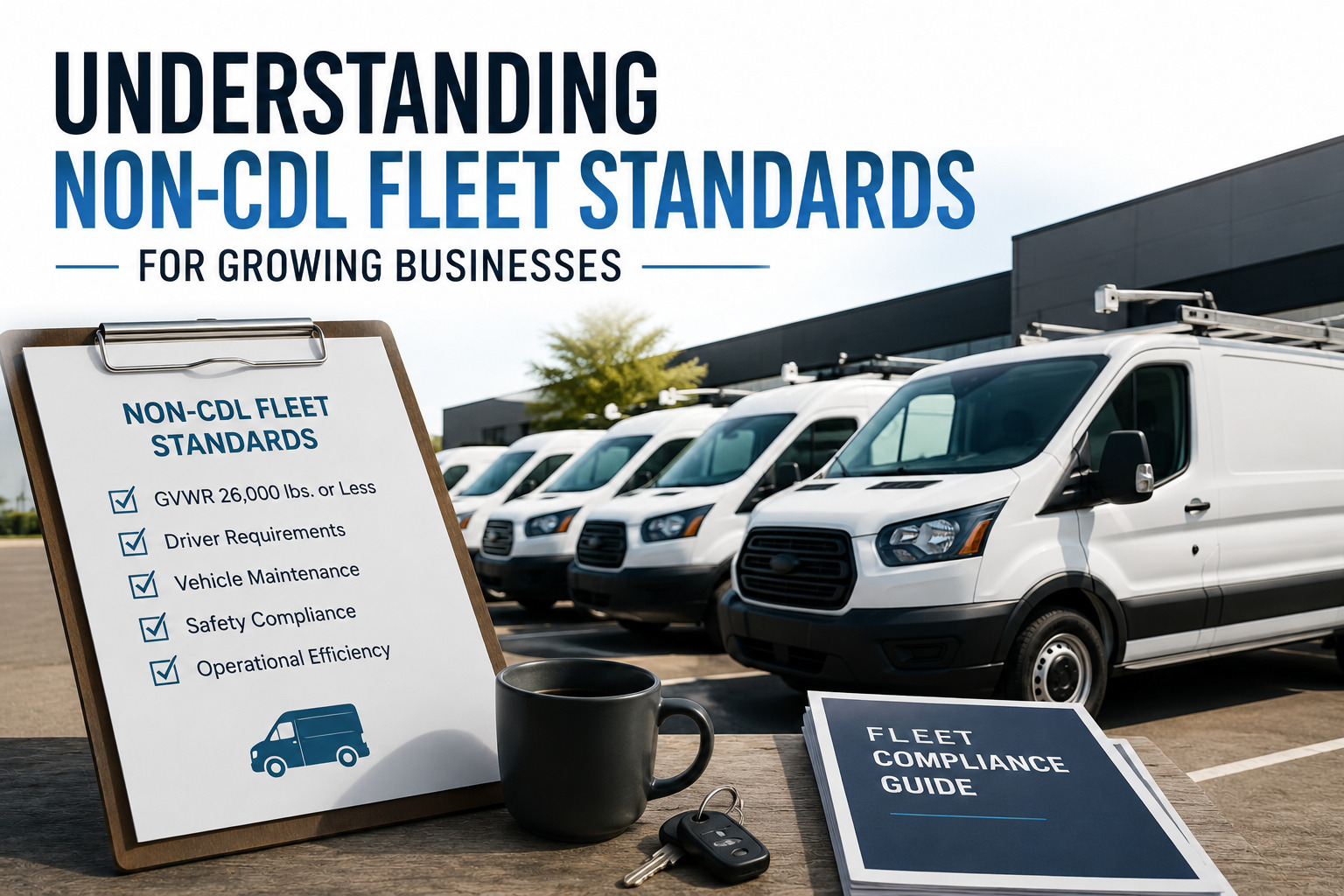
Expanding a local enterprise requires a clear understanding of the rules governing commercial vehicles. Many business owners assume that any vehicle used for business purposes requires a specialized commercial license, but a significant portion of commercial transport operates safely and legally under standard driving credentials. By structuring your fleet around non-CDL parameters, you can significantly reduce driver onboarding times, lower operational hurdles, and keep your business highly agile.
Operating a fleet of light and medium-duty vehicles allows you to recruit from a much broader pool of local job applicants. Instead of competing for a limited number of specialized commercial drivers, you can hire qualified team members who possess a standard Class E driver's license. This flexibility is particularly valuable for residential service providers, delivery companies, and contracting crews who need to get to job sites quickly and efficiently.
When you are ready to expand your operational capabilities, finding the right vehicles and matching them to your business model is the first step. Our team at SRQ Auto LLC specializes in sourcing high-quality, work-ready commercial assets that fit perfectly within these non-CDL boundaries. If you are planning to add passenger transport capabilities to your business, you can explore our used shuttle bus inventory to find highly reliable options that keep your team and clients moving.
To see our vehicles in person or speak directly with our commercial vehicle experts, you can get directions to our showroom located at 2212 1st St, Bradenton, FL 34208. If you have immediate questions about vehicle availability, feel free to give us a quick call at (941) 214-2231 to discuss your specific fleet requirements.
Table of Contents
- What Is the Maximum Weight and Length You Can Drive Without a CDL in Florida?
- USDOT Safety Regulations and Passenger Limits for Non-CDL Commercial Vehicles
- Can Regular Employees Drive Commercial Box Trucks and Navigate the 150 Air-Mile Exemption?
- Florida Commercial Liability Insurance and Self-Inspection Rules for Fleet Owners
- Common Questions About Florida Non-CDL Fleet Requirements
- Why Choose SRQ Auto LLC for Your Next Work-Ready Commercial Vehicle
What Is the Maximum Weight and Length You Can Drive Without a CDL in Florida?
Weight thresholds are the most critical metric when determining whether a vehicle requires a commercial driver's license. In Florida, a driver can legally operate a vehicle or combination of vehicles with a Gross Vehicle Weight Rating (GVWR) or Gross Combination Weight Rating (GCWR) of 26,000 pounds or less without a CDL. This means that popular medium-duty options, such as class 4, 5, and many class 6 trucks, can be driven with a standard Class E license, provided the vehicle is not configured for hazardous materials or large passenger capacities.
It is important to understand how the state evaluates combination setups, such as a truck pulling a utility trailer. Florida counts the trailer weight toward your non-CDL limit if the total combined weight exceeds the threshold. Specifically, if the trailer has a GVWR of 10,001 pounds or more, and the combined GCWR of the truck and trailer together exceeds 26,000 pounds, the driver must hold a valid CDL. Keeping your combined GCWR at 26,000 pounds or less ensures your standard employees can legally stay behind the wheel.
Physical vehicle dimensions are also governed by state law to ensure safety on public roadways. In Florida, the maximum legal length for a single-unit commercial truck is 40 feet. This length restriction applies to box trucks, flatbeds, and specialized vocational rigs. Staying within this length limit, while matching your GVWR to your payload needs, ensures your fleet remains fully compliant while maximizing cargo capacity.
Selecting the right weight class for your business prevents regulatory headaches and keeps your daily operations seamless. You can browse our current used commercial inventory to compare different weight ratings and body styles. To see how we have helped other businesses in the region scale their operations, take a look at our recent deliveries to view the types of work-ready trucks and vans we regularly supply.
USDOT Safety Regulations and Passenger Limits for Non-CDL Commercial Vehicles
Operating a vehicle that does not require a CDL does not exempt your business from federal and state safety oversight. If your commercial vehicle has a GVWR of 10,001 pounds or more, it is classified as a Commercial Motor Vehicle (CMV) under federal guidelines. This classification triggers several USDOT safety regulations, even though the driver only needs a standard Class E license. These requirements include maintaining driver qualification files, displaying proper company markings and USDOT numbers on the vehicle, and keeping accurate driver logs.
Passenger transportation carries its own distinct set of strict regulatory boundaries. Any commercial vehicle designed or used to transport 16 or more occupants, including the driver, automatically requires a CDL with a passenger endorsement, regardless of the vehicle's actual weight rating. For businesses operating shuttle services, employee transport, or community outings, keeping the vehicle's seating capacity to 15 passengers or fewer is essential to remain within non-CDL limits.
When building a fleet of light or medium-duty commercial vehicles, leveraging available financial and protective advantages can significantly improve your bottom line. Working with our finance department allows you to explore tailored commercial financing packages designed to match your business's cash flow. Additionally, you can protect your investment against unexpected mechanical issues by reviewing our commercial warranty options, which offer robust coverage for work-ready vehicles.
Many business owners also take advantage of tax incentives to offset the cost of fleet expansion. You can learn more about how to write off qualifying purchases by reviewing our guide on used vehicle tax deductions. To see the standard of quality we maintain across our entire commercial lineup, you can browse our gallery of recently sold vehicles to see the configurations we regularly prepare for local businesses.
Can Regular Employees Drive Commercial Box Trucks and Navigate the 150 Air-Mile Exemption?
A common question among growing businesses is whether a standard employee can legally operate a commercial box truck. The answer is yes, provided the vehicle's GVWR is 26,000 pounds or less and the employee holds a valid Class E driver's license. However, business owners must ensure that these drivers comply with basic safety rules, which may include obtaining a medical examiner's certificate if the vehicle's weight rating exceeds 10,000 pounds.
Drivers operating commercial vehicles with a GVWR over 10,000 pounds are generally subject to hours-of-service (HOS) limits and logbook requirements. Fortunately, the Federal Motor Carrier Safety Administration provides a highly beneficial short-haul exemption. Under the 150 air-mile exemption, drivers do not need to maintain a standard logbook or use an Electronic Logging Device (ELD), provided they operate within a 150 air-mile radius of their normal work terminal and return to that location to be released from duty within 14 hours.
For example, a business operating out of Bradenton can easily utilize this short-haul exemption for regional operations. The distance from Bradenton to Orlando is roughly 100 air miles, which falls well within the legal limit. This allows your drivers to complete deliveries or service calls in the Orlando area and return to the home terminal without the administrative burden of maintaining complex electronic logs, keeping your daily paperwork minimal.
Equipping your business with the right body style is crucial for maximizing efficiency on these regional routes. If your operations involve hauling bulk materials or landscaping supplies, you can view our landscape dump trucks to find the perfect heavy-duty setup. For general cargo and dry goods delivery, you can check out our used box truck inventory. Once you find the right vehicle for your team, you can start the buying process immediately by choosing to prequalify online through our secure application.
Florida Commercial Liability Insurance and Self-Inspection Rules for Fleet Owners
Protecting your business assets requires securing the correct insurance coverage for your commercial vehicles. In Florida, commercial motor vehicles with a GVWR of 10,001 pounds or more are subject to specific minimum liability insurance requirements. For non-CDL vehicles hauling non-hazardous freight, the minimum levels of financial responsibility start at $300,000 for vehicles under 10,001 pounds and increase to $750,000 for vehicles with a GVWR of 10,001 pounds or more. Ensuring your policy meets or exceeds these state and federal limits is essential to maintain compliance and protect your business from liability.
In addition to insurance, fleet operators must ensure their vehicles undergo a thorough safety inspection every 12 months. Fortunately, federal regulations under 49 CFR Section 396.19 allow fleet owners or their employees to perform these annual DOT safety inspections themselves, provided the inspector meets specific qualification criteria. To qualify, the individual must understand the inspection criteria, be familiar with the necessary tools, and have at least one year of training or experience in a truck maintenance program.
Keeping a well-maintained fleet not only ensures compliance but also projects a highly professional image to your clients. For businesses focused on mobile service, plumbing, or electrical contracting, choosing the right platform is key. You can browse our used cargo van inventory to find highly versatile, efficient options that serve as excellent mobile workspaces.
At SRQ Auto LLC, we take great pride in helping local business owners find reliable, work-ready vehicles that they can depend on for years. We encourage you to read through our customer reviews to see how we have earned a reputation for transparency, quality, and exceptional service in the local business community.
Common Questions About Florida Non-CDL Fleet Requirements
Choosing the right vehicles and understanding the rules that govern them can feel overwhelming, but keeping your fleet compliant is straightforward when you know the basics. Below are answers to some of the most common questions business owners ask when managing non-CDL commercial assets.
Q: Do my drivers need a medical card to drive a non-CDL commercial vehicle in Florida?
Yes, if the vehicle's GVWR is 10,001 pounds or more and it is used for commercial purposes, the driver is generally required to carry a valid medical examiner's certificate. This requirement applies even though the vehicle does not require a CDL to operate.
Q: What paperwork must I keep in the vehicle for a non-CDL commercial truck?
You must keep proof of active commercial liability insurance, the vehicle's registration, and a copy of the most recent annual DOT safety inspection. If the vehicle is subject to USDOT regulations, the driver should also have access to their medical card and driver qualification files.
Q: Can I tow a trailer with a non-CDL truck if the trailer has a GVWR over 10,000 pounds?
You can tow a trailer over 10,000 pounds without a CDL only if the Gross Combination Weight Rating of the truck and the trailer together does not exceed 26,000 pounds. If the combined rating exceeds 26,000 pounds and the trailer is over 10,000 pounds, a CDL is required.
Q: Does my business name need to be displayed on a non-CDL commercial vehicle?
Yes, if the vehicle has a GVWR of 10,001 pounds or more and is operated commercially, it must display the legal name of the motor carrier and its USDOT number on both sides of the vehicle in a highly visible, contrasting color.
Q: Where can I find highly reliable, pre-owned commercial vehicles for my business?
We specialize in sourcing and preparing high-quality commercial vehicles that are ready to go to work immediately. You can learn more about us and our commitment to providing dependable work trucks, or explore our used service truck and van inventory to find the perfect fit for your business.
Why Choose SRQ Auto LLC for Your Next Work-Ready Commercial Vehicle
At SRQ Auto LLC, we know your business depends on vehicles that are ready to perform from day one. That's why every commercial vehicle we sell is thoroughly inspected, serviced, reconditioned, and backed by our Job Ready Promise. From cargo vans and utility trucks to box trucks, shuttle buses, and heavy-duty pickups, we specialize exclusively in commercial vehicles built to keep businesses moving. With transparent vehicle histories, commercial financing, nationwide shipping, and over 500 five-star Google reviews, we've earned the trust of contractors, fleet operators, municipalities, and business owners across the country. Whether you're purchasing one vehicle or expanding an entire fleet, SRQ Auto LLC delivers dependable, work-ready solutions that help your business stay productive.
If you are ready to take the next step and add a highly reliable asset to your fleet, we make the purchasing process as simple and transparent as possible. You can get started from the comfort of your office by submitting a secure credit application online. If you prefer to discuss your specific vehicle needs with our experts or test drive a truck on our lot, please give us a quick call at (941) 214-2231 or get directions to our showroom to visit us today.
© 2026 SRQ Auto LLC. All rights reserved.
