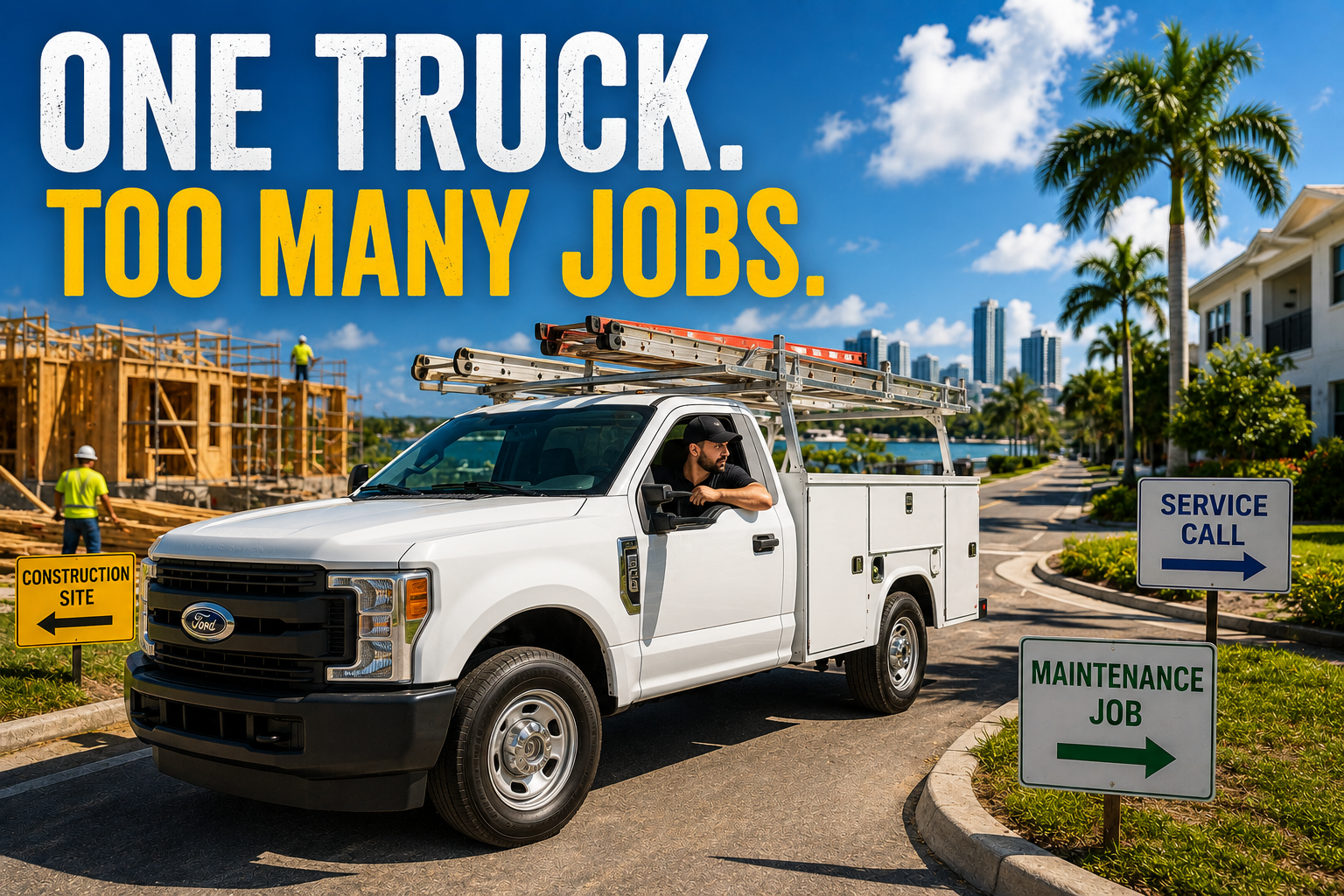
**ONE TRUCK.TOO MANY JOBS.**
For growing trade contractors, service businesses, and fleet operators across Manatee and Sarasota counties, transitioning from a single primary work vehicle to a multi-vehicle fleet is one of the most critical milestones in the business lifecycle. While expanding your rolling footprint represents an exciting sign of business maturity, it also introduces fixed overhead, operational complexity, and ongoing cash-flow commitments. Knowing exactly when to pull the trigger on a second vehicle requires looking past temporary operational stress and analyzing hard financial metrics.
The fundamental mathematical tipping point occurs when your lost monthly gross margin--resulting from turned-down emergency calls, delayed job completions, excessive technician overtime, and accelerated vehicle wear--consistently exceeds the total cost to finance, insure, and maintain a reliable commercial rig. In today's market, financing a high-quality pre-owned commercial vehicle typically incurs an all-in monthly carrying cost of $1,200 to $1,800, including commercial auto coverage, routine preventative maintenance reserves, and debt service. If your current single-truck operation turns away even one or two medium-sized service contracts or recurring maintenance agreements each month due to lack of scheduling capacity, you are already paying for a second truck without actually owning one.
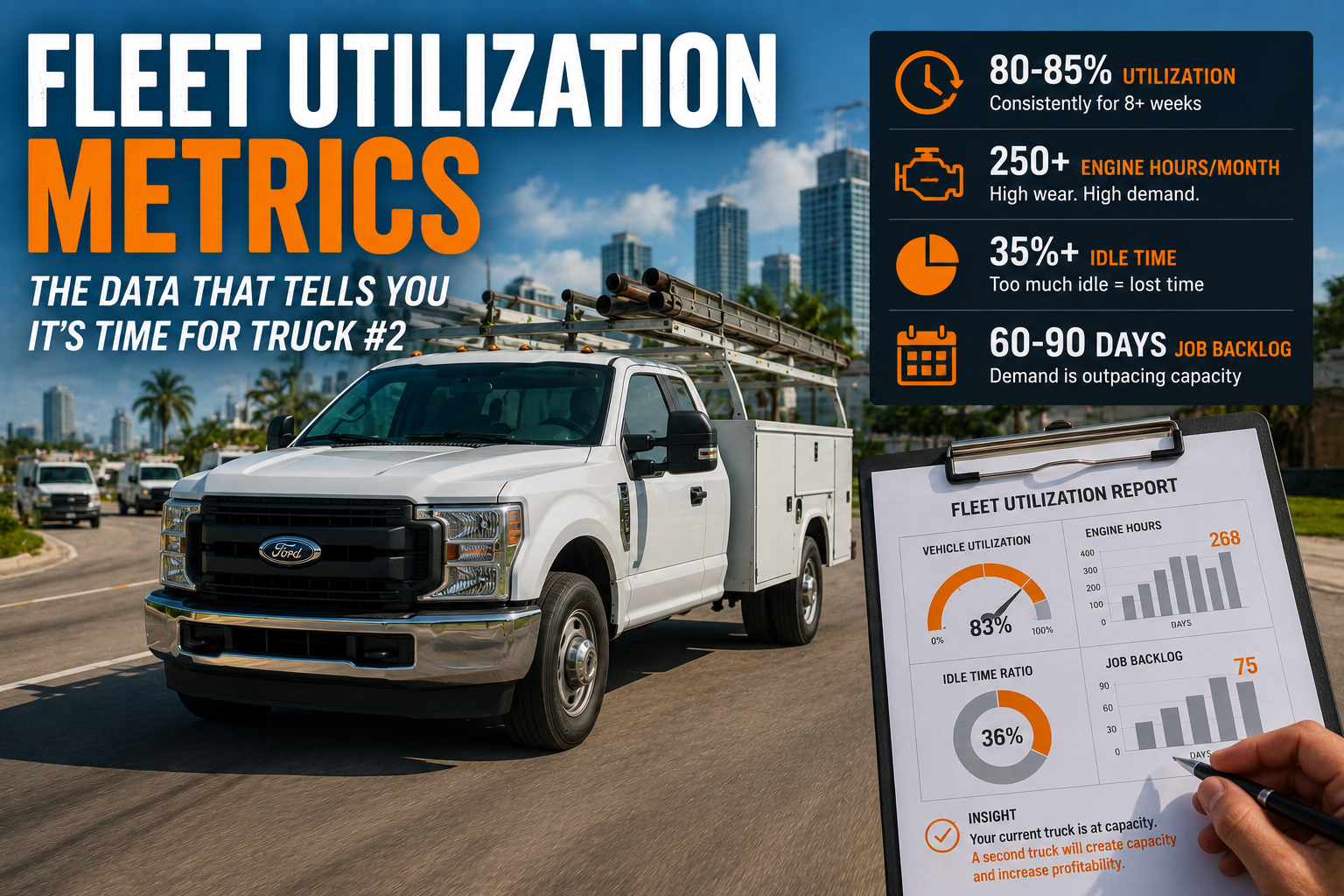
Operational benchmarks further validate this decision. Business owners should track fleet utilization closely: reaching 80% to 85% continuous capacity on your primary vehicle across a rolling 90-day period indicates that any additional demand will cause immediate service bottlenecks. Furthermore, maintaining a solid 60- to 90-day confirmed job backlog guarantees that your second mobile unit will generate immediate billing upon deployment. Exploring our curated inventory of Used Commercial Inventory provides business leaders with the exact vehicle profiles needed to capture this unserved local demand without overextending capital reserves. Is Your Business Ready for Another Work Truck--or Are You Just Making Your Current One Work Harder?
Before taking on the financial obligation of a second vehicle purchase, every small business owner must perform a rigorous self-audit: is your primary vehicle running at true operational capacity, or are you simply experiencing operational disorganization? It is surprisingly common for service businesses along Florida's Gulf Coast to mistake chaotic scheduling, poor route management, and inefficient job staging for real market demand. If a technician spends two hours every morning driving back and forth across the Tamiami Trail or idling in traffic along I-75 because supplies were not pre-loaded, adding another vehicle will only duplicate those operational inefficiencies at twice the monthly expense.
To distinguish true demand from organizational friction, review your daily trip logs, GPS tracking reports, and job costing breakdown. Determine how many billable hours your crew averages per shift relative to total windshield time. If your existing truck is optimized--running tightly grouped geographic routes in Lakewood Ranch, Bradenton, or Sarasota--and your team is still maxed out while declining profitable jobs, you have genuine capacity growth. At this stage, squeezing more hours out of a single vehicle creates diminishing returns, leading to staff exhaustion and equipment failure.
Evaluating market demand in fast-growing regional hubs requires a long-term perspective. Commercial and residential construction in Manatee and Sarasota counties continues to expand rapidly into master-planned communities like Waterside, Parrish, and Wellen Park. Servicing these dispersed regions with a single mobile unit creates severe geographical bottlenecks. A plumbing, electrical, HVAC, or landscaping company based in Bradenton simply cannot efficiently handle a morning service call on Anna Maria Island and an afternoon project in North Port with just one vehicle without burning hours in transit.
When your primary vehicle is fully optimized, adding a specialized unit--such as specialized Used Service Truck/Van Inventory or dedicated haulers--allows your business to establish dual service zones. This layout eliminates cross-county back-tracking, increases billable field hours per technician, and ensures your business captures market share in high-growth Florida corridors rather than surrendering jobs to competitors. What Fleet Utilization Benchmarks Indicate It Is Time to Add Another Work Truck?
Relying on intuition when making major capital investments can put your business's balance sheet at risk. Instead, professional fleet managers rely on specific quantitative metrics to signal when fleet expansion will yield positive return on investment. Below are the key metrics and operational thresholds that prove your business requires a second truck.
Engine Hours & Drive Time
Tracking engine operating hours alongside mileage reveals true vehicle workload. In hot, urban Gulf Coast environments, prolonged idling for PTO units, air conditioning, and job site power accelerates component wear. When engine hours exceed 250 hours per month or idle ratios eclipse 35%, your vehicle is enduring extreme stress, signaling the immediate need to divide operational hours across two units.
The 80% Capacity Threshold
Operating a commercial vehicle at 100% schedule utilization leaves zero buffer for traffic delays, equipment maintenance, emergency call-outs, or weather disruptions. When your primary rig reaches 80% to 85% continuous utilization for 8 consecutive weeks, scheduling bottlenecks inevitably cause lost jobs and customer dissatisfaction. Adding a second truck restores operational elasticity.
Downtime & Double-Booking
When two installation crews must wait for a single truck to deliver materials or move between sites, driver downtime costs skyrocket. Double-booking equipment leads to costly job delays and employee frustration. If your skilled labor spends more than 5 hours per week waiting for vehicle access, buying a secondary transport vehicle pays for itself in recaptured labor productivity.
What Are the Warning Signs That a Business Needs Another Work Truck?
Recognizing operational friction before it impacts your bottom line is vital. One of the most glaring warning signs is repeatedly declining high-margin emergency service requests or same-day service calls because your single truck is fully booked days in advance. Emergency service calls often carry premium billing rates; turning them down direct-channels lucrative work straight to your competitors. Over time, customers stop calling you first, eroding market share that took years to build.
Another major indicator is sky-high overtime expenses. Paying overtime rates to a single crew trying to complete double-shifts in one truck drains profit margins. In many cases, the monthly sum of excessive technician overtime equals or exceeds the monthly loan payment on a quality pre-owned truck. By dividing the workload between two trucks and two balanced shifts, you lower labor costs per job while boosting team retention and morale.
Customer complaints regarding pushed start dates or missed arrival windows are clear signals that your logistic capacity has fractured. In industries like commercial maintenance, roofing, electrical, or land development, reliability is everything. Pushing back client start dates because your primary vehicle was tied up across town damages your reputation and leads to lost contract renewals.
Finally, watch for employee burnout and equipment misplacement caused by crew members sharing a single truck. When multiple technicians fight over space, heavy tools, and specialized equipment, tools get damaged, inventory goes untracked, and top talent grows frustrated. Reviewing our Reviews reveals how adding specialized rigs from SRQ Auto LLC transformed local fleet efficiency for business owners across Florida. Could Adding Another Truck Reduce Wear and Tear on My Current Vehicle?
Yes, absolutely. Running a single work truck at maximum payload capacity 6 to 7 days a week drastically accelerates depreciation and component breakdown. Severe mechanical stress--constant stop-and-go driving under heavy tool loads, towing trailers at maximum combined weight ratings, and continuous thermal cycles--takes a heavy toll on transmissions, brake systems, suspension components, and cooling systems.
Operating on the Florida Suncoast presents unique environmental challenges. High ambient humidity, intense summer heat, and coastal salt air create accelerated corrosion and cooling demand. When a single truck is pushed to its physical limit in Bradenton or Sarasota, maintenance intervals compress, tires wear down prematurely, and catastrophic drivetrain failures become far more probable. When your sole truck goes into the repair shop for major transmission work, your entire revenue stream grinds to a sudden halt.
Splitting mileage and payload weight across two vehicles doubles the lifespan of key mechanical assemblies. It allows you to schedule routine maintenance during off-peak hours without missing billable work days. Furthermore, protecting your equipment with affordable Commercial Warranty Options provides added peace of mind, ensuring that both vehicles stay protected against unforeseen mechanical expenses while preserving overall fleet value. Calculating the True Monthly Cost vs. Revenue Potential of a Second Rig
Monthly Expense Breakdown (The Cost Side)
To build an accurate break-even model for expanding to two trucks, you must look beyond the monthly loan payment. A realistic commercial vehicle budget accounts for four primary fixed and variable cost centers:
• Principal & Interest Loan Payment: Typically $600 to $950/month for a dependable pre-owned work truck depending on term and structure via Commercial Financing. • Florida Commercial Auto Insurance:$250 to $450/month depending on coverage limits, driving records, and payload specs. • Fuel & Fluids:$300 to $500/month based on local mileage across Bradenton, Sarasota, and Fort Myers service routes. • Maintenance Reserve:$150 to $250/month set aside for tires, oil changes, brake pads, and wear items. Total Estimated Carrying Cost: $1,300 - $2,150 / month New Billing Capacity (The Revenue Side)
Now compare that monthly carrying cost against the revenue an additional mobile crew generates. In trade contracting, a two-person crew with their own fully equipped truck typically bills out at $85 to $150+ per hour in Southwest Florida.
• Daily Billing Potential: 6 billable hours/day × $100/hour = $600 gross revenue per day. • Monthly Billing Potential (20 working days):$12,000 gross monthly revenue. • Labor & Materials Cost (60%):$7,200/month. • Net Monthly Operating Margin:$4,800/month. Subtracted from the vehicle carrying cost ($1,800 average), the second truck yields a net positive profit of $3,000 per month to your company's bottom line.
What Specifications Matter Most When Choosing a Second Work Truck for a Small Business?
When expanding your fleet, your second vehicle should complement--not duplicate--your primary truck's capabilities. Selecting the right configuration allows you to handle a broader range of job site requirements efficiently.
Light-Duty vs. Heavy-Duty
If your primary truck is a heavy-duty 1-ton diesel utility rig, consider choosing a 1/2-ton or 3/4-ton gas pickup or cargo van as your second vehicle. Light-duty trucks offer superior fuel efficiency for quick service estimates, small repairs, and material runs, while heavy-duty trucks remain dedicated to heavy towing and main job sites.
Body Style & Utility Storage
Match the vehicle body to your operational needs. Service beds and utility bodies keep specialized tools locked and organized. Enclosed vans protect dry goods and electronics from sudden Florida rainstorms, while specialized Landscape Dump Trucks provide high-capacity hauling for land clearers and masons. Cab Size & Towing Capacity
Evaluate crew transport requirements carefully. Regular cab configurations maximize bed length and payload capacity for materials, whereas Crew Cab setups transport up to 6 technicians alongside essential tools, reducing the need to drive multiple personal vehicles to a single job site.

When Does Analysis Clearly Indicate It Is Time to Expand My Work Truck Fleet?
To provide absolute clarity, we have established a structured decision-tree framework. If your business checks at least three of the following four operational criteria, financial analysis confirms it is time to purchase your second commercial vehicle:
1. Cash Reserve Adequacy: Your business maintains at least 3 months of operating expenses plus initial vehicle down payment capital in liquid reserves. 2. Confirmed Job Backlog: You hold signed contracts or confirmed master service agreements representing at least 60 to 90 days of continuous forward work. 3. Labor Readiness: You have a qualified, licensed driver or lead technician ready to take ownership of the new vehicle immediately. 4. Seasonal Revenue Stability: Your business maintains steady cash flow during both peak summer demand and slower seasonal transitions along Florida's Suncoast.
When these criteria are met, delaying fleet expansion active-costs your business revenue and hands valuable market share to competitors. Take the first step by pre-qualifying for streamlined commercial financing today.
Tax Incentives, Section 179, and Cash Flow Strategies for Commercial Buyers
One of the most powerful financial drivers for acquiring a second work vehicle is the tax write-off potential offered under Internal Revenue Code Section 179. Section 179 allows qualifying small and medium-sized businesses to deduct up to 100% of the purchase price of eligible commercial vehicles during the tax year the vehicle is placed into service, rather than depreciating the vehicle slowly over five to seven years.
To qualify for maximum tax deductions, the vehicle must be used more than 50% for business operations. Vehicles with Gross Vehicle Weight Ratings (GVWR) exceeding 6,000 pounds--such as heavy-duty pickups, utility bed trucks, and commercial cargo vans--frequently qualify for full tax write-offs. To understand the exact tax savings for your fleet, explore our dedicated resource on Used Vehicle Tax Deductions. Beyond federal tax incentives, selecting the right commercial financing structure preserves cash flow while acquiring necessary assets. Options such as commercial lines of credit, traditional vehicle loans, and customized lease-purchase agreements allow business owners to align vehicle payments with seasonal revenue cycles.
At SRQ Auto LLC, our dedicated commercial finance specialists work closely with business owners to structure low-down-payment options that keep working capital liquid for payroll, inventory, and emergency reserves. Learn more about our business-focused dealership by visiting our About Us page. 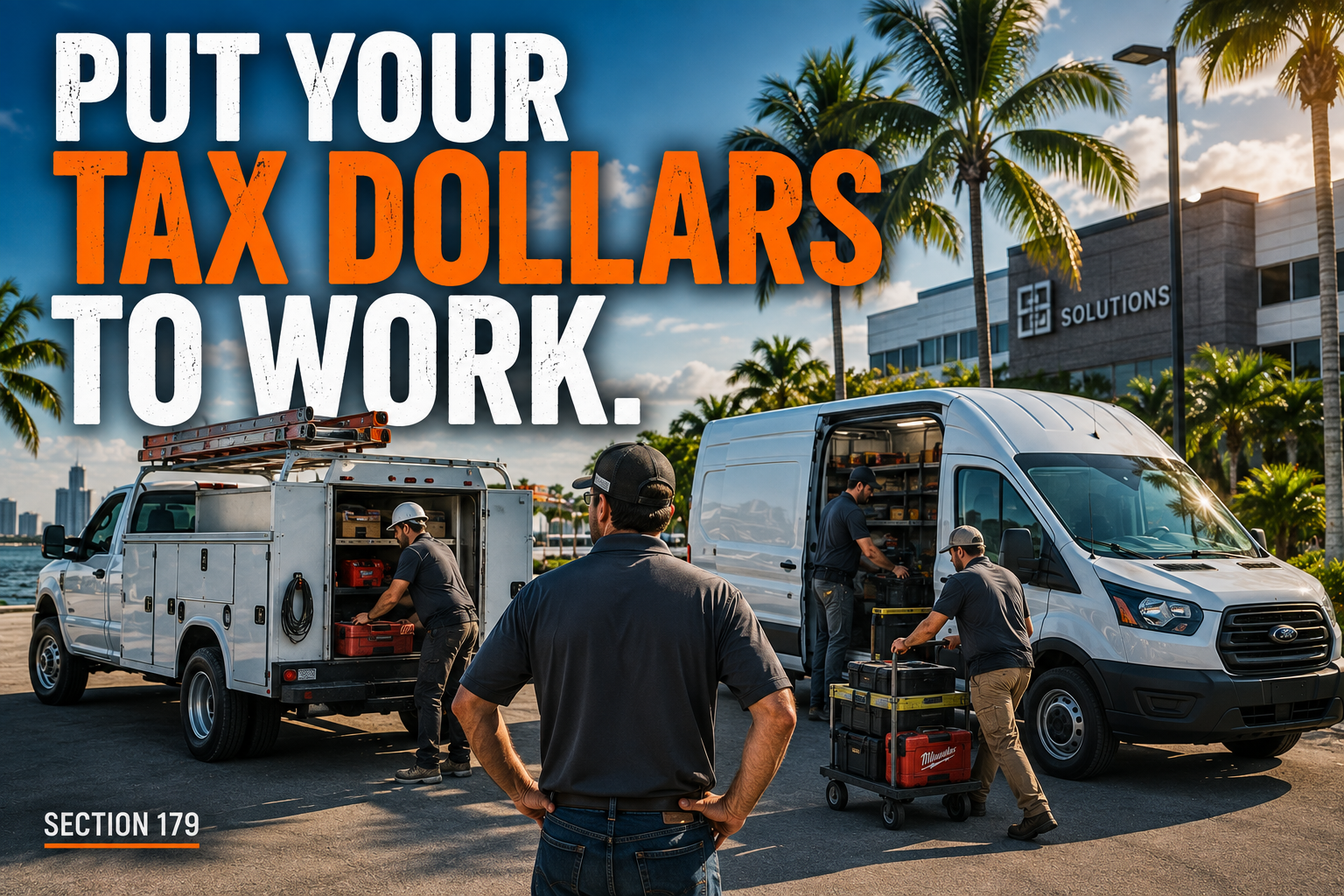
Local Operational Advantages: Navigating Gulf Coast Service Routes with a Two-Truck Fleet
Operating a trade business in Southwest Florida presents specific geographical challenges. A two-truck fleet allows trade companies to establish strategic territorial routes, reducing transit time and increasing daily productivity.
Coastal & Barrier Islands
Island routes such as Anna Maria Island, Longboat Key, and Siesta Key feature bottlenecked causeways and heavy tourist traffic. Dedicating one vehicle specifically to coastal routes eliminates cross-bridge transit delays for your main mainland crew.
I-75 Inland Growth Corridors
Fast-growing communities in East Manatee and Sarasota counties--including Lakewood Ranch, Parrish, and North Port--require consistent daily presence. Operating a dedicated inland truck ensures fast response times for new residential developments.
How to Test Fleet Expansion Risk-Free Before Committing to a Purchase
If you are close to the financial decision point but want to minimize risk, execute a 30-day operational test. Sub-contract peak transport loads temporarily or hire a temporary lead technician to handle overflow work using a secondary leased unit. Track the precise billing revenue generated by this overflow capacity.
Analyze your job costing data carefully: if the temporary overflow crew generates consistent gross margin that easily covers a monthly vehicle carrying cost, your business model is proven. Reviewing Recently Sold Vehicles gives business owners an idea of popular, proven vehicle configurations chosen by other local businesses. Explore real-world examples of local fleet expansion by browsing our Recent Deliveries showcase to see how other trade contractors successfully added their second rigs. Ready to Add Your Next Work Truck? Explore Commercial Vehicles at SRQ Auto LLC
When the financial indicators align--unmet market demand, an 80%+ fleet utilization rate, and a solid job backlog--expanding from one work truck to two is the most rewarding growth move your company can make. At SRQ Auto LLC, we specialize in providing businesses across Bradenton, Sarasota, and nationwide with dependable, work-ready pre-owned commercial vehicles backed by our Job Ready Promise.
Every commercial vehicle in our inventory undergoes a rigorous mechanical inspection and reconditioning process so it is ready to earn revenue for your business from day one. Whether you require a utility bed service truck, a heavy-duty pickup, a cargo van, or a specialized hauler, our team provides transparent vehicle histories and flexible commercial financing options tailored to your business goals.