
That Cheap Used Work Truck Might Cost You More Than You Think
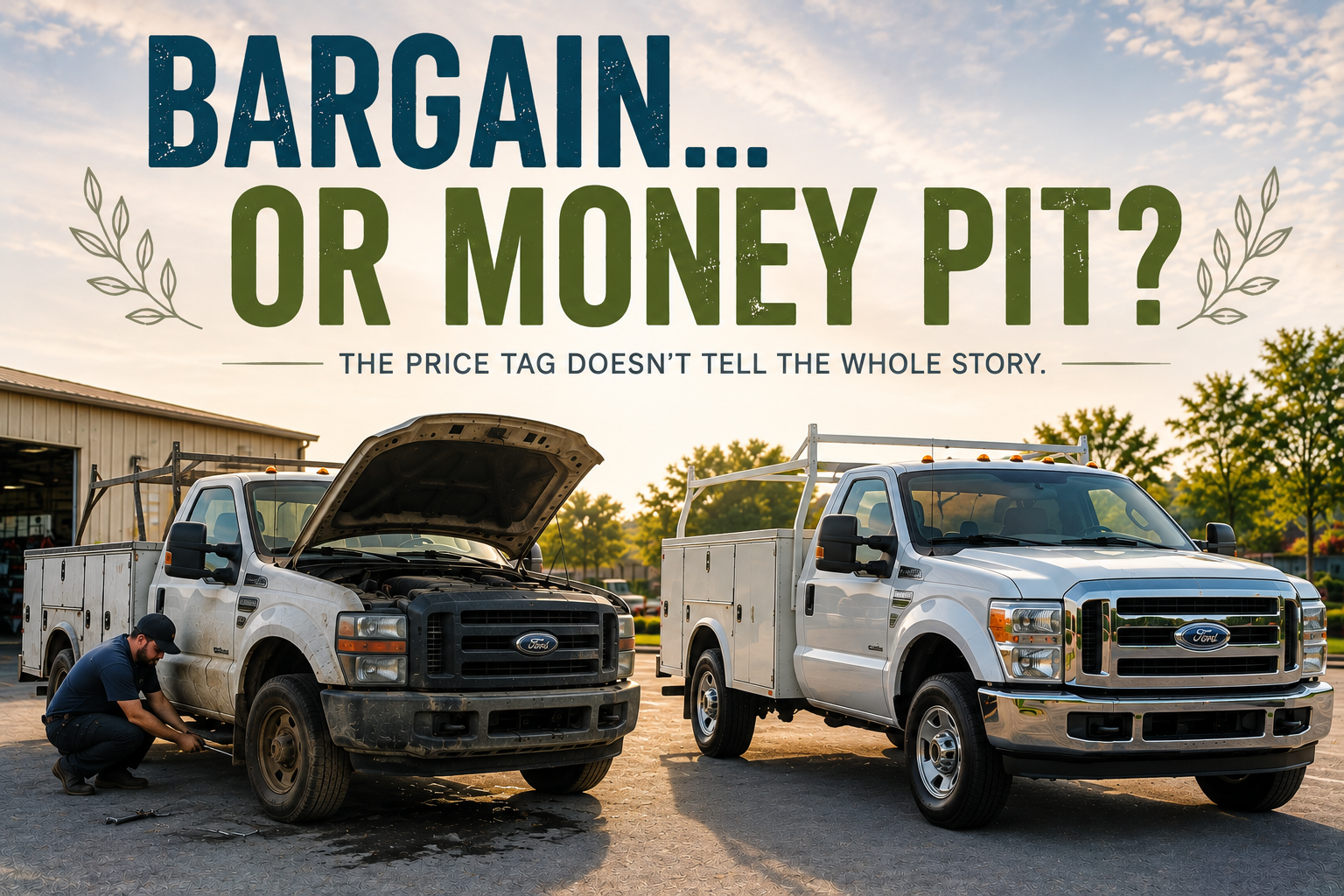
Evaluating a cheap used work truck requires analyzing its total cost of ownership by inspecting frame rail integrity, checking engine blow-by, scanning Electronic Control Module run hours, verifying factory heavy-duty option codes, and obtaining a professional pre-purchase inspection before signing. A low sticker price quickly disappears if deferred maintenance or structural corrosion requires thousands of dollars in immediate mechanical repairs.
When comparing two pre-owned work trucks of the same year, trim, and mileage, the price tag on the windshield rarely reflects true commercial value. On the outside, two trucks may share matching paint, identical cab configurations, and clean bed liners. Beneath the surface, one truck may be configured as a standard light-duty commuter while the other contains specialized commercial equipment built for severe-duty hauling.
For trade business owners and fleet operators, purchasing a work truck is an investment in daily operational uptime. A truck that appears to be a bargain becomes an immediate business liability if it lacks the cooling capacity or axle strength required for heavy trailers. Paying a fair price for a vehicle equipped with factory-upgraded severe-duty components saves thousands of dollars in commercial retrofits and drivetrain repairs over the life of the asset.
To inspect work-ready commercial vehicles in person or speak with our sales staff, visit our showroom location on 1st Street or reach our team directly at (941) 214-2231 to verify vehicle build specifications before making a purchase decision.
Table of Contents
- Why Can the Cheapest Used Work Truck End Up Being the Most Expensive One You Buy?
- What Hidden Mechanical Problems and Drivetrain Wear Are Most Common in Bargain Trucks?
- Why Is Frame Inspection and Structural Integrity So Critical on a Work Truck?
- What Specific Items Should Be Included on a Used Work Truck Pre-Purchase Inspection Checklist?
- Common Questions About Used Work Truck Inspection and Total Cost of Ownership
- How to Secure a Job-Ready Commercial Truck at SRQ Auto LLC
Why Can the Cheapest Used Work Truck End Up Being the Most Expensive One You Buy?
A bargain-priced used work truck often becomes the most expensive option because deferred mechanical maintenance, hidden chassis corrosion, worn consumables, and undisclosed damage can require $5,000 or more in immediate repairs while causing costly job-site downtime.
To calculate the true Total Cost of Ownership (TCO) for a commercial work truck, buyers must look beyond the initial purchase price. The complete TCO formula combines the upfront purchase price, interest charges, fuel costs, insurance premiums, scheduled maintenance, anticipated immediate repairs, and lost revenue from vehicle downtime, minus the estimated future resale value:
$$\text = \text{Purchase Price} + \text + \text + \text + \text + \text{Immediate Repairs} + \text{Downtime Losses} - \text{Resale Value}$$
Industry maintenance studies show that commercial pickups average about $0.20 per mile in maintenance and repair costs over their operational lifecycle. For a high-mileage work truck running 100,000 to 130,000 miles annually, routine upkeep and wear-item replacements easily total $20,000 to $26,000 per year. When an owner defers necessary service to keep an asking price artificially low, the buyer inherits those accumulated expenses on day one.
Bringing a neglected commercial truck back to job-ready condition involves substantial baseline costs:
- Six commercial-grade load range E tires: $1,200 to $1,800 installed
- Heavy-duty brake rotors, pads, and caliper service across both axles: $800 to $1,400
- Front suspension reconditioning including ball joints, tie rod ends, and bushings: $1,000 to $2,000
- Complete drivetrain fluid exchange including synthetic engine oil, transmission fluid, transfer case fluid, and differential gear lube: $500 to $900
For contractors hauling equipment in Sarasota along major commercial corridors, a truck priced higher that already features fresh commercial tires, serviced brakes, and documented maintenance logs delivers a lower operational cost from the first day on the job site. Business owners can explore our pre-owned commercial vehicle inventory to compare fully reconditioned, work-ready options.
What Hidden Mechanical Problems and Drivetrain Wear Are Most Common in Bargain Trucks?
Bargain work trucks commonly conceal severe valvetrain wear from extreme engine idle time, improper differential gear ratios for heavy towing, transmission slippage under load, and internal engine blow-by caused by worn piston rings.
Two trucks built on the exact same assembly line can leave the factory with drastically different towing capabilities based on optional equipment codes. The most significant hidden mechanical value driver is the differential axle ratio. A truck equipped with a numerical higher 3.73 rear axle ratio or 4.10 rear axle ratio delivers significantly more mechanical advantage and low-end pulling torque than a twin fitted with a fuel-economy-focused 3.31 rear axle ratio. While both engines produce identical horsepower, the truck with the higher gear ratio safely pulls heavier trailers without overheating the transmission.
When commercial buyers examine two trucks side-by-side on our lot, our sales staff shows them the engine run-hour counter on the dashboard before opening the hood. Commercial pickups often spend extended hours idling on job sites to run climate control or power tools. One hour of engine idling generates mechanical wear on valve trains, oil pumps, and emission systems roughly equal to 30 miles of highway driving. A truck with lower odometer mileage but high idle hours often carries twice as much internal engine wear.
Key severe-duty factory packages that command a legitimate value premium on the pre-owned market include:
- Factory towing package featuring upgraded engine oil coolers, auxiliary transmission fluid coolers, high-capacity radiators, and a heavy-duty alternator
- Integrated trailer brake controller built directly into the dashboard and electronic stability system for smooth brake modulation
- Limited-slip or locking rear differential providing mechanical traction on sand, mud, and wet loading ramps
- Heavy-duty payload package with reinforced rear leaf springs, upgraded rear axle housings, and commercial wheels
Testing for internal engine wear requires checking for blow-by. With the engine idling at operating temperature, removing the oil filler cap and checking for heavy smoke or pulsing pressure reveals whether worn piston rings or cylinder liners are pushing crankcase gases past the seals.
Why Is Frame Inspection and Structural Integrity So Critical on a Work Truck?
Frame inspection is critical because severe corrosion, cracks, or non-factory welds compromise a work truck's structural capacity, rendering it unsafe for heavy towing and leading to repair costs that can reach $12,000 or more.
In coastal environments, frame rust represents a primary hidden cost driver. Extensive rust perforation weakens structural steel, compromises suspension mounting points, and degrades leaf spring shackles. On heavy-duty trucks, original manufacturer payload and towing ratings only apply if the frame rails and crossmembers remain structural and undamaged. Localized frame repairs typically cost $800 to $2,500, while full frame replacement costs $5,000 to $12,000 or more depending on chassis complexity.
Coastal moisture and salt air in Fort Myers accelerate undercarriage scaling on trucks used for marine construction or utility work. Furthermore, trucks exposed to high water carry severe risks of flood contamination. In Florida, flood-damaged vehicles are branded on the title as Water Damage, Salvage, or Total Loss, which permanently depresses market value by 20% to 40% and restricts conventional commercial financing.
Physical indicators of unrecorded flood exposure include:
- Silt, fine sand, or mud packed deep inside frame rail channels and crossmember tubes
- Corrosion on interior seat tracks, wire harness connectors beneath carpets, and under-dash junction blocks
- Persistent musty odors inside the cab or water lines inside door panels
- Corrosion on aluminum engine accessories and alternator housings
What Specific Items Should Be Included on a Used Work Truck Pre-Purchase Inspection Checklist?
A thorough commercial work truck pre-purchase inspection checklist must evaluate documentation, engine health, chassis structure, drivetrain engagement, and electronic diagnostics to uncover hidden mechanical defects before purchase.
Consumer and industry buying guides recommend budgeting $80 to $150 for an independent pre-purchase inspection. Catching structural rust, transmission slipping, or head gasket leaks before finalizing a sale protects working capital and gives buyers strong leverage during price negotiations.
| | COMMERCIAL WORK TRUCK INSPECTION PROTOCOL | | --- | | 1. DOCUMENTATION & IDENTITY | | - Verify VIN consistency across frame, door, and title | | - Confirm clean title history, excluding salvage or flood branding | | - Examine maintenance logs and yearly DOT compliance records | | 2. COLD START & ENGINE INTEGRITY | | - Perform cold start to assess exhaust color and smoke | | - Check oil for milky contamination suggesting gasket failure | | - Monitor blow-by pressure at the filler neck during idle | | 3. STRUCTURAL & CHASSIS EVALUATION | | - Scan frame for welds, cracks, or deceptive undercoating | | - Assess brake component condition and surface scoring | | - Review suspension components like ball joints and leaf springs | | 4. DRIVETRAIN & PERFORMANCE TESTING | | - Validate 4WD/low-range transfer case engagement | | - Assess transmission performance under load and acceleration | | - Check differential seals and monitor for abnormal noise | | 5. ELECTRONIC & ECM DIAGNOSTICS | | - Extract active and stored diagnostic trouble codes (DTCs) | | - Validate engine hours relative to total vehicle mileage | | - Match door jamb specifications with installed towing gear |Business owners preparing to purchase a pre-owned commercial vehicle can complete our streamlined process by submitting an online credit application to secure pre-approval for flexible financing terms.
Common Questions About Used Work Truck Inspection and Total Cost of Ownership
Q: How do I verify whether a truck has a factory tow package versus an aftermarket hitch?
Check the vehicle option code sticker located on the door jamb or inside the glove box for original factory towing codes. A genuine factory tow package includes an integrated dashboard trailer brake controller, auxiliary transmission fluid cooling lines routed to the radiator, a high-capacity alternator, and a factory-wired seven-pin harness plug rather than spliced wiring.
Q: How does engine idle time affect total engine wear compared to odometer mileage?
Commercial work trucks often idle on job sites for hours to power climate systems or equipment. One hour of idling generates mechanical wear on valvetrains, oil pumps, and emission controls equal to approximately 30 miles of highway driving. Checking ECM run hours provides an accurate picture of total engine usage that odometer mileage alone cannot supply.
Q: What options exist if a pre-purchase inspection reveals minor wear on consumable parts?
When an inspection reveals routine wear on tires, brakes, or shocks, buyers can use those findings to negotiate a lower purchase price or request that the dealer replace worn components prior to delivery. This ensures the vehicle enters service in job-ready condition without immediate out-of-pocket maintenance costs. You can review our dealership background and job-ready standards to learn how we evaluate our commercial fleet.
Q: Can a branded title prevent my business from obtaining commercial financing?
Yes, title brands such as Salvage, Rebuilt, or Water Damage permanently reduce market value by 20% to 40%. Most commercial lenders refuse to finance branded-title vehicles, and commercial insurance carriers often restrict coverage to basic liability policies, leaving your business exposed to total financial loss in an accident.
Q: How do factory axle ratios impact real-world commercial performance?
A numerical higher axle ratio, such as a 3.73 rear axle ratio or 4.10 rear axle ratio, provides greater torque multiplication at low engine speeds. This allows heavy-duty pickups and specialized vehicles, like those found in our pre-owned box truck selection, to accelerate smoothly with heavy cargo without overheating the transmission fluid.
How to Secure a Job-Ready Commercial Truck at SRQ Auto LLC
Finding a dependable work truck requires choosing a vehicle with transparent history, verified mechanical specifications, and sound structural integrity. Paying a fair price for a thoroughly reconditioned truck equipped with factory severe-duty options protects your working capital from unexpected breakdown expenses and keeps your crew productive.
At SRQ Auto LLC, every commercial truck in our inventory undergoes a multi-point structural and mechanical evaluation backed by our Job Ready Promise. We provide transparent vehicle history reports, detailed option code verification, and competitive financing tailored to independent trade professionals and fleet operators.
To inspect our current lineup of commercial pickups, cargo vans, and utility vehicles, visit our Bradenton showroom or call our team at (941) 214-2231. You can also explore flexible payment options through our commercial lending options to secure the right work truck for your business today.
© 2026 SRQ Auto LLC. All rights reserved.
