Ford Transit Custom Payload and Fuel Consumption: The Direct Numbers for Work Use
For commercial operators, electrical contractors, independent plumbers, and fleet managers across Bradenton and Manatee County, selecting a commercial work van comes down to two bottom-line numbers: payload capacity and fuel efficiency. The Ford Transit Custom has consistently set the benchmark in the mid-size commercial van segment by striking a precise balance between heavy-hauling capability and manageable daily operating costs.
In standard commercial configurations, the Ford Transit Custom provides a maximum net payload capacity ranging from 2,800 to over 3,200 lbs (1,300 to 1,450 kg) depending on the gross vehicle mass (GVM) rating, roof height, and wheelbase length selected. When fitted with Ford's advanced 2.0L EcoBlue turbodiesel engines or EcoBoost Hybrid powertrains, the Transit Custom achieves highway fuel economy equivalents of 32 to 38 MPG(approx. 6.5 to 7.5 L/100 km), while the fully electric E-Transit variant delivers an EPA-estimated driving range of 126 to 159 miles per full charge. If you are evaluating options in our Used Cargo Van Inventory, understanding these core specs ensures you invest in a workhorse that maximizes profit while keeping route costs low. What Payload Capacity Does the Ford Transit Custom Deliver Across Trim Levels?
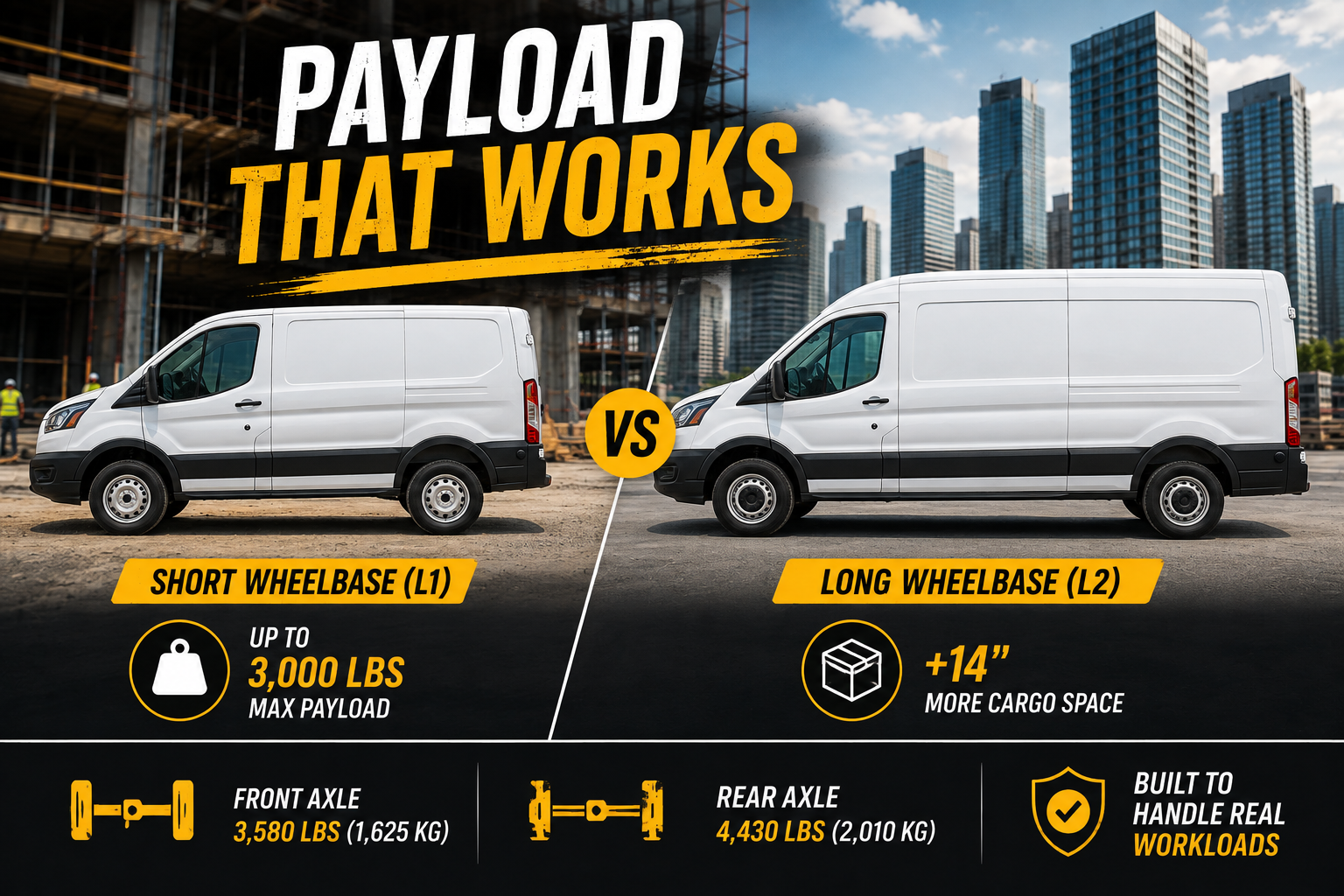
Gross Vehicle Mass (GVM) ratings dictate exactly how much weight your van can carry legally and safely, including vehicle body, fuel, driver, crew, interior racking, and cargo payload. Ford categorizes the Transit Custom into distinct GVM tiers, typically ranging from 2,800 Series (approx. 2.8 metric tons GVM) up to 3,400 Series (3.4 metric tons GVM).
Short Wheelbase (L1) vs Long Wheelbase (L2): The L1 configuration features a compact 115-inch wheelbase ideal for nimble maneuvering in tight job sites, delivering a peak net payload up to 3,000 lbs in maximum GVM trims. The extended L2 chassis adds roughly 14 inches to the cargo floor; while this increases floor area and cubic volume, the slight addition of curb weight reduces maximum payload allowance by approximately 100 to 150 lbs compared to an equivalent L1 variant.
Axle load ratings are equally vital for tradespeople hauling heavy specialized tools or bulk materials like tile, concrete, or copper pipe. The front axle rating typically sits around 3,580 lbs (1,625 kg) while the heavy-duty rear axle handles up to 4,430 lbs (2,010 kg), preventing uneven sagging and maintaining steering control under maximum load conditions.
Passenger vs. Cargo Cab Trim Impact: Choosing a Double Cab-in-Van (DCiV) or Crew Cab trim adds a second row of seating for up to 6 crew members. However, the extra seats, glass, and interior trim add 250–350 lbs of vehicle dead weight, reducing net cargo hauling capacity accordingly. For pure hauling efficiency, standard panel cargo configurations remain the premier choice.
Real-World Fuel Economy and Engine Performance for Daily Work Routes
In real-world driving conditions across Bradenton, Palmetto, and Sarasota, fuel consumption varies based on payload weight, traffic patterns, and engine design. The backbone of the Transit Custom fleet is the 2.0-liter EcoBlue turbodiesel engine, offered in multiple power outputs (105 HP, 130 HP, 170 HP, and 185 HP).
2.0L EcoBlue Diesel Performance: Under light-to-moderate cargo loads, the 130 HP and 170 HP variants consistently return between 32 and 38 MPG on highway stretches such as I-75 or US-301. In dense urban stop-and-go driving along Tamiami Trail, expectations shift closer to 24–28 MPG equivalent. High-torque output at low RPMs (up to 305 lb-ft of torque at 1,750 RPM) allows the diesel engine to pull heavy loads effortlessly without excessive gear-hunting.
EcoBoost Mild Hybrid (mHEV) & Plug-in Hybrid (PHEV): Mild-hybrid EcoBlue configurations utilize a 48-volt lithium-ion battery and starter/generator to capture energy during deceleration. This system assists the engine during heavy acceleration, reducing stop-and-go fuel consumption by up to 8–12% on urban delivery routes.
For business owners seeking maximum local fuel savings, plug-in hybrid variants pair a 1.0L EcoBoost engine with an electric motor, offering over 30 miles of zero-emission electric range before switching seamlessly to gas power. Learn more about how SRQ Auto LLC sources commercial vehicles built for operational longevity by visiting our About Us page. How Transit Custom Payload Compares to What is the Overall Best Cargo Van for Commercial Use
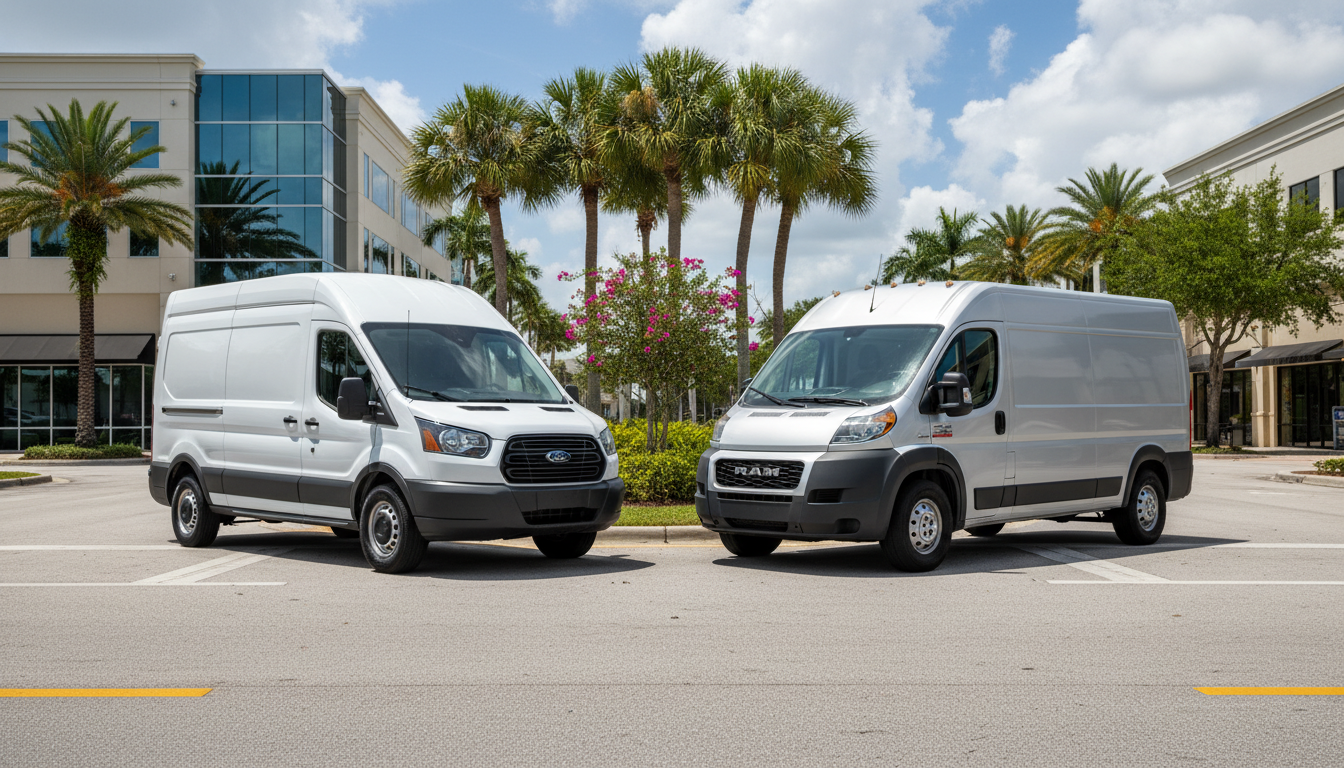
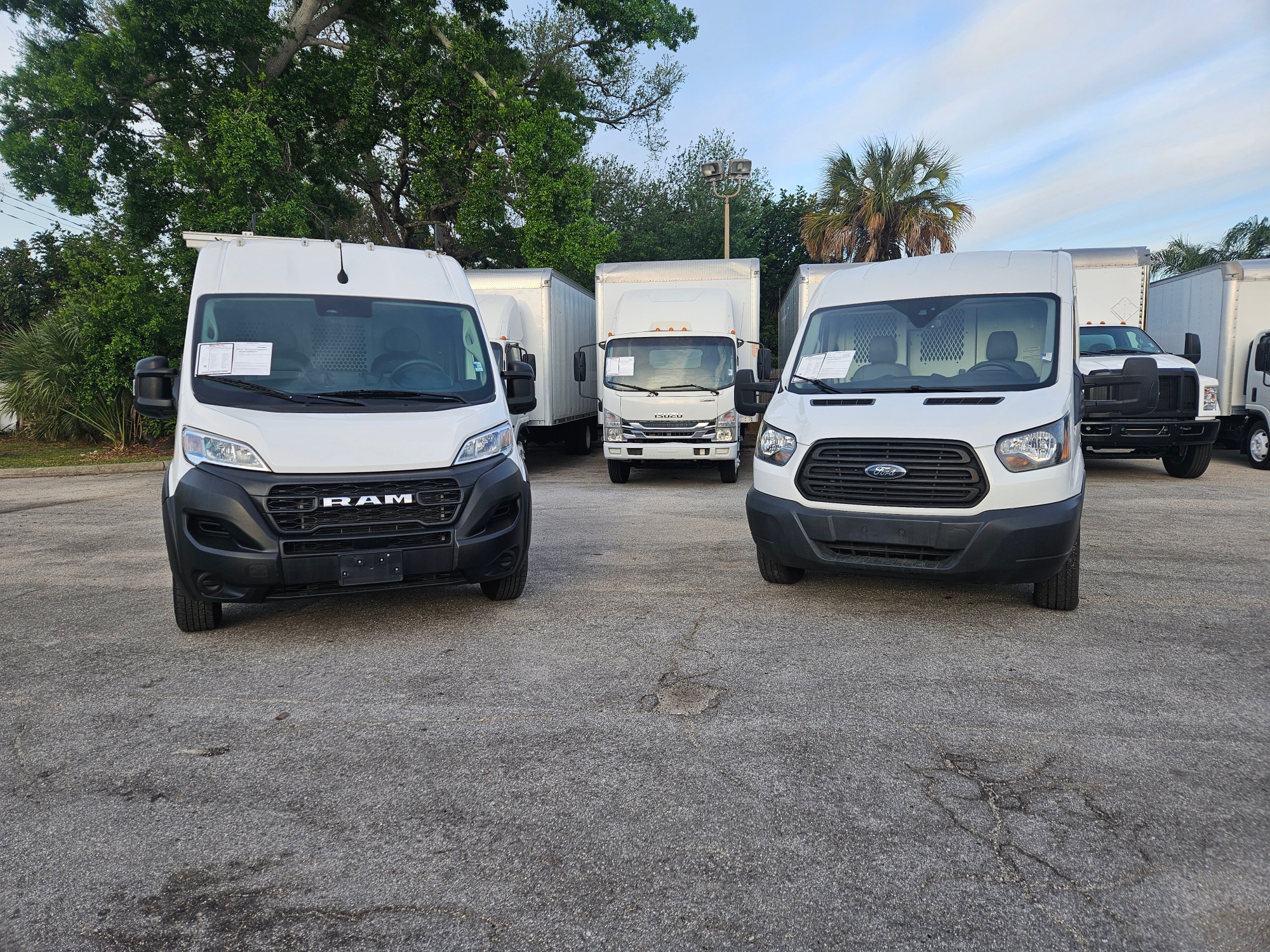
Determining what is the overall best cargo van for commercial use requires weighing payload density against total cubic cargo volume. Full-size vans like the standard Ford Transit, Ram ProMaster, and Mercedes-Benz Sprinter offer massive interior height and cubic capacity, but mid-size vans like the Transit Custom excel when weight density matters more than raw space.
As shown above, the Transit Custom matches full-size entry vans in net payload allowance while delivering significantly superior fuel efficiency and tighter turning circles. For plumbers, electricians, and HVAC technicians who carry heavy tools rather than voluminous light boxes, the Transit Custom offers unmatched operational economy.
Why Cargo Width Between Wheel Wells Important for Work Vans and Fleet Load Efficiency
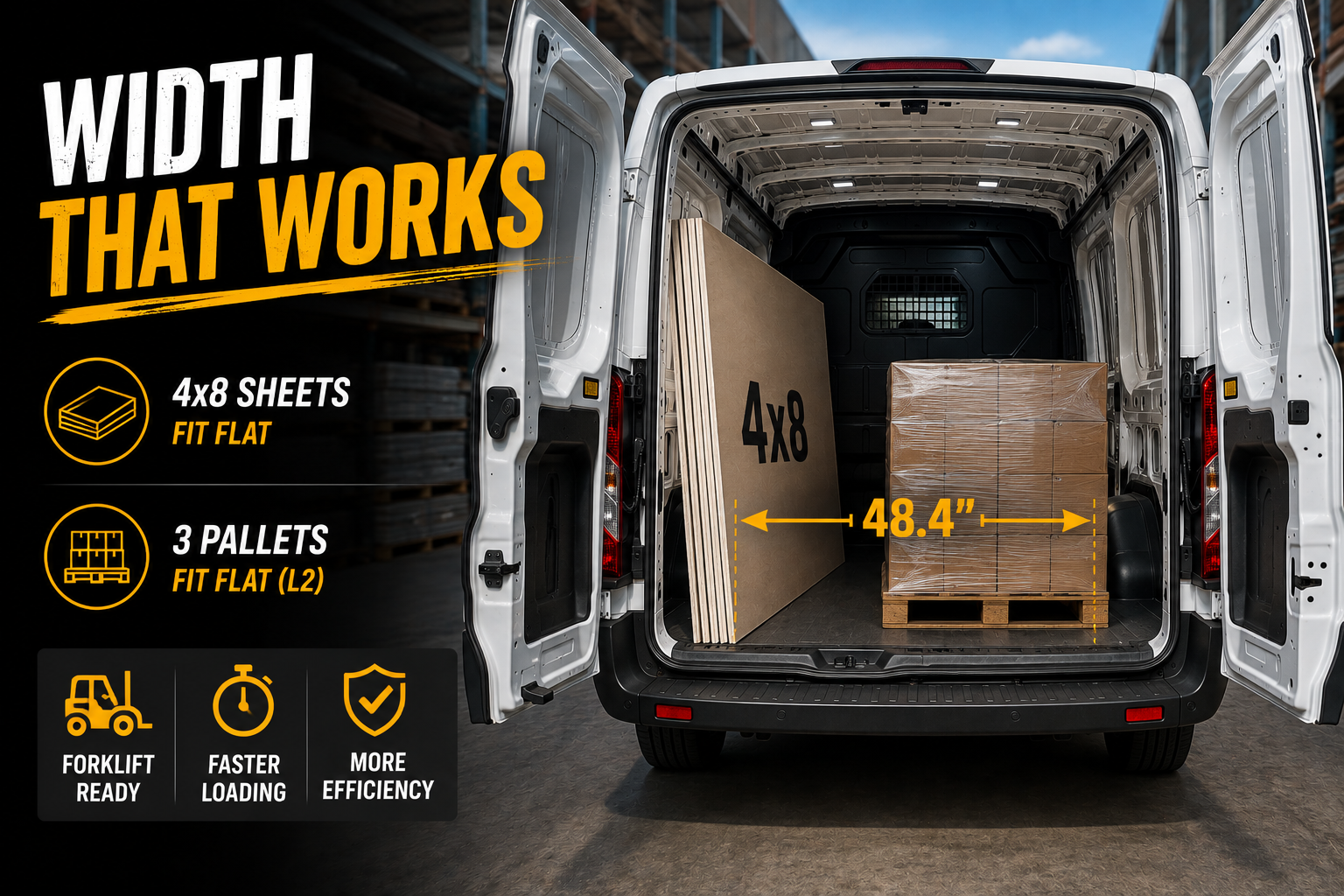
Standard Sheet Loading
Why is cargo width between wheel wells important for work vans? Building materials like 4x8 drywall, plywood, and insulation boards are manufactured to standard 48-inch widths. The Transit Custom provides 48.4 inches (1,268 mm) of clear width between rear wheel arches, allowing 4x8 sheets to lie completely flat on the floor without angled tipping or sheet damage.
Pallet Handling
For logistics and courier operators, fitting standard Euro-pallets (1,200 x 800 mm) or standard US pallets (48 x 40 inches) straight into the rear cargo bay via forklift eliminates manual loading. The Transit Custom easily accommodates up to three Euro-pallets flat on the floor in L2 configurations.
Electric Work Vans: What is the Driving Range of the Ford E-Transit on a Full Charge?
Commercial fleet electrification is accelerating rapidly across Southwest Florida. A frequent question contractors ask is: What is the driving range of the Ford E-Transit on a full charge? Equipped with a standard 68 kWh usable capacity lithium-ion battery pack, the Ford E-Transit delivers an EPA-estimated driving range of up to 126 miles for low-roof models (and extended range ratings reaching up to 159 miles on select European urban cycle configurations).
According to Ford Telematics data, the average commercial work van in the United States travels roughly 74 miles per day. A 126-mile daily range provides a comfortable safety buffer for urban service calls across Bradenton, Lakewood Ranch, and Sarasota without mid-shift charging delays.
Pro Power Onboard Generator Functionality: One of the E-Transit's biggest productivity features is Pro Power Onboard, providing up to 2.4 kW of 120V auxiliary power directly from the main traction battery. Contractors can power circular saws, battery battery chargers, or specialized diagnostic equipment at the job site without hauling heavy gas generators.
DC fast-charging capability allows the E-Transit to charge from 15% to 80% state of charge in approximately 34 minutes using a 115 kW high-speed charger. Exploring commercial electric or conventional powertrains? Review our flexible Commercial Financing options to get your business moving. Which Work Vans Are Best for Contractors Who Need Maximum Cargo Volume?
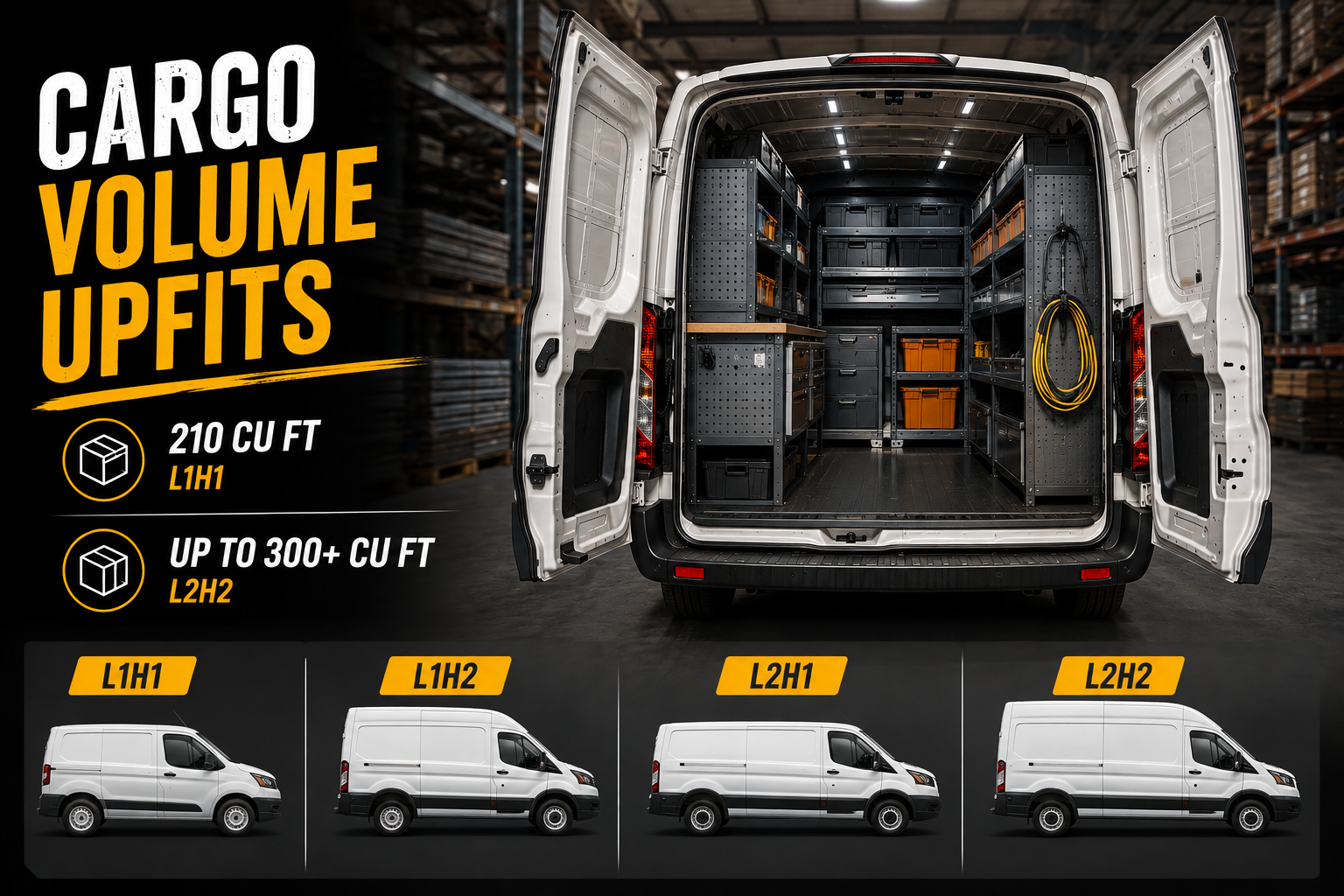
When asking which work vans are best for contractors who need maximum cargo volume, cubic capacity and interior layout customization take center stage. The Ford Transit Custom is available in four primary dimensional bodies: L1H1 (short wheelbase, low roof), L1H2 (short wheelbase, high roof), L2H1 (long wheelbase, low roof), and L2H2 (long wheelbase, high roof).
Cubic Volume Breakdown: Standard L1H1 models provide approximately 210 cubic feet (6.0 cu meters) of space. Upgrading to the high-roof L2H2 variant expands usable volume up to 293–300+ cubic feet (8.3 cu meters), allowing workers up to 5 ft 10 in tall to stand upright inside the rear cargo box during upfitting or inventory sorting.
How Van Reliability Affects Downtime Risk for Self-Employed Owners
For independent contractors and self-employed tradespeople, a service van is not just transportation—it is a mobile office and primary tool workbench. Understanding how van reliability affects downtime risk for self-employed owners is crucial to protecting your bottom line. An unscheduled mechanical breakdown means canceled client appointments, lost labor revenue averaging $500 to $1,500 per day, and potential damage to your professional reputation.
At SRQ Auto LLC, every pre-owned commercial vehicle undergoes a comprehensive multi-point inspection, full reconditioning, and adherence to our Job Ready Promise before hitting the lot. To further safeguard your trade, explore our comprehensive Commercial Warranty Options built specifically to cover high-mileage commercial duty cycles. Have questions about mechanical protection for your work fleet? Call us at (941) 214-2231 today to speak with our commercial vehicle experts. Which Van Is Easier to Drive in Tight City Spaces, Transit or ProMaster?
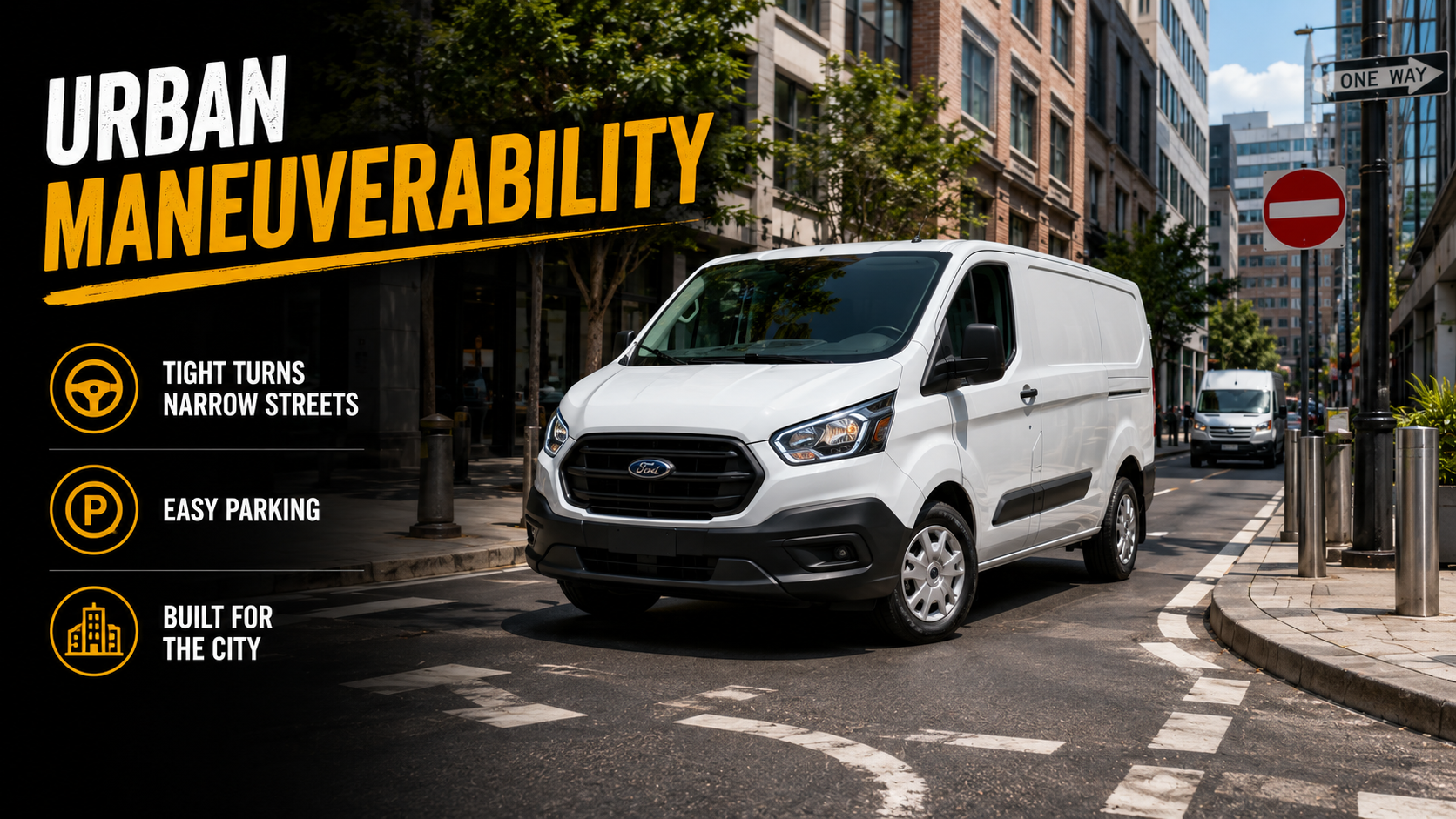
Turning Circle & Maneuvers
When evaluating which van is easier to drive in tight city spaces, Transit or ProMaster, steering geometry and wheel positioning are critical. The Ford Transit Custom delivers a curb-to-curb turning radius as tight as 35.8 ft, making U-turns on narrow downtown Bradenton streets seamless compared to wider full-size vans.
Driver Ergonomics & Visibility
The Ford Transit Custom provides an car-like seating angle, power-assisted steering, and optional 360-degree camera system. While the Ram ProMaster's cab-forward seating offers good forward sightlines, its rigid beam rear axle creates a firmer ride on uneven pavement.
Evaluating Best Work Vans for Floridian Trades: Cooling, Corrosion, and Coastal Driving
Operating commercial work vans in Southwest Florida presents unique environmental challenges. Between sub-tropical summer heat waves, extreme humidity, afternoon downpours, and corrosive salt air along coastal regions like Anna Maria Island and Longboat Key, fleet managers must choose vehicles engineered for resilience.
Air Conditioning Performance: Summer cab temperatures in Bradenton can quickly surpass 120°F when parked in direct sunlight. The Transit Custom features high-capacity climate control compressors and optional rear-cabin auxiliary AC units, essential for keeping crews cool and productive during extended summer work shifts.
Corrosion Protection & Chassis Longevity: Constant exposure to coastal salt air accelerates rust on underbody frame rails, leaf springs, and lower door rocker panels. Modern Ford Transit Custom vans utilize double-sided galvanized steel body panels and e-coat rust protection barrier coatings to maintain structural integrity.
What Buying Options Are Available When Shopping for a Work Van Near Bradenton, FL?
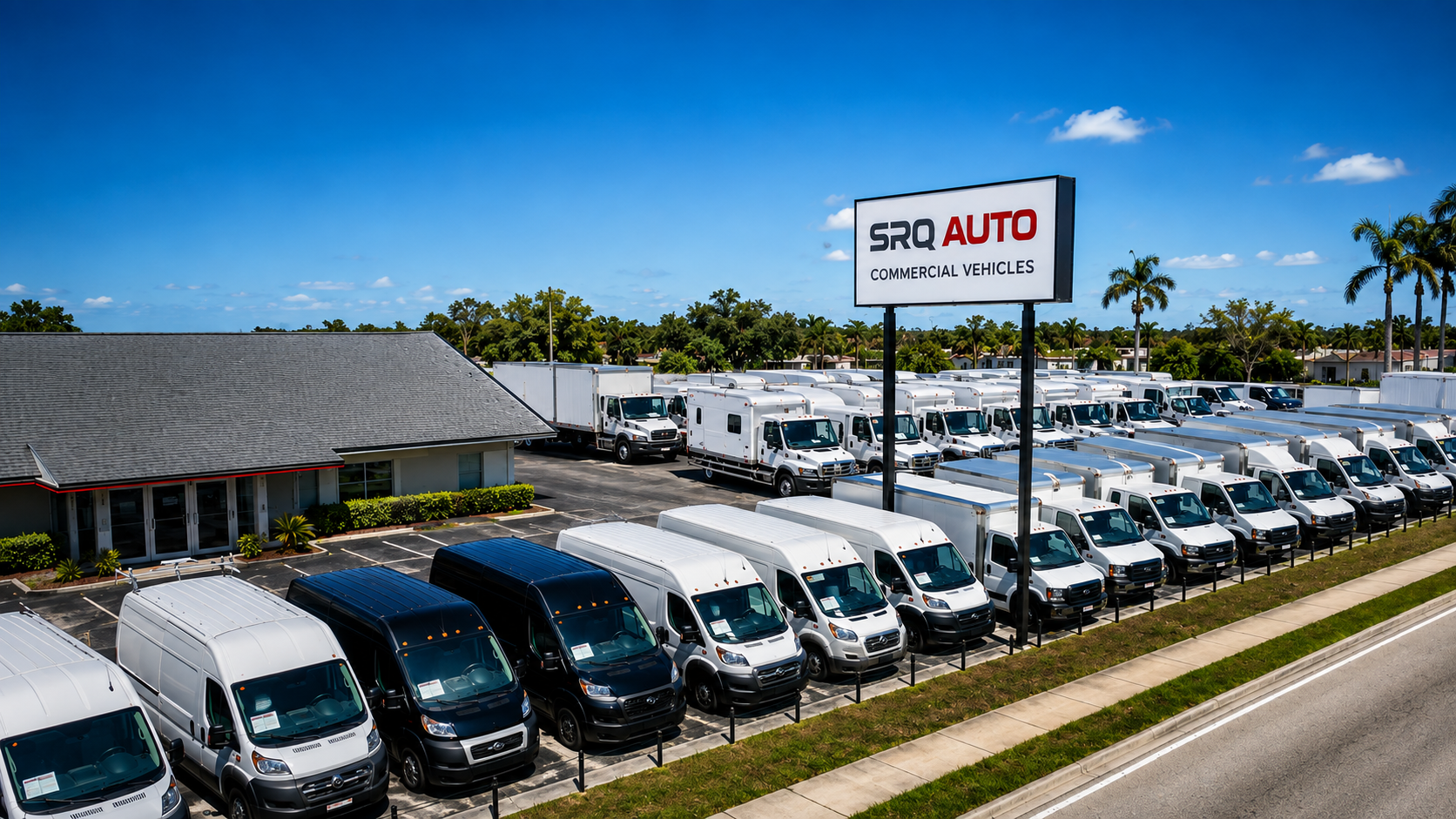
When evaluating what buying options are available when shopping for a work van near Bradenton, FL, local trade owners need transparency, fast turnarounds, and vehicle reliability. Located conveniently at 2212 1st St, Bradenton, FL 34208, SRQ Auto LLC specializes exclusively in work-ready commercial inventory.
Our dealership provides fair trade-in evaluations, localized vehicle sourcing, and transparent vehicle history reports on every unit. Get Directions to SRQ Auto LLC to test drive work-ready vans today. Commercial Financing, Fleet Leasing, and Tax Deductions at SRQ Auto LLC
Financing a commercial work van requires structured credit options tailored to business cash flow. SRQ Auto LLC partners with leading commercial lenders to offer competitive interest rates, customized repayment schedules, and fleet vehicle financing for businesses of all sizes.
Section 179 Tax Savings: Small business owners purchasing commercial vehicles above 6,000 lbs GVWR may qualify for immediate Section 179 expense deductions, allowing you to write off up to 100% of the purchase price in the taxable year the vehicle is placed into service. Learn more on our Used Vehicle Tax Deductions page, review our Recent Deliveries, or complete an online Get Approved Now credit application. Find the Right Commercial Work Van at SRQ Auto LLC in Bradenton Today
Ready to upgrade your business fleet with a payload-maximizing, fuel-efficient commercial work van? At SRQ Auto LLC, we specialize exclusively in quality pre-owned commercial vehicles backed by our Job Ready Promise. With over 500 five-star Google customer Reviews and nationwide delivery capabilities, we help contractors and commercial business owners buy with absolute confidence. Visit our Bradenton showroom today or view our Recently Sold Vehicles to see what commercial inventory moves through our dealership every week.