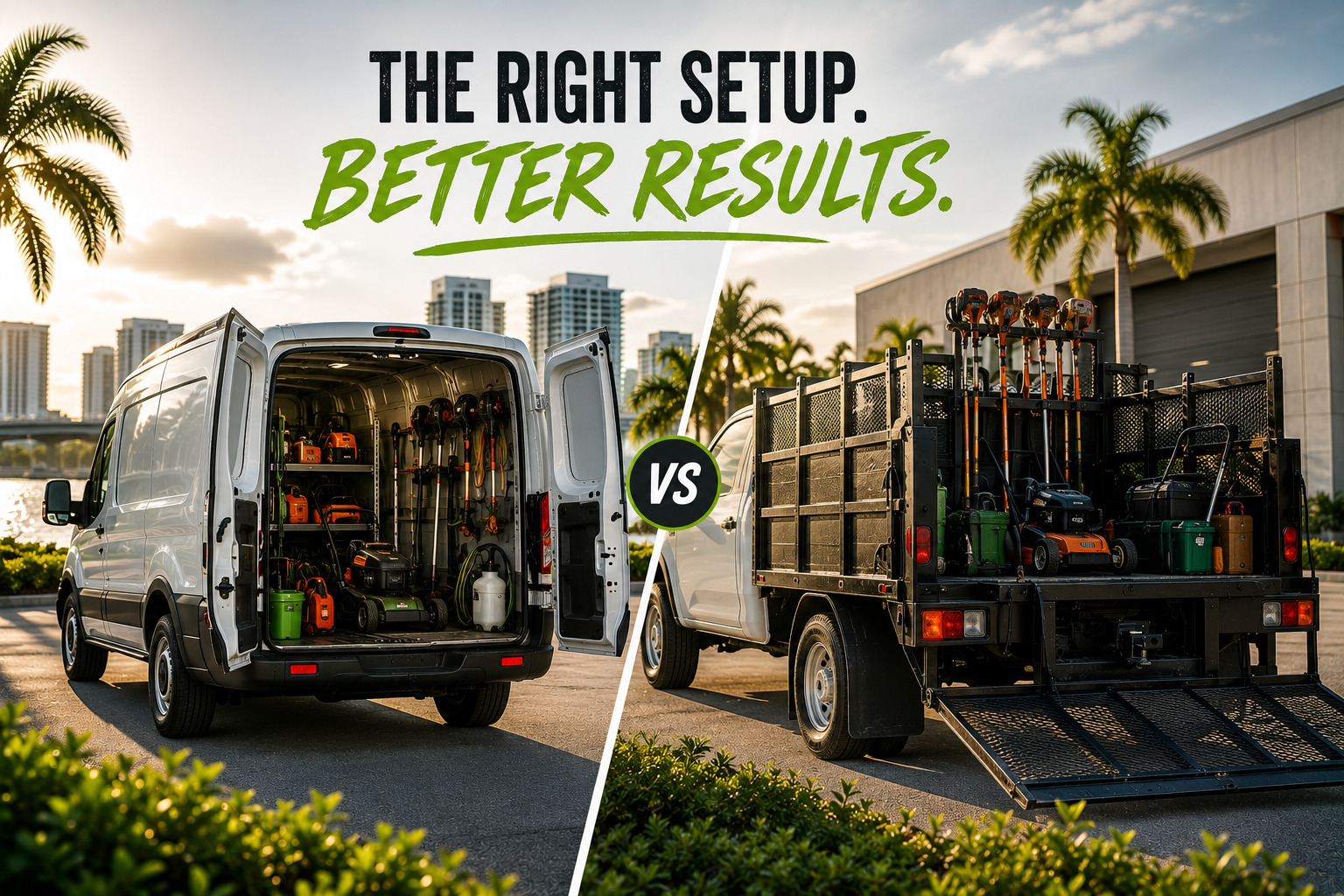
Landscape Dump vs. Dovetail Truck: Which One Fits Your Landscaping Business?

For a landscaping business, choosing between a dovetail landscape truck and a landscape dump truck comes down to one question: What does the truck need to do most often to make your crew productive?
If most of the day is spent moving mowers and lawn equipment from property to property, an integrated dovetail can simplify the operation. If the business routinely hauls mulch, soil, brush, clippings or debris, a hydraulic landscape dump may be the better tool.
The right answer is not based on which truck looks more impressive. It is based on the work that generates revenue for your business.
Browse SRQ Auto's current landscape trucks for sale.
What Is a Dovetail Landscape Truck?
A dovetail landscape truck is designed around transporting landscaping equipment. The body typically incorporates a rear dovetail or ramp system so crews can load and unload equipment such as zero-turn mowers, stand-on mowers, walk-behind equipment and other lawn-care tools without towing a separate landscape trailer.
For route-based lawn maintenance businesses, that integrated design can reduce the number of separate pieces of equipment the company has to manage. The truck and equipment platform travel as one unit.
What Is a Landscape Dump Truck?
A landscape dump truck is built around hauling and unloading material. Its hydraulic dump body can be useful for mulch, soil, brush, clippings, debris and other loose material commonly handled by landscaping, property-maintenance and cleanup businesses.
The major advantage is not simply cargo space. It is the ability to hydraulically unload appropriate material instead of relying entirely on manual unloading.
Expert Perspective: Jessica Anderson
Jessica Anderson brings 21 years of automotive experience spanning administrative operations, commercial vehicle applications and helping customers match their business with the appropriate vehicle. Her experience includes KUVs, service bodies, shuttle buses, box trucks, dealership logistics and nationwide vehicle shipping.
For a landscaping company, the useful conversation starts with how the truck will spend its week. Is the crew primarily moving mowing equipment from stop to stop? Is it hauling material and debris? Does the company perform both maintenance and installation work? Where will the truck operate and how will it be loaded?
The right landscape truck should solve the work the business performs most often.
Choose a Dovetail Truck When Equipment Transport Is the Priority
A dovetail configuration deserves serious consideration when the business is centered on recurring lawn maintenance and equipment transport.
It may be particularly useful when crews regularly carry:
- Zero-turn or stand-on mowers
- Walk-behind mowers
- Trimmers and blowers
- Hand tools
- Fuel and jobsite equipment where properly secured and permitted
The integrated loading area can also eliminate the need to connect, park, maintain and maneuver a separate pull-behind landscape trailer for certain operations.
Choose a Landscape Dump When Material Handling Is the Priority
A landscape dump can make more sense when the truck spends a meaningful part of its day carrying material rather than primarily transporting mowing equipment.
Typical work can include:
- Mulch installation
- Soil and landscape material transport
- Brush and vegetation removal
- Clipping and yard-waste transport
- Property cleanup
- Landscape installation and renovation work
For these operations, the hydraulic dump function can be a core productivity feature rather than an occasional convenience.
Dovetail Truck vs. Truck and Trailer
Many landscaping companies begin with a pickup or work truck pulling a trailer. That setup can work extremely well and may remain the right choice for some businesses.
An integrated dovetail truck changes the operating equation. The equipment deck and truck become one vehicle, which can simplify parking, backing, storage and daily equipment loading in some environments.
A separate trailer, however, can offer flexibility because it can potentially be disconnected or paired with another tow vehicle. The right choice depends on route density, equipment size, parking, driver comfort and how the company manages its fleet.
Rather than assuming one approach always saves time, evaluate how your crews actually move through a normal day.
Can a Landscaping Business Need Both?
Yes. A growing landscaping company may eventually have different crews performing different work.
A maintenance crew may benefit from a dovetail truck built around mower transport, while an installation or cleanup crew may get more value from a landscape dump. In that situation, trying to make one vehicle perform every task can create compromises.
Fleet growth should follow the work. When different revenue streams require different equipment, specialized trucks can become more productive than forcing one configuration to handle everything.
Payload Matters More Than the Name on the Body
Neither “landscape dump” nor “dovetail” tells you how much a specific truck can carry.
Payload depends on the vehicle's ratings and completed weight. The body, ramps, hydraulic equipment, fuel, occupants, tools and accessories all contribute weight before cargo or landscaping equipment is added.
That means buyers should verify the specific truck's GVWR and configuration and understand how much usable capacity remains for the intended load.
A larger-looking landscape truck does not automatically mean you can legally or safely carry more material or equipment.
What Chassis Makes Sense for a Landscape Truck?
Landscape bodies can be installed on different commercial chassis, including conventional-cab trucks and low-cab-forward platforms such as the Isuzu NPR.
A conventional cab may feel familiar to drivers accustomed to pickups and work trucks. A cab-over design can offer excellent forward visibility and a compact overall footprint relative to the body length.
The best chassis depends on payload needs, body configuration, route environment, driver preference, service requirements and the work being performed.
Gas vs. Diesel for a Landscape Truck
Fuel type should be evaluated as part of the complete vehicle rather than treated as an automatic decision.
Consider expected annual mileage, route type, idle time, payload, maintenance practices, local service availability and how long the business expects to keep the truck.
For many used commercial buyers, the condition and maintenance history of the specific truck can be more important than choosing a powertrain based only on a general gas-vs.-diesel rule.
What Should You Inspect on a Used Dovetail Landscape Truck?
- Ramp and dovetail structure: Check condition, hinges, latches, welds and mounting points.
- Deck and flooring: Look for excessive wear, damage, corrosion or previous repairs.
- Equipment securement: Inspect tie-down points and verify they are appropriate for the equipment being carried.
- Body condition: Examine sides, gates and storage areas.
- Chassis: Evaluate mechanical condition, tires, brakes, steering and suspension.
- Previous use: Look for evidence of overloading, hard commercial use or poorly executed modifications.
What Should You Inspect on a Used Landscape Dump?
- Hydraulic system: Operate the dump and inspect for leaks, unusual noises and proper movement.
- Hoist and mounting points: Inspect visible structural components and attachment areas.
- Dump floor: Look for damage, corrosion, distortion and heavy wear.
- Sides and tailgate: Confirm gates, hinges and latches operate properly.
- Body condition: Look for previous repairs and signs of hard material handling.
- Chassis: Inspect the truck mechanically and consider how previous payload and work may have affected wear.
Why Reconditioning Matters on a Used Landscape Truck
Landscape trucks work in demanding environments. Dirt, moisture, grass, debris, equipment loading and repeated commercial use can take a toll on both the chassis and the body.
SRQ Auto's Job Ready process focuses on mechanical, functional and presentation needs identified on qualifying used commercial vehicles before they are offered to the next business.
Learn more about SRQ Auto's commercial vehicle reconditioning process.
Frequently Asked Questions About Landscape Trucks
Is a dovetail truck better than a landscape dump?
Neither is universally better. A dovetail can be a strong fit for businesses primarily transporting mowing equipment, while a landscape dump can be more useful when hauling and unloading loose material or debris is a major part of the work.
Can a dovetail truck replace a landscape trailer?
For some operations, yes. An integrated dovetail can transport landscaping equipment without a separate pull-behind trailer. Businesses should compare equipment capacity, route needs, parking and fleet flexibility before deciding.
What can a landscape dump truck be used for?
Depending on the specific truck's ratings and body, landscape dumps can be used for materials such as mulch, soil, brush, clippings and landscaping debris. Always verify payload and the suitability of the body for the intended material.
Does a larger landscape body mean more payload?
No. Payload depends on the specific vehicle's ratings and completed weight. The body, hydraulic system, ramps, occupants, fuel, tools and equipment all contribute to vehicle weight.
What should I inspect before buying a used landscape truck?
Inspect the chassis mechanically and then evaluate the commercial body. On a dovetail, focus on the ramp, deck, hinges and securement points. On a dump, operate and inspect the hydraulic system, hoist, floor, sides and tailgate.
Find the Right Landscape Truck at SRQ Auto
SRQ Auto specializes in fully reconditioned, Job Ready commercial vehicles for landscaping companies, contractors, fleets and businesses throughout Florida and nationwide.
Browse Current Landscape Trucks for Sale
Need help structuring the purchase? Learn about Tailored Commercial Financing or complete our online credit application.
SRQ Auto has earned 550+ 5-Star Google Reviews. Read our customer reviews or get directions to SRQ Auto in Bradenton.