Is a Used Isuzu NPR Worth Buying? What Fleet Owners Should Know Before They Buy

Buying a used Isuzu NPR can be a savvy investment, yet mileage is a deceptive metric; it rarely tells the full story of whether you are securing a reliable workhorse or an ongoing repair headache. Service history, engine choice, duty cycle, body configuration and chassis condition matter far more than the number on the odometer. By focusing on these indicators rather than just the odometer reading, you can better identify trucks that offer the low total cost of ownership and longevity the Isuzu platform is known for.
Table of Contents
- How Many Miles Will an Isuzu NPR Last in Commercial Service?
- Is a Gas or Diesel Isuzu NPR Better for Commercial Reliability?
- What Is the Total Cost of Ownership and Fuel Economy for an Isuzu NPR?
- How Should Buyers Research Isuzu NPR Reliability Before Purchasing?
- What Can a Bradenton Commercial Partner Offer Buyers Considering an Isuzu NPR?
- Common Questions About Isuzu NPR Longevity and Commercial Value
How Many Miles Will an Isuzu NPR Last in Commercial Service?
An Isuzu NPR typically lasts between 200,000 and 250,000 miles in gasoline configurations, while diesel variants frequently achieve 375,000 to 500,000 miles of active service before requiring a major engine overhaul. Overall service life depends heavily on operational duty cycles, payload weight management, and adherence to preventive fluid intervals.
Commercial engine ratings provide concrete expectations for long-term fleet planning. Isuzu publishes official B-life metrics for its commercial powerplants; the 5.2L 4HK1-TC turbo-diesel carries a B50 life of 375,000 miles, meaning 50% of these engines operate past that threshold before requiring internal overhaul work. Furthermore, published fleet data indicates a B-10 diesel rating of 310,000 miles, confirming that 90% of diesel NPR units reach over 300,000 miles without major internal mechanical failure. Gasoline models powered by the heavy-duty 6.6L V8 gas engine reach mid-life around 150,000 miles and deliver reliable service up to 250,000 miles when engine oil changes occur every 5,000 to 7,500 miles.
Commercial fleet buyers comparing gas and diesel models on our lot usually ask about expected engine overhaul mileage before they evaluate chassis upfit options. Beyond engine internals, drivetrain components are engineered for heavy-duty stress. Transmissions like the 6-speed Allison 1000 Series and Aisin 6-speed automatic feature commercial torque converters and double-overdrive gearing that lower highway engine speeds, reducing thermal strain on internal clutches.
To maximize vehicle longevity, fleet operators should maintain disciplined service intervals:
- Engine oil and filter replacements every 5,000 to 7,500 miles or 6 months.
- Transmission fluid flush and filter replacement every 30,000 to 50,000 miles.
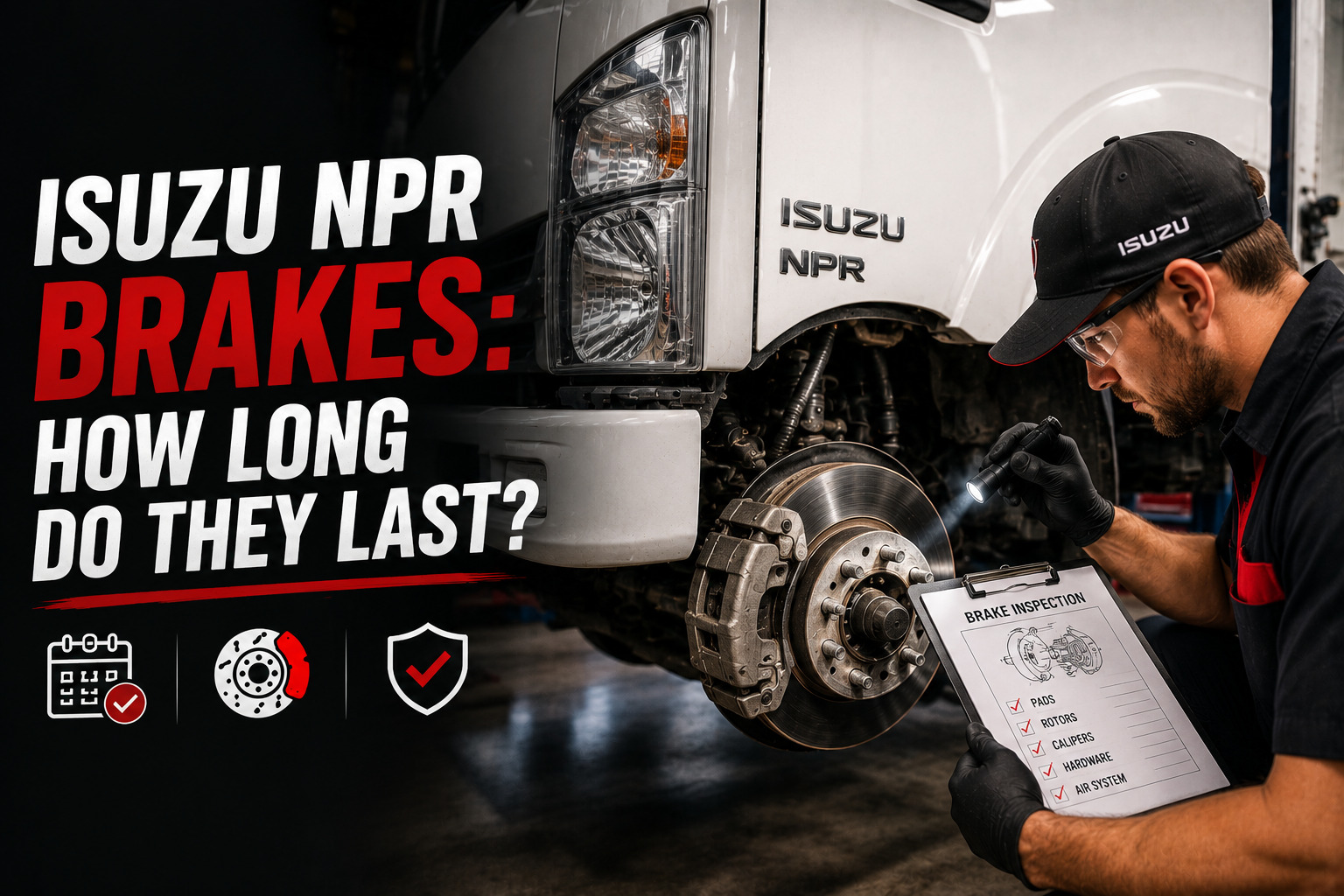
- Brake inspections every 10,000 miles, utilizing the standard exhaust brake to extend pad life.
- Diesel Particulate Filter (DPF) soot load checks and professional cleaning around 50,000 miles on diesel models.
Businesses looking to secure high-utility work vehicles can structure competitive payment plans through flexible commercial financing packages while reviewing our updated pre-owned commercial truck inventory online.
Is a Gas or Diesel Isuzu NPR Better for Commercial Reliability?
Choosing between a gas and diesel Isuzu NPR depends on annual mileage, daily route patterns, and towing requirements, as both options offer exceptional reliability when matched to the correct application. Gasoline models excel in low-mileage stop-and-go delivery, while diesel engines deliver maximum torque and endurance for high-mileage regional routes.
Gasoline-powered Isuzu NPR trucks feature a GM-sourced 6.6L V8 gas engine mated to a heavy-duty 6L90 automatic transmission or 6-speed Allison 1000 Series gearbox. This powertrain configuration offers distinct reliability advantages for fleets operating under 20,000 miles annually. Gasoline models do not require Diesel Exhaust Fluid (DEF) or active DPF regeneration cycles, completely eliminating emissions-related sensor faults and regeneration delays during urban routes. Component replacement is straightforward and inexpensive because ignition, cooling, and fuel delivery parts are shared with widespread domestic truck platforms.
Diesel variants, such as the Isuzu NPR-HD and Isuzu NPR-XD, utilize the heavy-duty 5.2L 4HK1-TC turbo-diesel paired with an Aisin 6-speed automatic transmission. Built with a heavy-duty cast-iron block, forged crankshaft, and lower operating RPM ranges, this diesel engine handles sustained heavy payloads and long highway runs with minimal wear. Post-2010 diesel models utilize Selective Catalytic Reduction (SCR) technology to meet EPA standards. While SCR systems require periodic DEF top-offs, Isuzu's emissions architecture is proven and widely supported by domestic service networks.
| Feature Comparison | Gasoline Isuzu NPR | Diesel Isuzu NPR (HD / XD) |
|---|---|---|
| Engine Architecture | 6.6L V8 gas engine | 5.2L 4HK1-TC turbo-diesel |
| Transmission | 6-speed Allison / GM 6L90 | Aisin 6-speed automatic |
| Average Lifespan | 150,000 - 250,000 miles | 375,000 - 500,000 miles |
| Emissions System | Standard Catalytic Converter | SCR with DEF & DPF |
| Ideal Duty Cycle | Local delivery, under 20k mi/yr | Heavy hauling, over 20k mi/yr |
Protecting your investment regardless of fuel type is effortless when backed by commercial warranty protection plans that guard against unexpected mechanical repairs.
What Is the Total Cost of Ownership and Fuel Economy for an Isuzu NPR?
Operating an Isuzu NPR yields a highly competitive total cost of ownership, with gas models averaging 10 to 12 MPG and diesel variants delivering 13 to 16 MPG under standard payload conditions. Over a typical 5-year commercial ownership cycle, total operating costs--including fuel, routine maintenance, and wear items--generally range between $0.35 and $0.55 per mile.
Fuel economy and tank capacities directly impact daily route planning and efficiency. Gasoline NPR models feature a standard 38-gallon in-frame tank positioned safely between the rear frame rails, providing an operating range of roughly 350 to 420 miles per fill-up. Diesel NPR models carry a standard 30-gallon side-mounted tank, with optional 33-gallon or dual-tank setups available on longer wheelbases. The diesel engine's higher thermal efficiency cuts fuel consumption by roughly 25% to 30% compared to gas V8 engines when hauling near maximum payload limits.
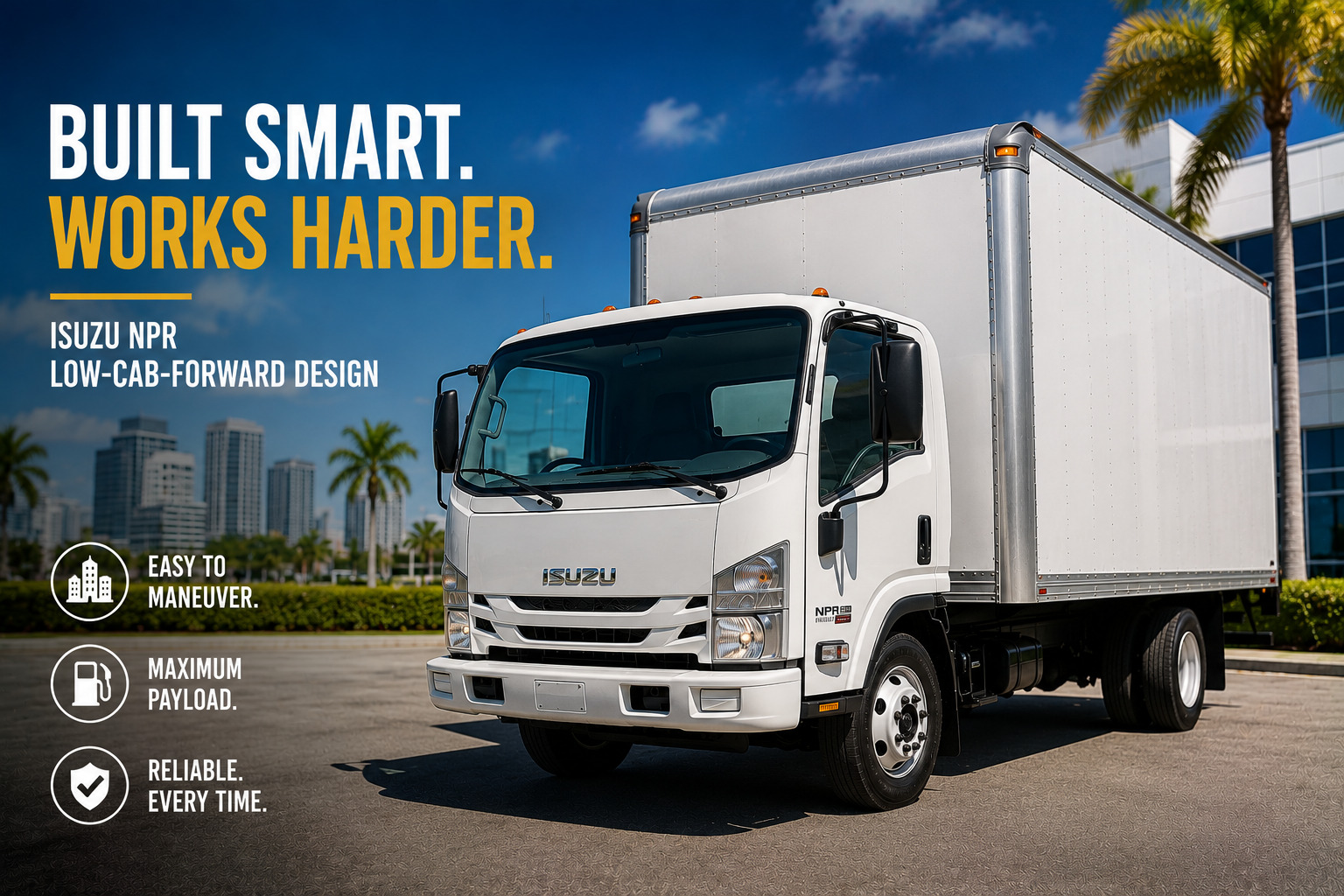
Maintenance costs remain predictable due to component availability and ease of service. Unlike discontinued cabovers like the Mitsubishi Fuso, where imported replacement parts incur steep freight surcharges and weeks of backorder delays, Isuzu commands over 80% of the U.S. low-cab-forward market. Replacement brake pads, rotors, water pumps, and electronic sensors are stocked locally throughout commercial supply networks.
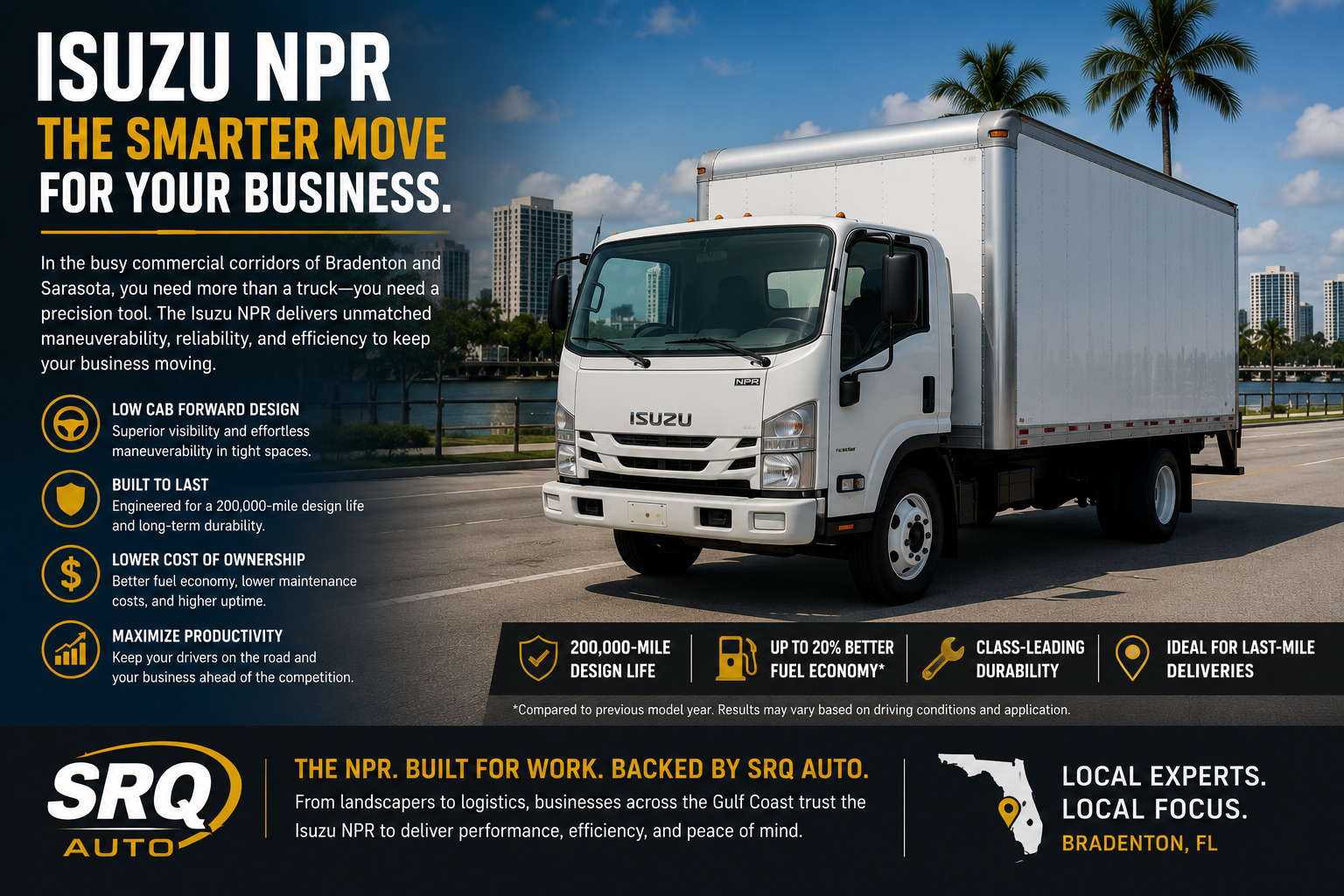
Maneuverability also reduces costly cosmetic and suspension damage on job sites. A 49.5-degree wheel cut provides a turning radius significantly tighter than conventional Class 4 work trucks. Drivers navigating narrow alleys or crowded coastal delivery zones in Sarasota can maneuver without mounting curbs, protecting tires, wheel alignments, and steering linkages from premature wear.
How Should Buyers Research Isuzu NPR Reliability Before Purchasing?
How many miles is too many for a used Isuzu NPR? That question is distinct from how many miles an Isuzu NPR will last, and for a buyer, it is arguably more critical. There is no universal mileage cutoff; a 70,000-mile truck that was poorly maintained and constantly overloaded is a bigger risk than a 140,000-mile model with a clean chassis, one-owner fleet history, and documented service. At SRQ, we look beyond the odometer, evaluating the specific duty cycle, frame integrity, and maintenance habits to determine a vehicle's true worth. That level of technical scrutiny is what separates a reliable workhorse from a liability..
Why Buying a Used Isuzu NPR From a Commercial Truck Specialist Matters
A dedicated commercial dealer provides vetted inventory, tailored financing structures, and comprehensive reconditioning standards that protect small business capital when investing in work trucks. Partnering with commercial specialists ensures that every vehicle added to your fleet is mechanically sound and upfitted for your specific trade.
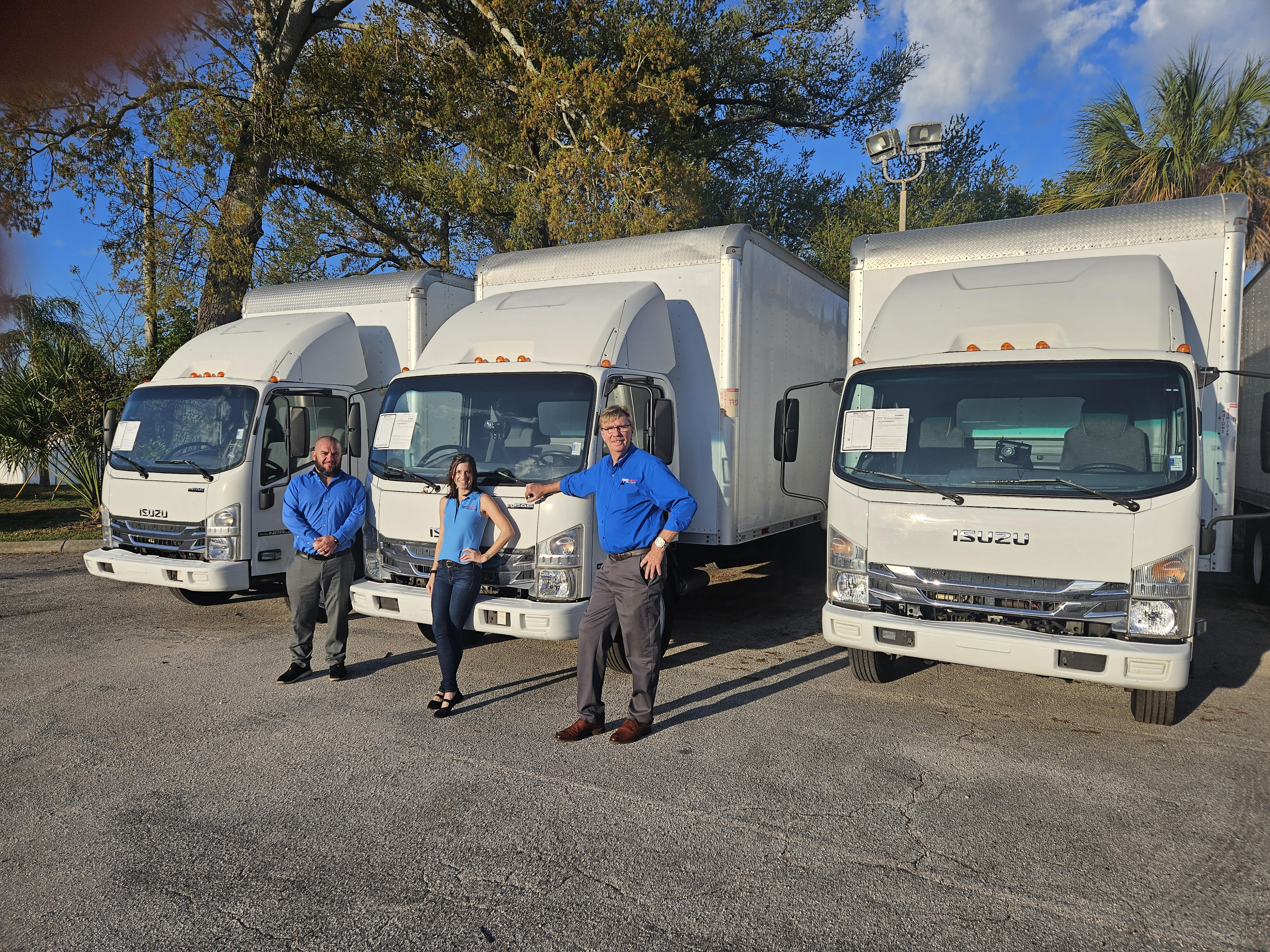
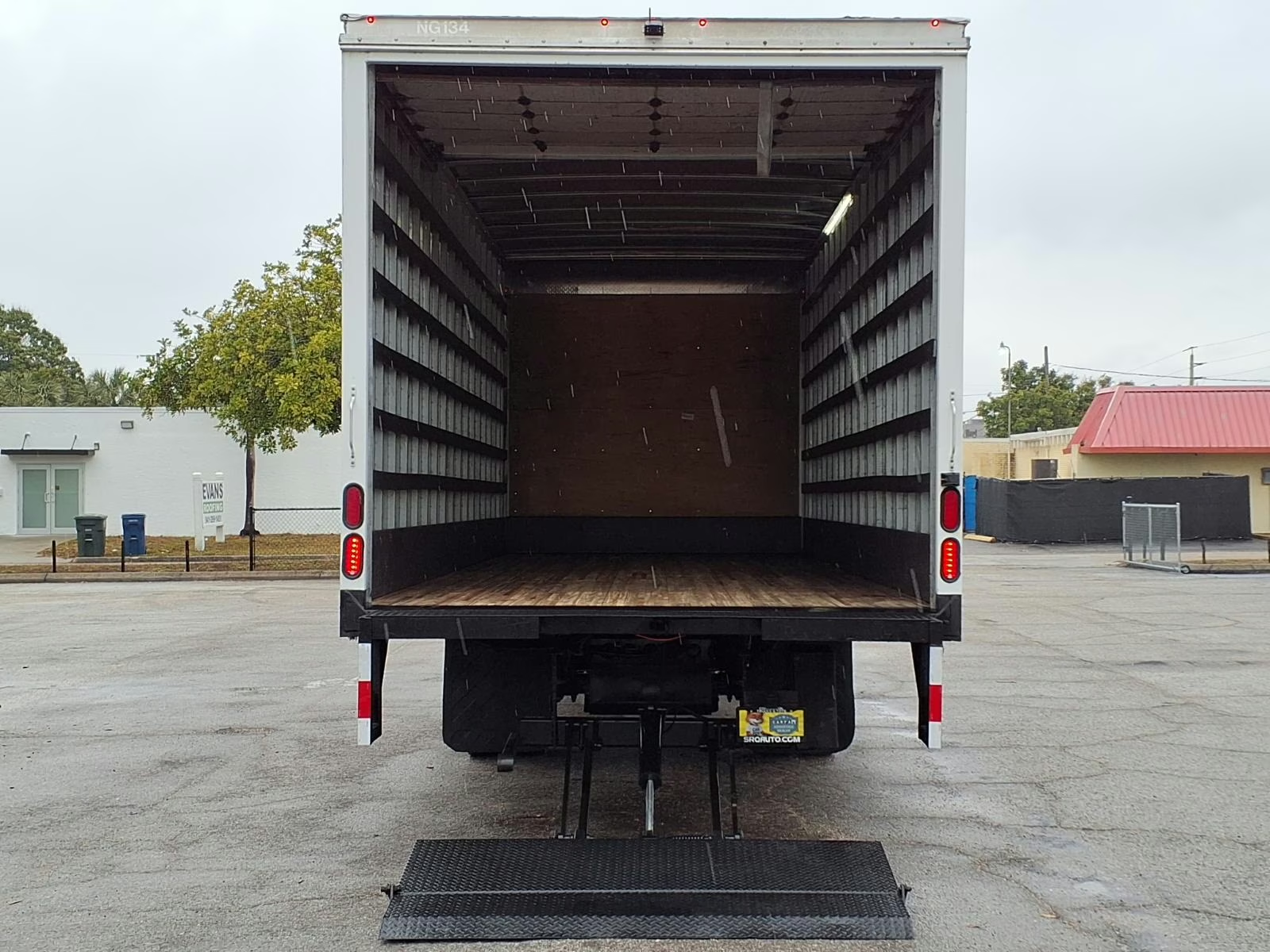
At SRQ Auto LLC, every pre-owned commercial cabover undergoes a rigorous multi-point mechanical inspection, fluid overhaul, and road test before reaching our sales lot. Our Job Ready Promise guarantees that key wear components--including brakes, tires, batteries, and safety systems--meet strict commercial operational thresholds. Whether your business requires a landscape dump, box truck, utility service body, or flatbed, our team aligns vehicle GVWR ratings and chassis dimensions to your daily payload demands.
Local contractors and fleet managers across Bradenton rely on transparent vehicle histories, flexible commercial financing terms, and Section 179 tax advantage guidance to maximize buying power. Additionally, our nationwide commercial transport expertise allows out-of-state businesses to purchase high-quality Florida work trucks with fast, reliable site delivery directly to their job locations.
Common Questions About Isuzu NPR Longevity and Commercial Value
Q: How many miles can a diesel Isuzu NPR last with regular care?
A: A diesel Isuzu NPR equipped with the 5.2L 4HK1-TC turbo-diesel engine regularly achieves 375,000 to 500,000 miles when serviced on schedule. Isuzu publishes a B50 life of 375,000 miles for this engine, indicating that half of all units operate past this milestone before needing an internal overhaul. Adhering to 5,000-to-7,500-mile oil changes, replacing fuel filters, and maintaining the DPF system are critical factors in reaching high mileage.
Q: Is the gas Isuzu NPR engine as durable as the diesel version?
A: While the gasoline 6.6L V8 gas engine delivers exceptional performance, its expected service life is typically 150,000 to 250,000 miles compared to the diesel's 375,000-plus mile capability. However, gas models offer lower upfront purchase costs, easier DIY maintenance, and no DEF requirements, making them ideal for urban fleets logging under 20,000 miles per year.
Q: How does the Isuzu NPR tilt-cab design benefit long-term maintenance?
A: The cab tilts forward 45 degrees to expose the entire engine bay, transmission linkages, and fluid reservoirs at waist height. Mechanics can perform belt replacements, oil filter changes, and valve adjustments in significantly fewer labor hours compared to conventional trucks with cramped engine hoods, directly reducing fleet repair bills over time.
Q: Are replacement parts for an Isuzu NPR easy to find locally?
A: Yes, parts availability for the Isuzu NPR is superior because Isuzu holds over 80% of the U.S. low-cab-forward market. Gasoline variants share engine and transmission components with domestic GM platforms, allowing local auto parts suppliers and independent mechanics to stock replacement components off the shelf without waiting on overseas shipments.
Q: What is the gross vehicle weight rating (GVWR) of an Isuzu NPR-HD?
A: The Isuzu NPR-HD features a 14,500-lb GVWR, placing it firmly in the Class 4 commercial truck category. This chassis rating allows business owners to install heavy box bodies, landscape dump beds, or towing equipment while maintaining legal payload capacities for commercial transport.
To explore our current work truck selection or discuss fleet financing options, visit 2212 1st St in Bradenton, call our sales team directly, or review our work truck background and standards online to get your fleet job-ready today.
© 2026 SRQ Auto LLC. All rights reserved.