Cargo Van or Service Body Truck: Which Is Better for Your Trade?
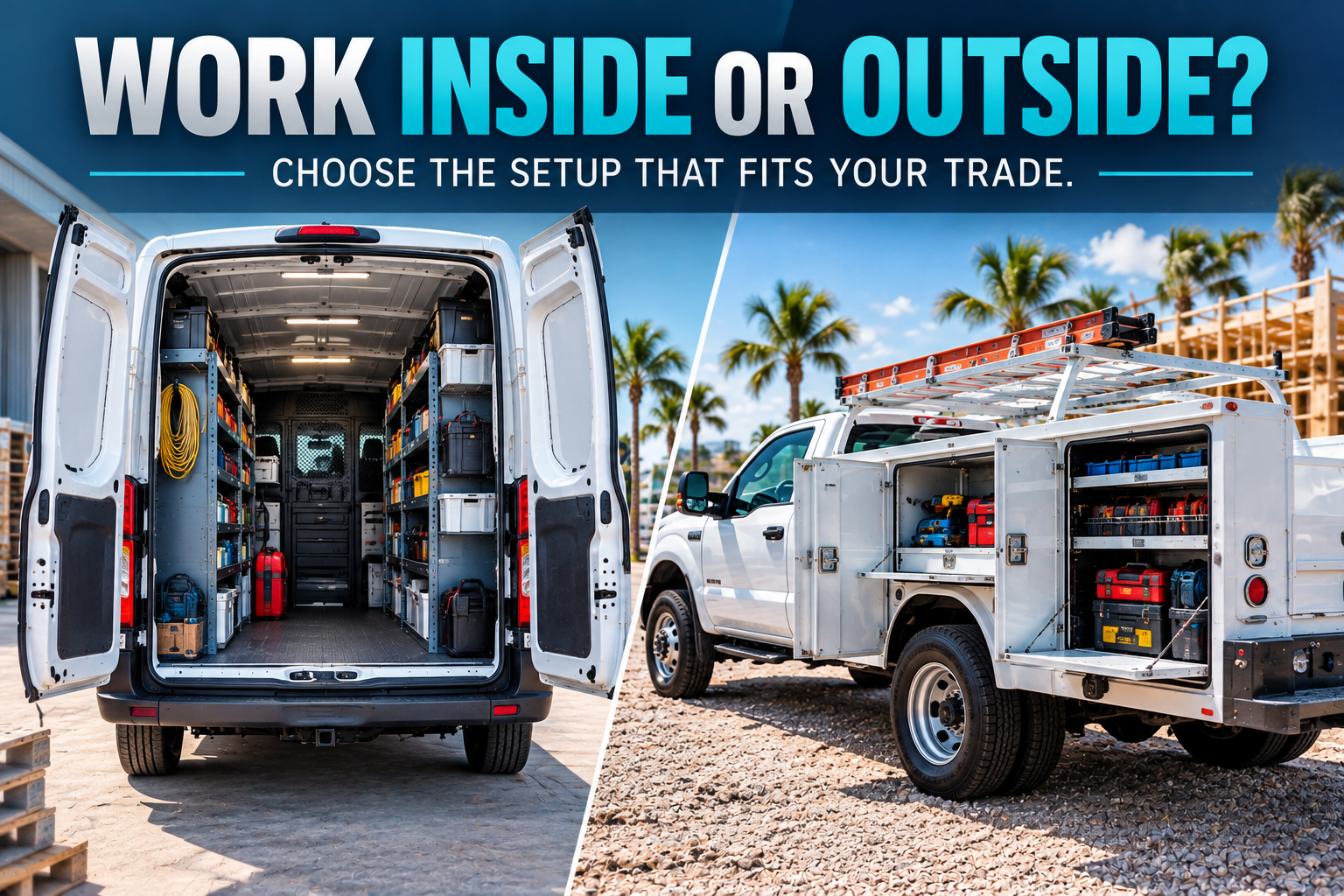
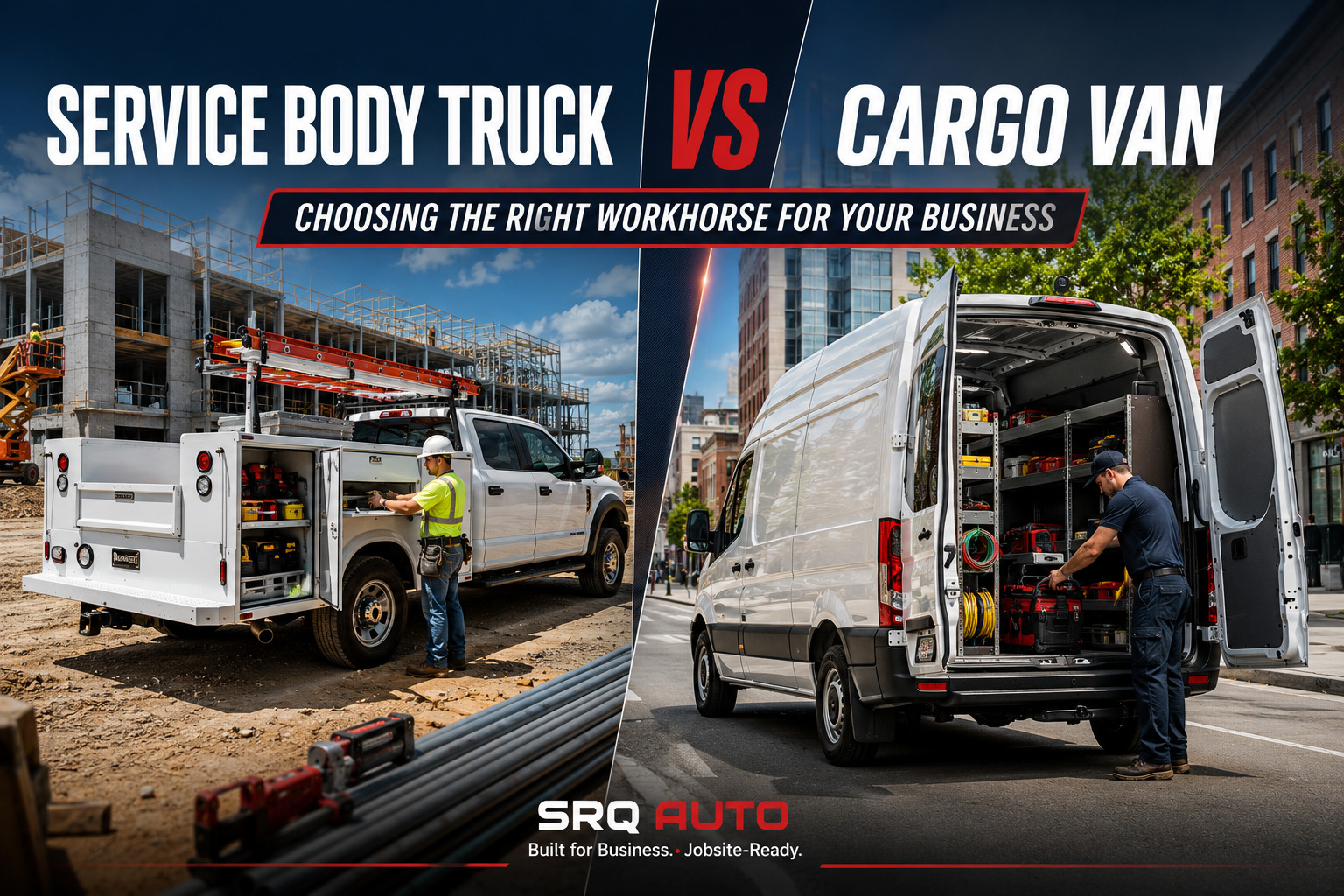
For many contractors, choosing between a cargo van and a service body truck comes down to one basic question: do you work mainly inside the vehicle, or around it?
A cargo van is usually the better fit when enclosed workspace, weather protection and walk-in organization matter most. A service body truck often makes more sense when fast exterior tool access, heavier equipment, towing or jobsite capability are higher priorities.
And for some businesses, an enclosed utility body such as a KUV can sit directly between the two—combining exterior compartments with a protected interior cargo area.
There is no universal winner. The right setup depends on how your technicians actually work every day.
Browse SRQ Auto's current commercial inventory to compare cargo vans, service trucks and other Job Ready commercial configurations available now.
Cargo Van vs. Service Body Truck: The Quick Answer
| If Your Priority Is... | Start With... |
|---|---|
| Enclosed interior workspace | Cargo van |
| Fast exterior access to tools | Service body truck |
| Weather-protected cargo | Cargo van |
| Compartmentalized tool storage | Service body truck |
| Standing room inside the vehicle | High-roof cargo van |
| Towing or heavier jobsite equipment | Configuration-specific, often service body |
| Exterior compartments plus enclosed cargo | KUV/enclosed utility body |
The important point is that cargo capacity alone doesn't determine productivity. How quickly a technician can find, reach and use the right equipment can matter just as much.
The Biggest Difference Isn't Cargo Space—It's How You Access Your Tools
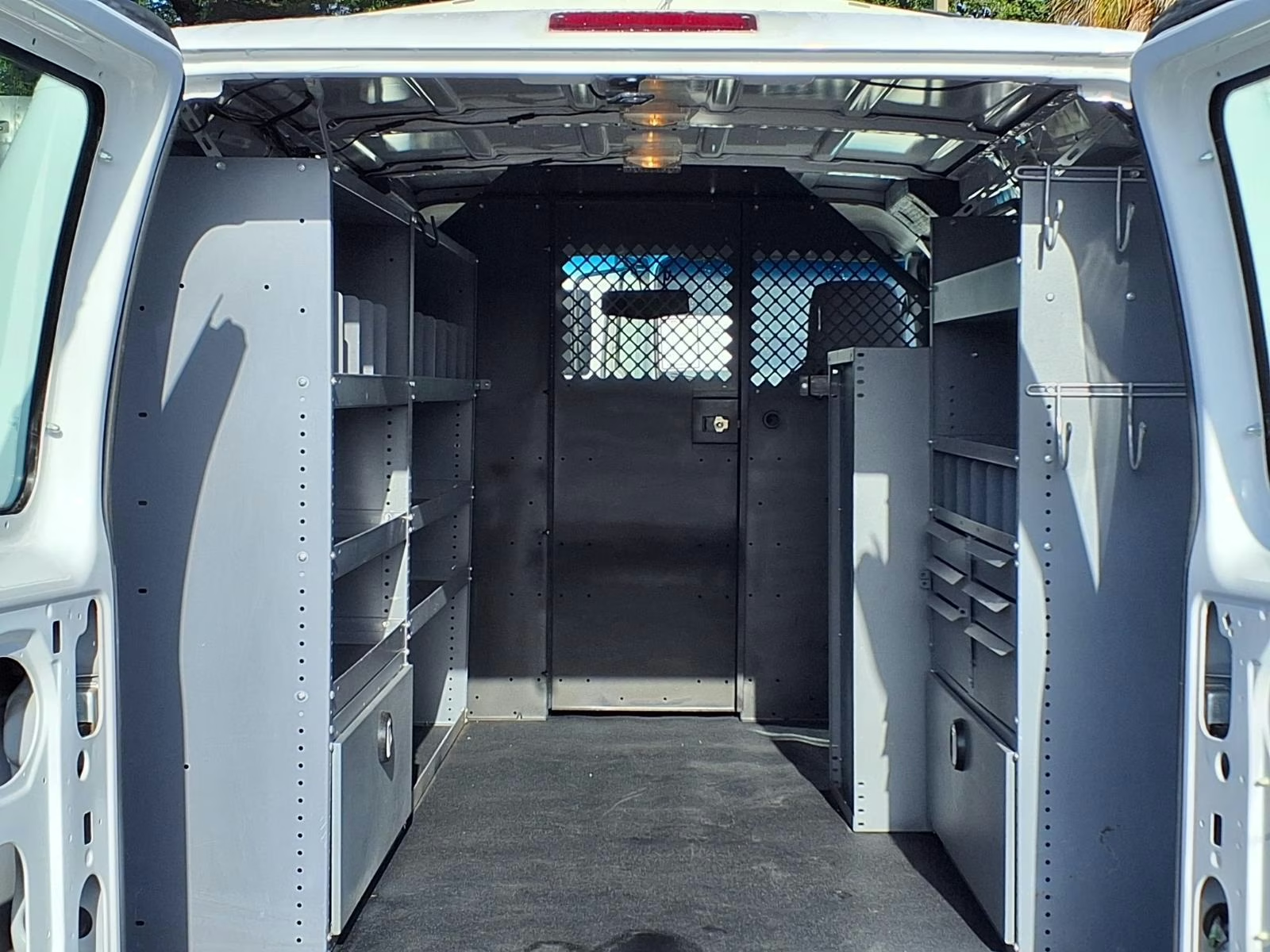
With a cargo van, the technician generally enters the workspace. Shelving, bins, drawers and equipment are organized inside the vehicle, protected from weather and largely hidden from view.
With a service body truck, the technician generally works from outside the vehicle. Tools and parts are divided into exterior compartments that can be opened individually without climbing into the truck.
That one difference can shape the entire workday.
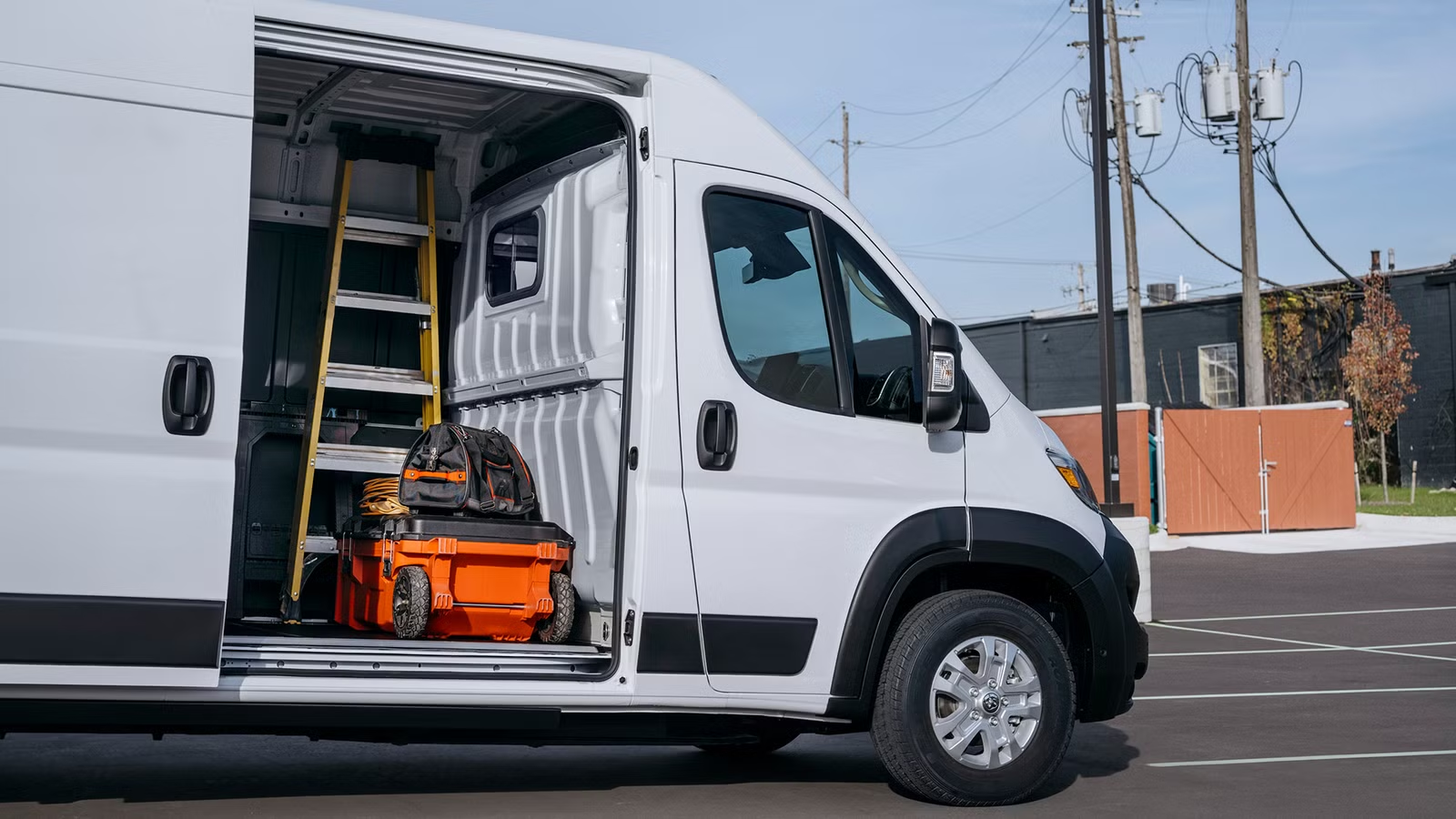
A technician making dozens of quick service calls may value being able to walk directly to one compartment, grab a tool and close the door. Another technician carrying hundreds of small parts may be far more productive inside a high-roof van with organized shelving on both sides.
The right vehicle should reduce wasted movement.
Which Is Better for HVAC?
HVAC businesses can make a strong case for either platform.
A high-roof Ford Transit or Ram ProMaster can function almost like a mobile stockroom. Shelving can hold fittings, controls, refrigerant tools, replacement components and diagnostic equipment while leaving a center aisle for the technician.
A service body truck, on the other hand, can make frequently used tools and parts accessible from outside without requiring the technician to climb into the cargo area.
For HVAC operations that want both concepts, an enclosed utility body or KUV can be especially attractive. Exterior compartments keep tools organized while the center cargo area remains protected for larger equipment and supplies.
If interior workspace is the priority, start with a cargo van. If fast exterior access and heavier equipment matter more, compare current service-body and utility-truck configurations.
Which Is Better for Electricians?
Electricians often need a large quantity of smaller parts, hand tools, test equipment, conduit accessories and specialty supplies.
A cargo van works well when the business wants everything enclosed and organized in one walk-in space. A high-roof van can accommodate tall shelving while still leaving a usable center aisle.
A service body can be better when technicians repeatedly reach for the same categories of equipment throughout the day and benefit from dedicated exterior compartments.
If the technician wants to step inside and see the whole inventory, lean toward a van. If the technician wants to walk directly to a compartment and grab one category of tools, lean toward a service body.
Which Is Better for Plumbers?
Plumbing can place more emphasis on payload because pipe, fittings, pumps, drain-cleaning equipment and other materials can become heavy quickly.
A cargo van provides excellent weather protection and organization, but the buyer needs to account for the weight of shelving, partitions, tools and inventory.
A service body truck may offer better exterior access to dense tools and equipment, and certain heavier-duty chassis configurations may provide additional capacity depending on the specific truck.
The badge alone doesn't answer the question. Evaluate the completed vehicle after the upfit, not just the empty chassis or van.
Which Is Better for General Contractors?
General contractors often give service body trucks the strongest argument.
Exterior compartments can make power tools, fasteners, saws, batteries and jobsite equipment easy to reach. Pickup-based service trucks may also offer towing and jobsite characteristics that fit contractors pulling trailers or moving equipment between sites.
But contractors who prioritize secure enclosed tool storage may still prefer a cargo van—especially when expensive equipment needs to stay out of weather and out of sight.
Florida Weather Changes the Equation
In Sarasota, Bradenton and throughout Florida, weather deserves more attention than it might in a generic vehicle comparison.
A cargo van keeps nearly the entire working inventory inside a weather-protected shell. That's useful when afternoon rain arrives quickly or sensitive tools and parts need to remain dry.
Service bodies protect tools inside individual compartments, but technicians may spend more time opening and working from those compartments in the weather.
There is another side to the equation: heat. A high-roof van can become extremely hot inside when parked in the Florida sun. Ventilation, interior lighting, insulation and the way technicians use the cargo area all matter.
The better choice depends on whether your business values full enclosed protection or quick outside access more during a typical day.
Which Is Easier to Upfit?
Both can be highly customizable, but they are customized differently.
Cargo vans commonly use shelving, bulkheads and partitions, drawer systems, ladder racks, interior lighting, E-track and cargo tie-downs, and conduit or long-material storage.
Service body trucks commonly use exterior compartment shelving, drawer packs, ladder racks, compressors, generators, crane systems, and auxiliary equipment or tanks.
When buying used, a professionally installed upfit that matches your trade can be a significant advantage because it may reduce both equipment cost and downtime. But an upfit only has real value when your business can actually use it.
Don't Forget Payload After the Upfit
This matters with both vehicle types.
A cargo van's shelving, partition, ladder rack, tools, crew and parts all consume available carrying capacity.
A service truck's steel utility body, drawers, ladder rack, crane, compressor, generator, crew and tools do the same.
That is why two vehicles with similar badges can have very different usable capacities once they are ready for work.
Always evaluate the ratings and completed working weight of the specific vehicle you're considering.
What About a KUV? The Middle Ground
For some trades, an enclosed utility body such as a Knapheide KUV-style configuration is one of the most interesting alternatives.
It combines the two basic work styles: exterior compartments provide service-body-style access to tools and parts, while an enclosed center cargo area provides protected storage similar to a cargo van.
That can make a KUV particularly useful for HVAC, plumbing, electrical and mobile-service operations that want compartmentalized access without giving up enclosed cargo space.
It is not automatically better than either a conventional cargo van or a traditional service truck, but it can be an excellent answer when the business genuinely needs elements of both.
Which One Holds Its Value Better?
There isn't a universal winner.
Commercial vehicles retain value based on a combination of condition, mileage, maintenance history, configuration, upfit quality and how useful that setup is to the next buyer.
A well-equipped cargo van with professional shelving may be more desirable to one contractor than an empty van with lower miles. A clean service body with organized compartments may command more interest from a trade buyer than a conventional pickup.
The original cost of the upfit isn't what determines resale value. Its usefulness to the next business does.
Which Should Your Business Buy?
Choose a cargo van when:
- Technicians regularly work inside the vehicle
- Weather-protected inventory is a major priority
- High-roof standing room improves productivity
- You carry many small parts that benefit from interior shelving
- Security and keeping tools out of sight are priorities
Choose a service body truck when:
- Technicians repeatedly access tools from outside
- Exterior compartment organization is more useful than interior shelving
- Towing or heavier jobsite equipment is part of the operation
- The truck needs to function well around jobsites
- Specialized equipment such as cranes or compressors may be installed
Consider a KUV or enclosed utility body when:
- You want exterior compartments and enclosed cargo storage
- Your technicians need both walk-in space and quick outside access
- Your trade carries a mix of tools, parts and larger protected equipment
Work Inside or Work Outside?
The cargo van versus service body decision becomes much easier when you stop comparing vehicles and start comparing workflows.
If your technician spends much of the day working inside the vehicle, start with a cargo van.
If your technician spends much of the day working around the vehicle, start with a service body.
If your business needs both, look closely at an enclosed utility-body configuration.
Choose the vehicle around the work—not the badge on the grille.
SRQ Auto specializes in fully reconditioned commercial vehicles prepared around our Job Ready Promise. We regularly sell cargo vans, service and utility trucks, KUV-style bodies, box trucks and other commercial configurations to businesses throughout Bradenton, Sarasota, Tampa, Orlando, Fort Myers and nationwide.
Compare Current Commercial Vehicles at SRQ Auto
Need help structuring the purchase? Learn about Tailored Commercial Financing or complete our online credit application.
Want to hear from other business owners? Read our customer reviews or get directions to SRQ Auto.