Choosing Your Next Commercial Workhorse: Box Truck vs Cargo Van
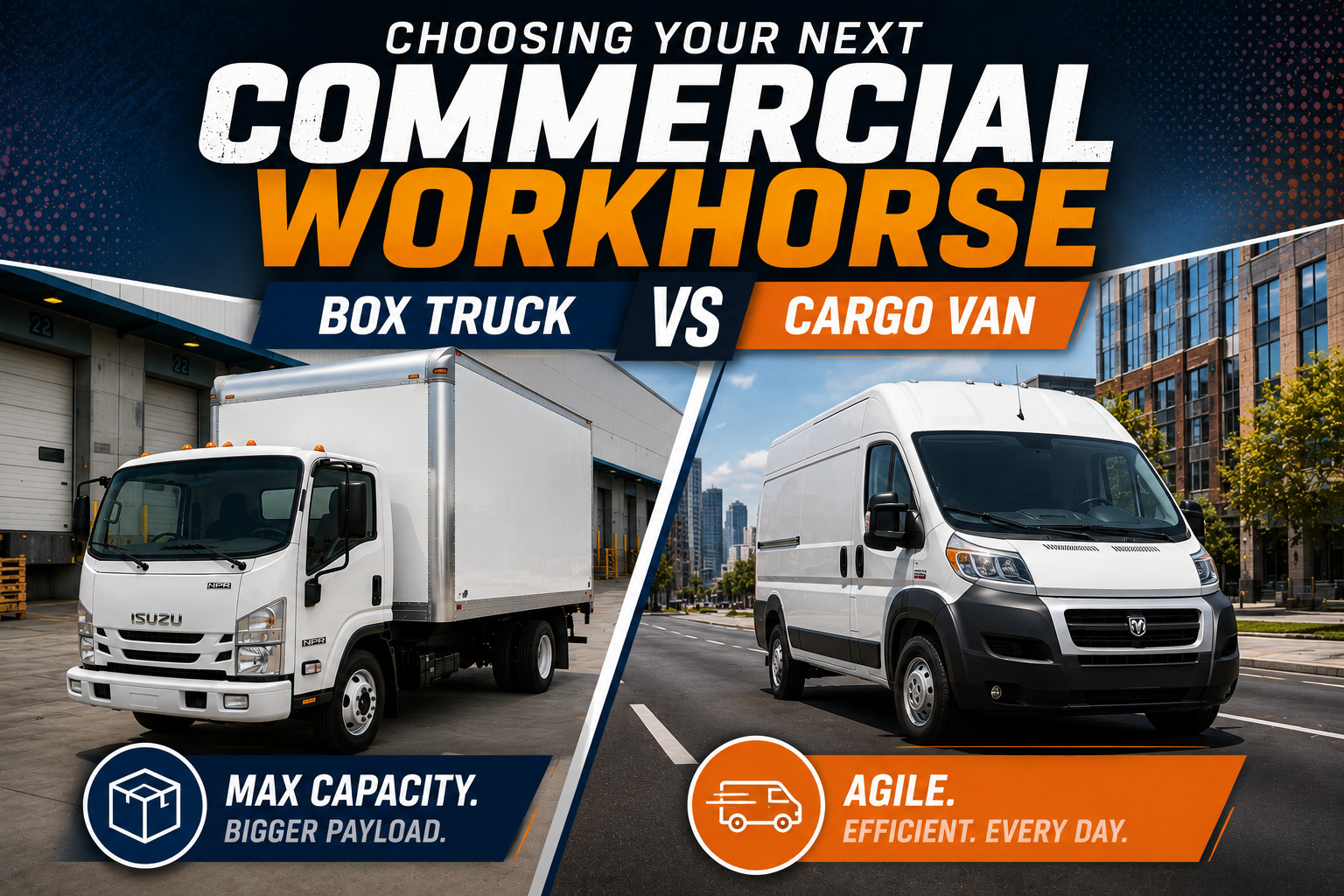
Selecting the right vehicle for your daily business operations is a critical decision that directly impacts your bottom line, productivity, and driver satisfaction. At SRQ Auto LLC, we specialize exclusively in quality pre-owned commercial vehicles, helping local business owners find work-ready solutions that match their specific operational demands. If you are currently evaluating your options, comparing a box truck versus a cargo van is the natural place to start. Each platform offers distinct advantages in maneuverability, storage capacity, and overall utility.
For businesses operating in master-planned communities like Lakewood Ranch, where wide suburban boulevards lead to tight residential driveways and upscale commercial plazas, choosing the correct vehicle footprint is essential. A cargo van might excel at navigating these manicured neighborhoods, whereas a larger transport job might demand the sheer hauling power of a box truck. To find the right fit for your fleet, you can browse our used box truck inventory or explore our versatile used cargo van inventory online.
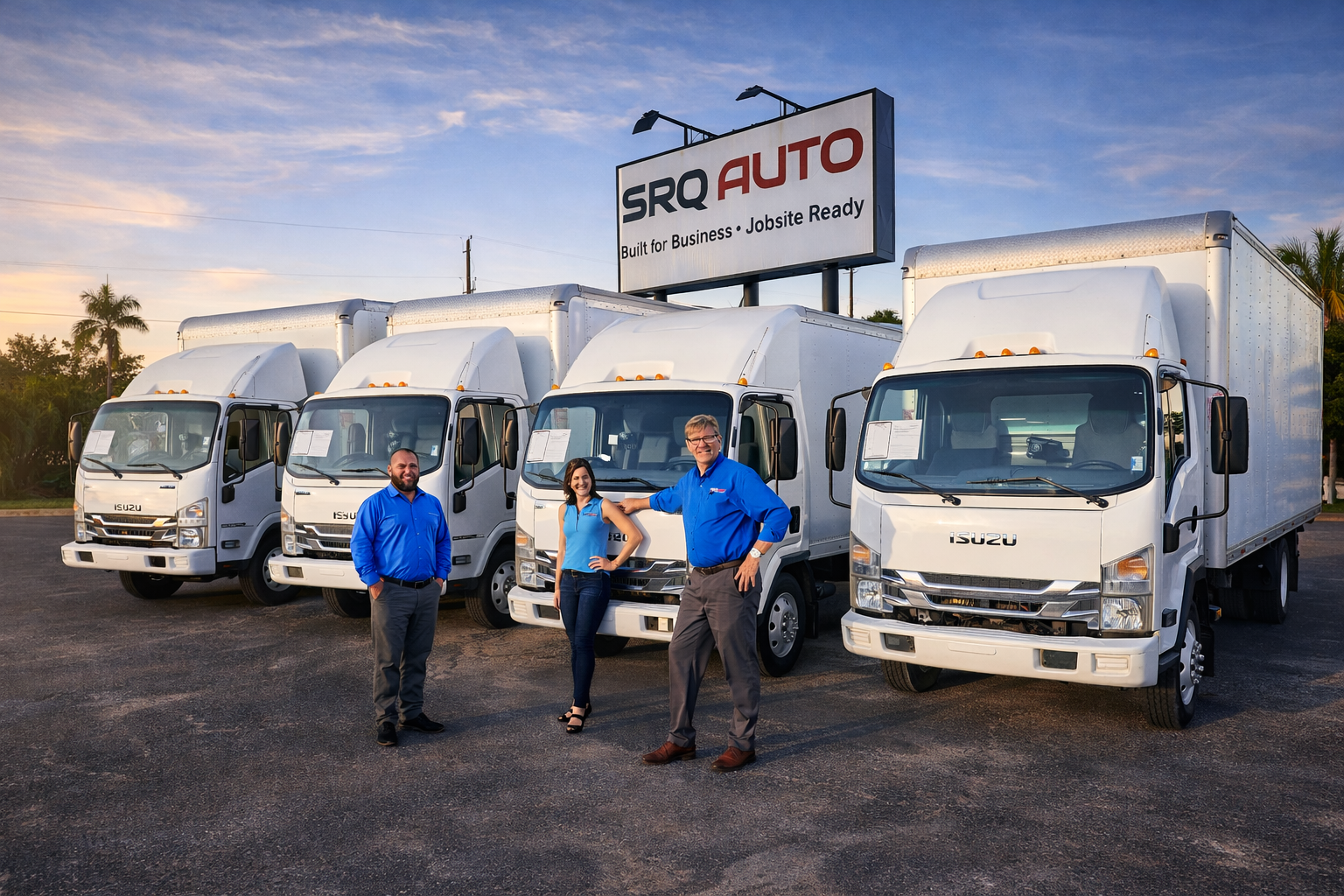
We are committed to delivering dependable, work-ready vehicles backed by our Job Ready Promise. Every commercial truck and van on our lot undergoes a rigorous inspection and reconditioning process to ensure it is ready to perform from day one. To help protect your investment, we offer flexible commercial warranty options designed to shield your business from unexpected mechanical repair costs. Additionally, our finance team provides competitive, tailor-made commercial financing solutions to fit your budget.
If you want to inspect these vehicles in person, drop a pin on your map for our Bradenton showroom or give our team a quick call to discuss what we currently have on the lot.
Table of Contents
- The Core Differences in Body Design and Cab-to-Cargo Accessibility
- Comparing Cargo Volume, Payload Capacity, and Liftgate Capabilities
- Annual Fuel Costs and Real-World Fleet Efficiency Differences
- Navigating Florida Commercial Insurance and Weight-Based Registration Requirements
- Choosing Between Step Vans and Cargo Vans for Final-Mile Delivery
- Common Questions About Commercial Vehicle Purchasing
- Quick Answers Before You Visit
- Find the Perfect Commercial Vehicle for Your Business Today
The Core Differences in Body Design and Cab-to-Cargo Accessibility
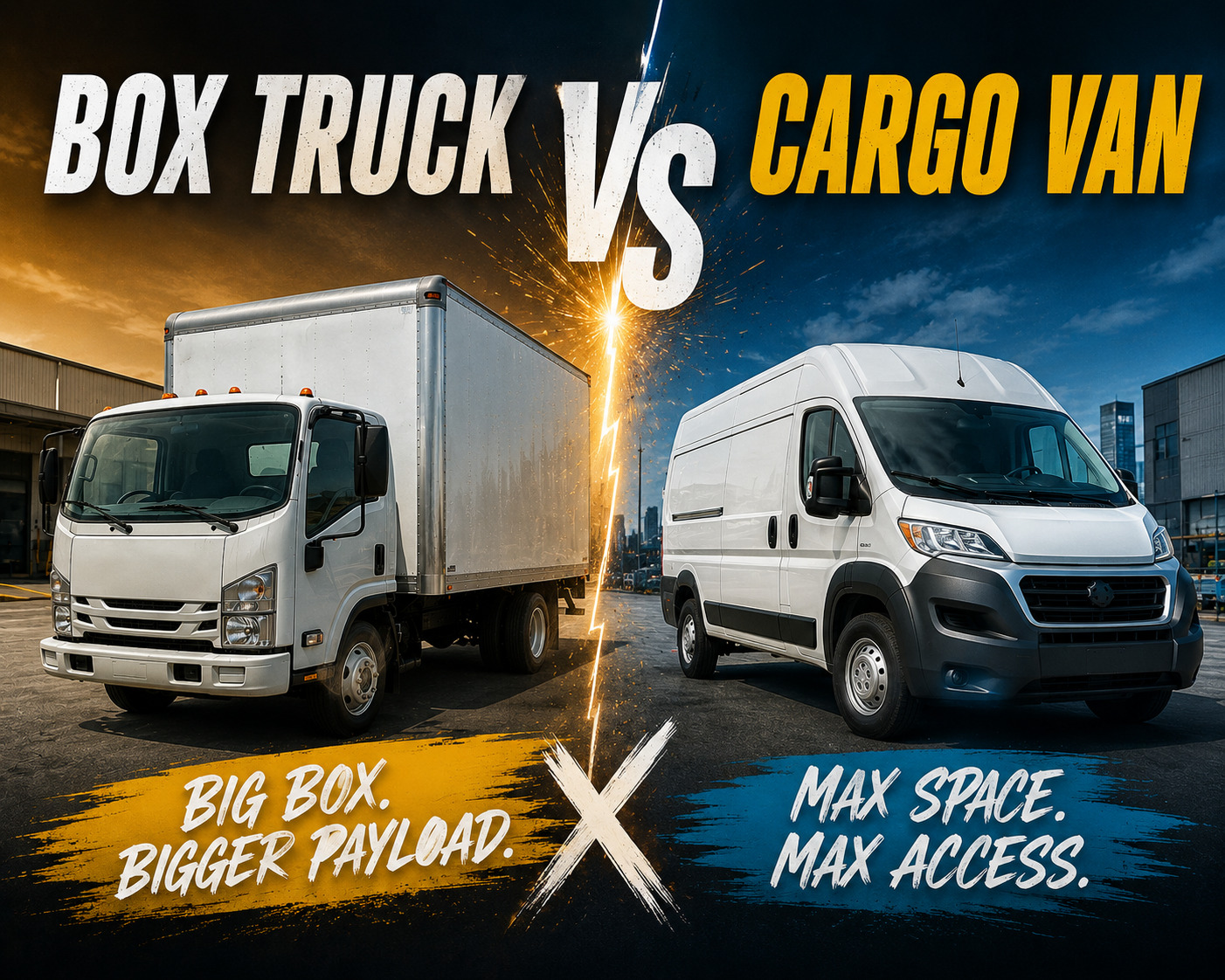
What is the main difference between a cargo van and a box truck? The answer lies in their fundamental structural engineering. A cargo van is a one-piece vehicle built on a unibody or body-on-frame platform where the driver's cab and the rear cargo area share a single, integrated shell. Conversely, a box truck—often referred to as a cube van or box van—features a completely separate, rectangular cargo box mounted onto a cab-chassis frame. This structural division creates vastly different physical boundaries and operational capabilities for the driver.
This architectural difference directly affects cab-to-cargo accessibility. In a cargo van, the driver can easily stand up or turn around to walk directly from the front seat into the rear cargo hold without ever stepping outside the vehicle. This seamless pass-through is highly prized by mobile locksmiths, plumbers, and HVAC technicians who need quick access to tools and parts while staying sheltered from the elements.
In contrast, a standard box truck physically isolates the driver's cab from the cargo box. To access your cargo, the operator must park, exit the cab, walk to the rear of the vehicle, and open the roll-up or swing-out doors. While some custom box trucks feature a small pass-through door in the partition wall, these are typically narrow and less convenient than the open layout of a van. For businesses that require specialized setups, we carry an extensive selection of used commercial inventory, as well as highly organized options in our used service truck and van inventory to match your workflow.
Comparing Cargo Volume, Payload Capacity, and Liftgate Capabilities
When your business relies on moving large quantities of inventory or heavy equipment, cargo volume and payload capacity become the deciding factors. Box trucks are the undisputed champions of raw volume and weight capacity. A standard commercial box truck typically features a cargo box length ranging from 10 to 24 feet, translating to an expansive cargo volume of 800 to over 1,600 cubic feet. Cargo vans, even in high-roof configurations, generally top out at around 400 to 500 cubic feet of interior space.
The payload differences are equally stark. A light-duty cargo van is engineered to carry payloads ranging from 3,000 lb to 4,500 lb. Medium-duty box trucks, such as those built on Class 4 or Class 5 chassis, are designed to handle payloads starting at 6,000 lb and climbing well past 10,000 lb. For example, a commercial chassis like the Isuzu NPR-HD features a Gross Vehicle Weight Rating of 14,500 lb, allowing it to carry heavy machinery, palletized freight, or dense construction materials with ease.
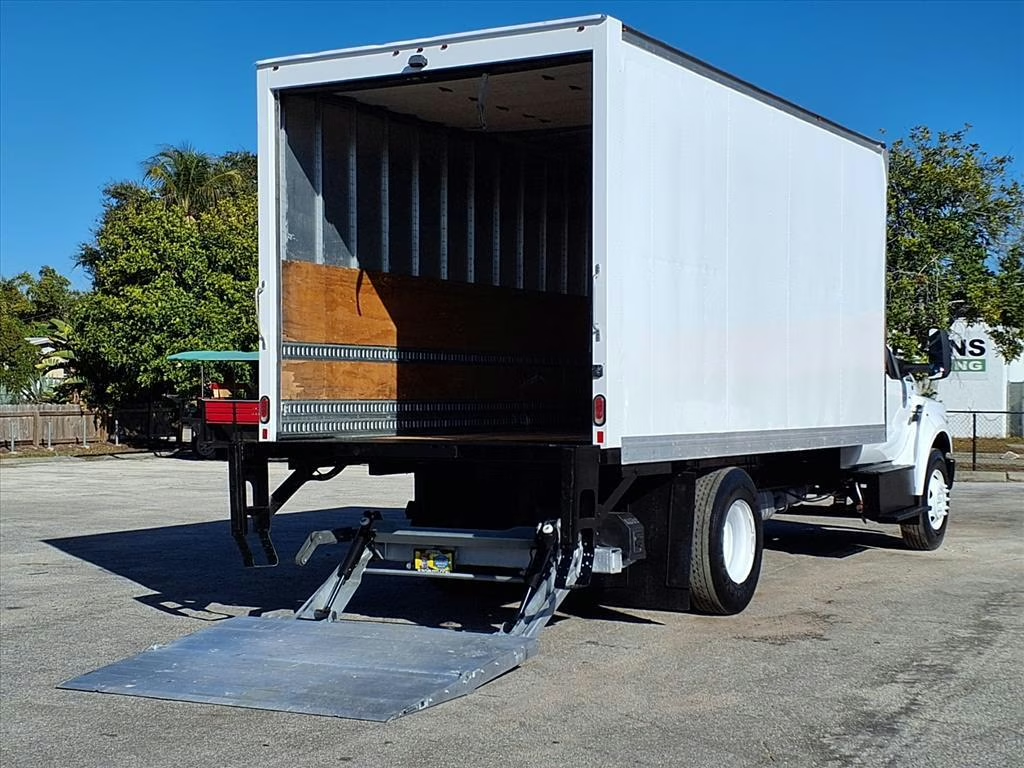
Loading these heavy items is also simplified by the box truck's flat floor design, which sits at dock height and completely eliminates rear wheel-well intrusions. This flat surface allows a standard box truck to accommodate a hydraulic liftgate, such as a tuckaway, rail, or cantilever gate. A liftgate is a game-changer for solo operators delivering heavy appliances, commercial landscaping equipment, or palletized goods, as it eliminates the physical strain of manual lifting. Cargo vans sit much lower to the ground and cannot accommodate standard heavy-duty liftgates, relying instead on ramps or slide-out steps.
To help you secure the hauling capacity your business requires, we make the purchasing process straightforward. You can easily start your purchase path online by prequalifying online or by completing our comprehensive credit application to secure competitive rates before visiting our showroom.
Annual Fuel Costs and Real-World Fleet Efficiency Differences
How much does a box truck cost to fuel annually compared to a cargo van? Because fuel is one of the largest ongoing operational expenses for any Florida business, understanding this efficiency gap is critical to calculating your true cost of ownership. The aerodynamic, streamlined profile of a cargo van allows it to slice through the air with far less resistance than the tall, flat-faced profile of a box truck, resulting in vastly different fuel economy figures.
To illustrate the financial impact, let us look at a typical annual driving scenario:
| Vehicle Type | Average Fuel Economy | Annual Gallons Used (at 20,000 Miles) | Estimated Annual Fuel Cost (at $3.50/Gallon) |
|---|---|---|---|
| Cargo Van | 15 mpg | 1,333 gallons | $4,665 |
| Box Truck | 9 mpg | 2,000 gallons | $7,000 |
This comparison demonstrates that operating a single box truck can cost over $2,300 more in annual fuel expenses compared to a cargo van over the same distance. For larger box trucks equipped with heavy-duty gas V8 engines or older diesel powertrains, the average fuel economy can drop closer to 8 mpg, widening the cost gap even further.
When analyzing these numbers, business owners must weigh the fuel savings of a van against the trip efficiency of a larger truck. If a cargo van requires two or three trips to move the same volume of goods that a box truck can deliver in a single run, the box truck may actually prove to be the more cost-effective and time-efficient asset. You can view our recently sold vehicles to see what local fleets have chosen, or read about our recent deliveries to see how other businesses balance volume and efficiency.
Navigating Florida Commercial Insurance and Weight-Based Registration Requirements
Operating a commercial vehicle in Florida comes with specific regulatory and financial responsibilities that vary significantly depending on the size of the vehicle. Commercial vehicle insurance rates are heavily influenced by the vehicle's Gross Vehicle Weight Rating (GVWR). Because cargo vans are lighter and present a lower risk profile on the road, they are generally much less expensive to insure. Box trucks, with their heavier operating weights and larger blind spots, carry higher liability risks and consequently demand higher insurance premiums.
Registration and taxing in Florida also scale with vehicle weight. For commercial vehicles with a net weight of 5,000 lb or less, registration fees are relatively modest. However, once a commercial vehicle exceeds a net weight of 5,000 lb—which applies to almost all medium-duty box trucks—the state transitions to a weight-based commercial registration system. These fees are calculated based on the vehicle's declared GVWR and can increase annual registration costs significantly.
Fortunately, licensed commercial vehicle dealers in Florida handle these complex registration, titling, and weight-based taxing calculations directly at the time of sale, saving you valuable time at the DMV. Our team at SRQ Auto LLC is highly experienced in commercial vehicle logistics, ensuring your new truck or van is fully compliant with state regulations before it leaves our lot. Whether you are purchasing one of our landscape dump trucks or a standard delivery vehicle, we make the paperwork seamless. Our dedication to transparent, hassle-free transactions is why we have earned over 500 five-star customer reviews from business owners across the region.
Choosing Between Step Vans and Cargo Vans for Final-Mile Delivery
The explosive growth of e-commerce has made final-mile delivery one of the most demanding sectors in commercial transport. When building a delivery fleet, operators frequently compare step vans against cargo vans. While both are highly popular, they serve different delivery volumes, route styles, and driver workflows.
Step vans—often called multi-stop trucks—are the preferred choice for high-volume, dedicated e-commerce delivery routes. They feature a sliding driver's side door, an ultra-low step-in height, and a spacious interior that allows the driver to stand fully upright while organizing packages. This design minimizes driver fatigue during routes that require 100 to 200 stops per day. Cargo vans, while offering a more comfortable, car-like driving experience and better fuel economy, require the driver to bend over to retrieve packages, which can slow down high-volume delivery operations.
However, cargo vans offer unmatched maneuverability. In urban centers and busy coastal areas, a cargo van can easily park in standard spaces, navigate narrow alleyways, and clear low-overhead parking garages that are completely inaccessible to tall step vans. For businesses that operate mixed fleets, we offer a wide variety of commercial options, including our specialized used shuttle bus inventory, to help you find the exact vehicle configuration your daily routes require.
Common Questions About Commercial Vehicle Purchasing
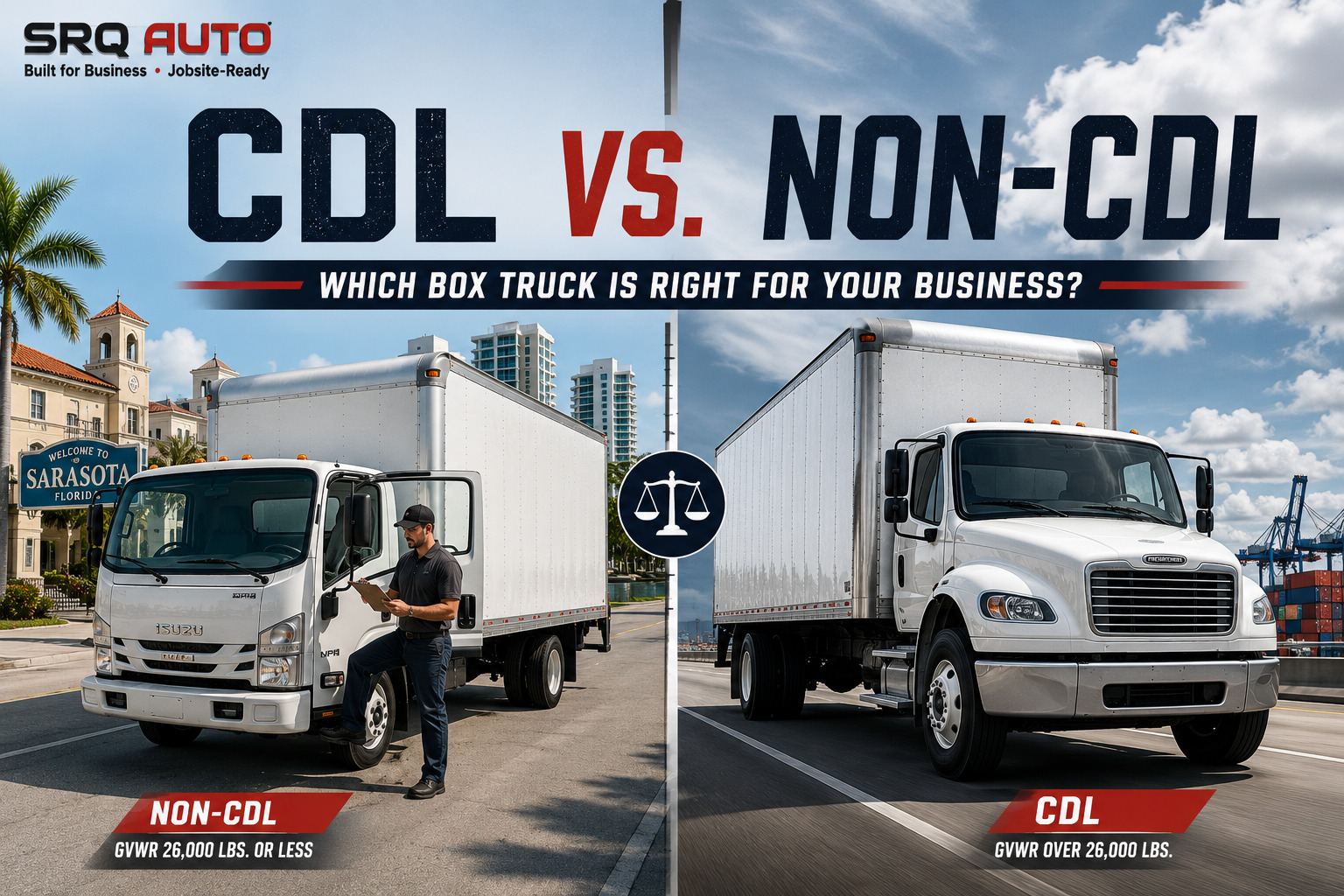
Before finalizing your commercial vehicle purchase, it is important to understand the tax benefits and licensing requirements associated with your new business asset. Many business owners are surprised to learn that they do not need a specialized Commercial Driver's License (CDL) to operate most standard box trucks. As long as the vehicle's GVWR is under 26,000 lb, any employee with a standard Class C driver's license can legally drive it, making staffing and fleet management highly flexible.
Additionally, purchasing a commercial vehicle offers substantial tax advantages. Under Section 179 of the IRS tax code, qualified businesses can deduct the full purchase price of eligible new or used commercial vehicles in the tax year they are placed in service. This deduction applies to both cargo vans and box trucks, providing an excellent opportunity to lower your taxable income while expanding your operational capabilities.
At SRQ Auto LLC, we are proud to be a trusted partner for businesses throughout the region. To learn more about our commitment to quality, read about us and discover why local contractors and fleet managers trust our team. If you are ready to take the next step, you can review our guide on used vehicle tax deductions to maximize your savings.
When you are ready to explore our inventory, get in touch with our team by calling (941) 214-2231, or use our digital mapping tool to get directions to our dealership.
Quick Answers Before You Visit
Q: Can I drive a 16-foot box truck with a standard driver's license in Florida?
Yes. In Florida, you only need a Commercial Driver's License (CDL) if the vehicle's Gross Vehicle Weight Rating (GVWR) is 26,001 lb or more. Since most 16-foot box trucks have a GVWR between 10,000 lb and 14,500 lb, they can be legally driven with a standard Class C driver's license.
Q: Do cargo vans fit in standard public parking garages?
Most standard-roof cargo vans will clear typical parking garage heights, which usually range from 7 to 8 feet. However, high-roof cargo van models often exceed 9 feet in height and will not clear standard parking structures, requiring drivers to utilize outdoor surface lots instead.
Q: Can a liftgate be installed on a cargo van?
No, standard heavy-duty hydraulic liftgates cannot be safely installed on cargo vans due to their low ground clearance and rear bumper design. Businesses requiring a liftgate for heavy lifting should look at box trucks or cutaway cube vans, which are engineered with the frame height and structural support necessary for hydraulic gates.
Q: What documents should I bring to SRQ Auto LLC to apply for commercial financing?
To expedite your commercial credit application, you should bring your current driver's license, business tax ID number (EIN), recent bank statements, and proof of commercial auto insurance. Having these documents prepared helps our finance team secure your approval quickly so you can get your vehicle on the job site.
Q: Is a box truck or a cargo van better for a mobile service business?
A cargo van is generally superior for mobile service businesses like plumbing, electrical work, or locksmithing. The integrated cab-to-cargo design allows the technician to access tools directly from the driver's seat without stepping outside, and the smaller vehicle footprint makes parking in residential driveways much easier.
Find the Perfect Commercial Vehicle for Your Business Today
At SRQ Auto LLC, we know your business depends on vehicles that are ready to perform from day one. Whether you need the nimble efficiency of a cargo van for quick service calls or the massive payload capacity of an Isuzu N-Series box truck for heavy deliveries, we have the quality, pre-owned commercial inventory to keep your business moving forward. Every vehicle on our lot is thoroughly inspected, serviced, and reconditioned so you can buy with complete confidence.
Ready to upgrade your fleet or add your very first work truck? Explore our current stock online, calculate your potential savings with our commercial tax deduction resources, and get pre-approved through our secure online credit application. When you are ready for a test drive, visit us at 2212 1st St, Bradenton, FL 34208, or call our commercial vehicle specialists at (941) 214-2231 to discuss your business needs.
© 2026 SRQ Auto LLC. All rights reserved.