Is a Liftgate Worth Paying More for on a Used Box Truck?

A liftgate can be one of the most valuable pieces of equipment on a box truck—or hundreds of pounds of equipment your business rarely uses.
The difference comes down to the job.
If your crew regularly moves appliances, furniture, commercial equipment, palletized freight or other heavy cargo without access to a loading dock or forklift, a properly sized liftgate can dramatically improve how the truck works. If you're primarily carrying lightweight boxes that can easily travel up a ramp, the added weight, maintenance and purchase cost may provide little benefit.
That's why the better question isn't simply “Is a liftgate worth it?”
Will a liftgate make your particular delivery operation faster, safer and easier often enough to justify having it on the truck?
Businesses comparing different commercial configurations can start with SRQ Auto's current commercial inventory to see which box trucks and liftgate-equipped vehicles are available now.
Which Businesses Benefit Most From a Liftgate?
A liftgate makes the strongest case when the cargo is too heavy or awkward for efficient manual loading and the truck frequently operates at locations without dock-height loading.
Appliance delivery: Refrigerators, ranges, washers, dryers and other large appliances can be difficult to safely move between ground level and a box-truck floor.
Furniture delivery: Large furniture may be bulky rather than exceptionally heavy, but a liftgate can provide a controlled loading platform.
Commercial equipment: Contractors and service businesses moving generators, compressors, machines or wheeled equipment may benefit substantially.
Medical and institutional delivery: Heavy equipment and rolling commercial carts can be difficult to handle on a conventional ramp.
Palletized freight: A liftgate can be particularly useful when deliveries occur at businesses without loading docks.
The value increases when those situations occur every day, rather than twice a year.
Liftgate or Ramp: Which Is Better?
A liftgate isn't automatically superior to a ramp.
For businesses moving lighter cargo with hand trucks, carts or dollies, a ramp can be simpler, lighter and less expensive to maintain.
| Consider a Liftgate When... | Consider a Ramp When... |
|---|---|
| Cargo is heavy or bulky | Cargo is relatively light |
| Pallets are common | Hand trucks handle most loads |
| Deliveries lack loading docks | Drivers can comfortably roll cargo |
| Wheeled equipment must be raised or lowered | Simplicity is a priority |
| Controlled vertical movement helps the operation | Maximum available payload matters |
| The gate will be used regularly | Hydraulic equipment would rarely be used |
A ramp has another important advantage: simplicity. There is no hydraulic pump, cylinder, electrical control system or lift mechanism to maintain.
A liftgate, however, can perform work that a ramp simply cannot do efficiently.
The right answer isn't about which piece of equipment is better. It's about which loading system removes the most friction from your route.
Does a Liftgate Reduce Box Truck Payload?
Yes. A liftgate becomes part of the truck, which means its weight counts against the completed vehicle's available carrying capacity.
This is particularly important on non-CDL box trucks, where businesses may already be balancing the cargo body, fuel, driver, passengers, equipment and freight against the truck's GVWR.
The liftgate's weight shouldn't automatically discourage you from buying one. If it allows your crew to perform deliveries that would otherwise require additional workers or equipment, that weight may be extremely productive.
But it needs to be included in the calculation.
Don't choose a box truck based only on box length and advertised chassis capacity. Evaluate the completed truck.
Consider GVWR, actual vehicle weight, liftgate weight, driver and passengers, cargo-control equipment, tools and equipment, and the maximum expected freight load.
The remaining capacity is what your business actually has available to work with.
Does a Liftgate Increase the Value of a Used Box Truck?
Usually, a useful, properly functioning liftgate can make a used box truck more desirable to the right commercial buyer.
But that doesn't mean a liftgate adds back every dollar it originally cost.
Commercial upfits don't work that way.
A piece of equipment is valuable in the used market primarily when the next business needs it.
A delivery company shopping for a 16-foot box truck to move appliances may place significant value on a functioning liftgate. A business carrying lightweight packaged goods may prefer the same truck with a ramp.
That's why two otherwise similar used box trucks shouldn't simply be valued by adding the original price of the liftgate to one of them.
The upfit's condition, capacity, design and usefulness to the next buyer determine how much value it really adds.
Is It Better to Buy a Used Box Truck With the Liftgate Already Installed?
If your business already knows it needs a liftgate, buying the truck with the correct gate already installed can be very attractive.
You're potentially avoiding the cost of a new liftgate, installation labor, truck downtime, electrical or hydraulic installation, compatibility issues and scheduling with an upfitter.
A used truck with the correct liftgate may therefore be able to go into service much faster.
But there's an important qualifier:
It needs to be the right liftgate.
A gate that's too small for your normal cargo, has the wrong platform design or is in poor mechanical condition isn't automatically an asset just because it's attached to the truck.
Evaluate the gate as its own piece of commercial equipment.
What Should You Inspect on a Used Box Truck Liftgate?
This is where buying a used commercial truck differs significantly from shopping for an ordinary vehicle.
Cycle the liftgate completely. Don't simply lower it six inches and assume it works. Run it through its full operating range and, when appropriate, evaluate its operation according to the manufacturer's procedures and ratings.
- Hydraulic leaks: Inspect cylinders, hoses, fittings and the pump area for signs of leakage.
- Platform condition: Look for bending, cracks, corrosion, damaged welds and excessive wear.
- Pins and pivot points: Excessive movement can indicate wear.
- Electrical connections: Wiring, grounds, switches and connectors live in a harsh environment and should be inspected carefully.
- Controls: Verify that operating switches work consistently.
- Mounting points: Inspect where the gate assembly attaches to the truck and chassis.
- Hydraulic operation: Listen for unusual noises or signs that the system is struggling.
- Platform surface: Check traction surfaces and overall condition, particularly on gates regularly exposed to rain.
Tuckaway Liftgate or Railgate?
Not all liftgates work the same way.
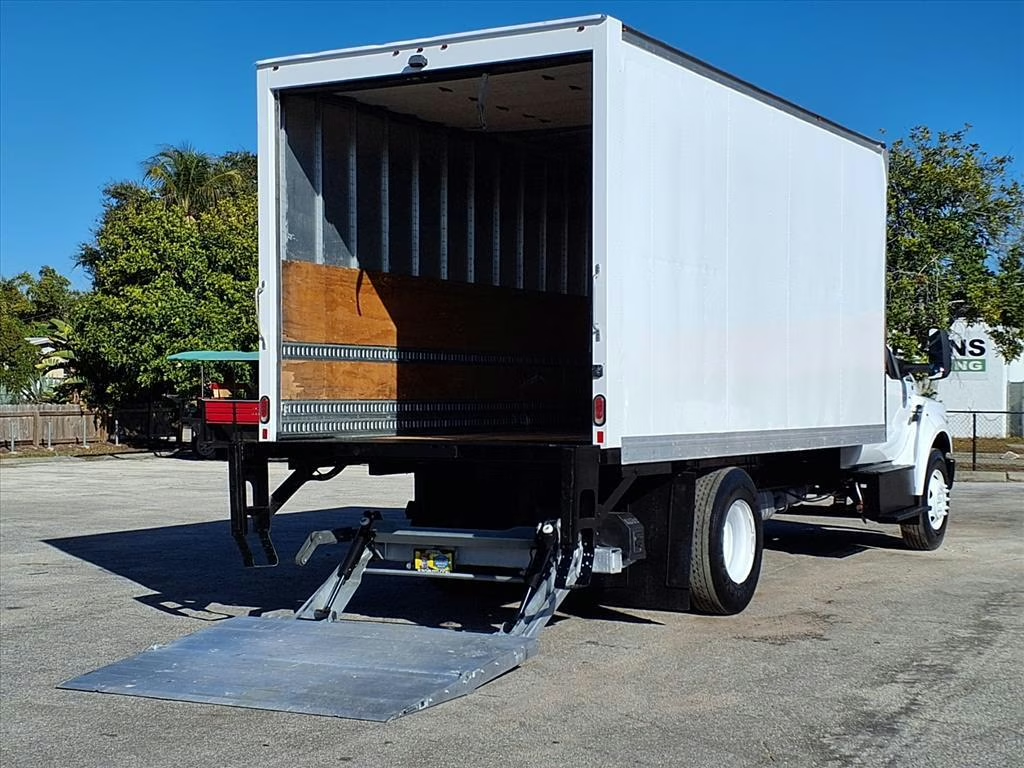
A tuckaway liftgate folds and stores underneath the rear of the truck when it isn't being used. This can leave the rear opening relatively unobstructed and works well for many general delivery operations.
A rail-style gate typically travels vertically along the rear of the body. Depending on the application, it can provide a large loading platform and useful lifting characteristics, but it also changes how the rear of the truck is accessed.
Neither design is automatically better.
Ask how frequently you'll use it, what the heaviest normal item will be, how large the platform needs to be, whether you regularly load at docks and how the gate affects rear-door access.
The answers should determine the gate—not appearance.
How Much Liftgate Capacity Does Your Business Need?
This is one place where more isn't automatically better.
The correct capacity depends on the heaviest load the business expects to lift, how that load is distributed on the platform and the specifications of the particular gate.
Don't assume that because a truck is large, its liftgate can safely lift anything that fits inside the cargo box.
The liftgate should have an identifiable manufacturer rating, and operators should follow the manufacturer's loading, positioning and safety requirements.
If your operation regularly moves particularly heavy equipment or pallets, verify the exact gate model and rated capacity before purchasing the truck.
When Should You Skip the Liftgate?
A liftgate probably shouldn't be a priority when your operation primarily handles lightweight freight that can be moved easily with a hand truck or cart.
It may also be unnecessary when virtually every pickup and delivery location provides a dock or forklift.
And if payload is already tight, carrying equipment the business rarely uses makes little sense.
Don't pay for an upfit because it looks valuable. Pay for equipment that makes your business more productive.
An expensive piece of equipment you never use isn't necessarily more valuable than a simple ramp you use 20 times every day.
What Box Truck With a Liftgate Should You Buy?
Start with the cargo.
- How large is it?
- How heavy is it?
- Is it palletized?
- Can one person move it?
- How often are you delivering without a dock?
- How frequently will the liftgate cycle each day?
Then evaluate the truck itself.
Box length, payload, GVWR, wheelbase, engine, chassis condition, maintenance history and overall reconditioning still matter.
The liftgate is part of the solution—not the entire truck.
Because SRQ Auto's inventory changes frequently, check our current commercial inventory to see available box trucks and liftgate-equipped configurations.
So, Is a Liftgate Worth Paying More For?
Yes—when your business actually needs it.
A good liftgate can turn a box truck into a much more capable delivery vehicle. It can make heavy or bulky freight easier to load, reduce dependence on loading docks and allow one truck to serve a wider variety of customers and locations.
But a liftgate also adds weight, mechanical complexity and maintenance.
So don't buy one simply because a truck equipped with a liftgate appears more “commercial.”
Buy it because you've looked at your routes, cargo and workflow and determined that the equipment will earn its place on the truck.
The best upfit isn't the most expensive one. It's the one your business uses.
SRQ Auto specializes in fully reconditioned commercial vehicles prepared around our Job Ready Promise. Our inventory regularly includes box trucks with liftgates, ramps and other commercial configurations for businesses throughout Bradenton, Sarasota, Tampa, Orlando, Fort Myers and nationwide.
Find Your Next Box Truck at SRQ Auto
Browse Current Commercial Inventory to compare Job Ready box trucks and other commercial vehicles available now.
Need help with the purchase? Learn about Tailored Commercial Financing or complete our online credit application.
Want to hear from other businesses that have purchased commercial vehicles from SRQ? Read our customer reviews or get directions to SRQ Auto.